




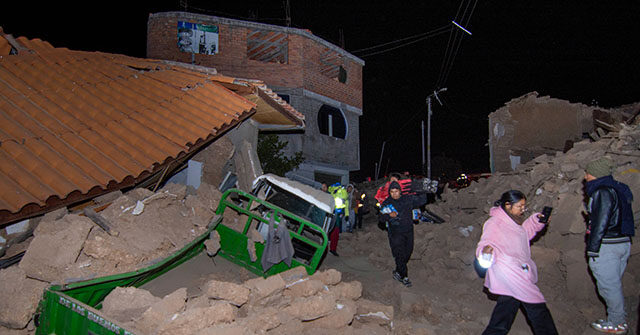
A magnitude 5.5 earthquake in central Peru over the weekend left at least five dead, dozens injured, and hundreds homeless.
The U.S. Geological Survey (USGS) reported that the earthquake struck on Saturday night (local time) two kilometers (1.24 miles) west-southwest of Sicaya, a town in the Junín region. A second earthquake, reportedly registered by Peru’s Geophysical Institute as a magnitude 3.7, hit several miles away about twenty minutes later.
Over 12 aftershocks have reportedly occurred in the hours following Saturday’s earthquakes, with two magnitude 3.4 quakes during the early Monday.
Speaking with RPP on Sunday, outgoing Prime Minister Luis Arroyo Sánchez initially said that six individuals had died — the death toll was reportedly corrected down to five. Arroyo Sánchez, citing preliminary reports, explained that 48 houses were destroyed and over 250 suffered damages. The identities of the five confirmed fatal victims — three men and two women — have been disclosed by local outlets, their ages ranging from 18 to 73.
WATCH:

The Peruvian newspaper La República reports that, as of Monday morning, over 300 individuals were left homeless by the earthquake as search and rescue operations continue in the affected region.
The newspaper explained on Sunday that the shallow depth of the earthquakes, and the flimsy construction of many of the houses — many of which featured rustic materials — contributed to the extend of the damage so far documented. Many of the local residents reportedly sought shelter at a nearby sports court out of fear that their homes could collapse at any moment.

The Peruvian Defense Ministry detailed on Monday morning that over seven tons of humanitarian aid are bound to Junín, which will benefit some 1,250 individuals representing 250 families for about ten days.
Outgoing interim Marxist President José María Balcázar claimed on Sunday that the Peruvian government is acting in an “immediate manner” to respond to the emergency in Junín, sending humanitarian aid and coordinating relief efforts with regional authorities.
“Rest assured that we are acting quickly. Aid is already in the hands of the authorities in Junín and the government. We are going to compile a list to assist those affected and provide them with the immediate care they need,” Balcázar said during an interview, according to the Peruvian government.
Conservative President-elect Keiko Fujimori expressed her condolences to the relatives of the deceased in a social media post. Fujimori, who will take office on July 28, welcomed the actions of the outgoing administration but urged the outgoing Balcázar government to continue carrying out the necessary measures to protect and assist all those affected.
Catholic priest Henry Díaz detailed to RPP on Sunday that the earthquakes also caused damage to the Santiago León de Chongos Bajo Church, built in the 16th century long before the Huancayo province was established. Father Díaz explained that the church’s tower “is a bit cracked, it has issues, and it seems to have leaned slightly.”
“I was in my room, I heard a noise and some plaster on the wall came loose,” Father Díaz told RPP. “I went downstairs and it was a cloud of dust that had fallen on the front of the church.”
Saturday’s earthquakes, and the subsequent aftershocks, are the latest on a list of 477 different seismic events experienced in Peru in 2026 so far. The South American nation’s seismically active territory is located in what is known as the Ring of Fire, a string of volcanoes and seismic activities around the edge of the Pacific Ocean — and an area deemed the most seismically active zone on Earth.
Hernando Tavera, the head of Peru’s Geophysical Institute, reportedly said during an interview over the weekend that Saturday’s earthquakes where the strongest documented in Peru since the 1969 magnitude 5.9 and 6 earthquakes.
Christian K. Caruzo is a Venezuelan writer and documents life under socialism. You can follow him on Twitter here.
Read the full article here


