




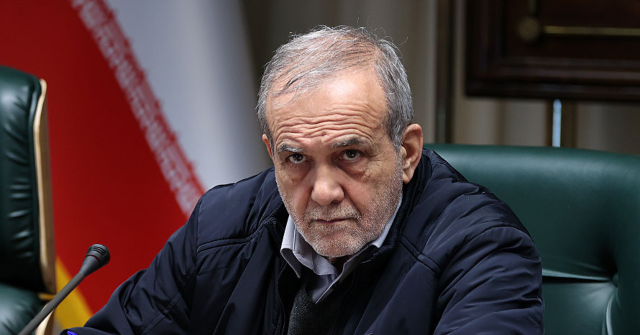
Iranian President Masoud Pezeshkian, who is subordinate to missing “supreme leader” Mojtaba Khamenei, declared in remarks on Monday that his country is in a “full-scale war” with the United States following the disintegration of a “memorandum of understanding” towards peace.
Pezeshkian, according to Iranian state media, made the comments while visiting Iran’s Supreme Judicial Council, one of the most powerful courts in the country. His declaration of war against the United States, which he couched as being part of a multi-front effort including economic sanctions and diplomacy, arrives as the Iranian Foreign Ministry insists that it is discussing a future peace deal with unspecified “mediators,” while U.S. Central Command (CENTCOM) reported another round of strikes against Iranian military assets on Monday night.
Iran and the United States have been in a state of informal war since February when President Donald Trump launched Operation Epic Fury and eliminated the country’s longtime dictator, “supreme leader” Ali Khamenei. Trump announced a ceasefire in April that yielded the drafting and signing of a “memorandum of understanding” in June, which prescribed a 60-day negotiation period to establish a sturdier peace deal. Instead, the Iranian regime organized funeral events for the elder Khamenei to coincide with the 250th anniversary of the Declaration of Independence on July 4 in which angry mobs demanded Trump’s killing, then it began to engage in military assaults against commercial ships in the Strait of Hormuz. The disruptions resulted in the return of American military activity to neutralize Iran’s ability to target the ships and its neighbors, most prominently Kuwait, Bahrain, and Jordan.
According to the state-run Islamic Republic News Agency (IRNA), Pezeshkian used his time with the senior judiciary to declare that “Iran is engaged in a full-scale war that extends well beyond missile strikes.” He claimed, however, that “the economy and public livelihood [is] the most important battlefront,” not the military engagements.
“He said the country’s enemies have concluded that military attacks alone cannot force Iran into submission and are now targeting the economy and daily life instead,” Pezeshkian claimed. “Pezeshkian warned that if economic pressure fuels public discontent, it could erode the social support his government has built among Iranians.”
While not directly referencing them, Pezeshkian appeared to be referring to the widespread protests in the country shortly before Operation Epic Fury. Iranians began taking the streets in large numbers in late December in response to the collapse of the value of the rial and severely poor quality of life, in addition to longstanding political and religious repression. The regime responded by shutting down the internet and engaging in extensive brutality against its own citizens. By late January, dissident groups were estimating that the regime had killed as many as 30,000 people for being implicated in pro-democracy protests.
Apparently to prevent a similar situation, Pezeshkian on Tuesday “called for unity, collective decision-making, and coordination across all branches of government to manage the crisis,” admitting that the economic situation in the country remained critical. The president demanded that his administration work to improve “poverty, unemployment, and livelihood problems.” IRNA added that he also appeared to absolve himself, as president, of some responsibility, having “stressed that Iran’s system of governance needs a final decision-making authority, saying that role belongs to the Leader of the Islamic Revolution.”
The “leader of the Islamic Revolution” currently is “supreme leader” Mojtaba Khamenei, who has made no public appearances, nor has he issued any video or audio messages, since being chosen to succeed his father in March. He conspicuously failed to appear for his father’s funeral, even as three other Khamenei sons did, releasing only a written statement vowing revenge against Trump and the United States.
While Pezeshkian acknowledged the alleged “full-scale war,” leaders in the terrorist Islamic Revolutionary Guard Corps (IRGC) announced an escalation of attacks in the Persian Gulf. Brigadier General Mohammad Karami, commander of the IRGC’s ground forces, reportedly engaged in an inspection of coastal activities on Tuesday in which he announced that “forces are continuously reorganizing and strengthening their defensive capabilities to neutralize any threat, stressing that the Iranian people and armed forces are fully prepared to respond to any aggression.” Like all other Iranian regime commanders, he also used the opportunity to threaten revenge against the United States for the elimination of the elder Khamenei.
The IRGC commander and other leaders in the organization similarly declared their intention of waging vengeance on Tuesday and also claimed they fully controlled the Strait of Hormuz, a critical maritime commercial route that Iran has been disrupting for months.
The aggressive tenor of Pezeshkian’s comments and the IRGC contrast to the messages out of the Iranian Foreign Ministry, which claimed this week to be engaging unnamed “mediators” seeking yet another peace deal. IRNA reported on Tuesday that Foreign Minister Abbas Araghchi had held conversations with his ambassadors in Italy, France, and the United Kingdom seeking to streamline Iran’s talking points to incorporate Iranian allies in negotiations with the United States.
“Emphasizing the necessity of leveraging all diplomatic capacities to safeguard national interests, Araghchi underscored the importance of continuing active consultations,” the state media outlet claimed, “articulating the principled positions of the Islamic Republic of Iran, and responsibly pursuing bilateral and multilateral issues with European countries.”
Follow Frances Martel on Facebook and Twitter.
Read the full article here


