






The Chinese Communist Party confirmed on Monday that it had subjected ten people to “administration penalties” over the past week for allegedly spreading “online rumors” and “misinformation” about the ongoing mudslide and flooding disaster in Tibet.
This revelation followed widespread reports that the Chinese government had censored some of the most horrifying videos of mudslides destroying entire communities, roads, bridges, and other critical infrastructure in Nepal and Tibet, leading critics to accuse Beijing of trying to hide the scale of the devastation in occupied Tibet.
WATCH:
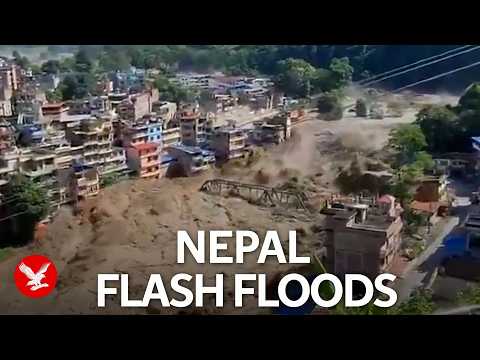
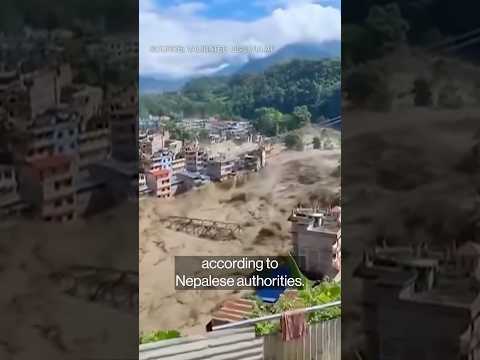

Nepal and neighboring Tibet experienced a sudden rush of ice, rock, water, and mud sliding down from tall Himalayan peaks and burying entire towns beginning on Wednesday after extensive, heavy rains. The U.S. Geological Survey (USGS), which monitors geological activity around the world, stated the next day that the rush of debris and water appeared to be the product of a sudden “glacial collapse.” The disaster occurred during an ongoing Hindu religious pilgrimage in Nepal and trapped citizens of countries around the world, hundreds of them still missing to this day. As of Monday, the government of Nepal has confirmed the deaths of over 900 people and documented at least 4,700 missing individuals. China, meanwhile, has confirmed 546 missing people as of Sunday and, shockingly, only 16 confirmed deaths.
The Chinese government complained that rescue efforts were allegedly being complicated by people online estimating that, judging from videos of the devastation, China’s casualty numbers did not make sense. At least ten cases of “online rumors” tied to the Tibet mudslides, the state-run Global Times revealed on Monday, had been processed by China’s cybersecurity police. The report did not specify exactly what kind of punishment the individuals were subjected to, but listed their alleged crimes.
“In one case … an internet user surnamed Qiu had speculated without evidence and posted a rumor on an online platform claiming that ‘the news says 1,400 people were killed, but actually 3,000 people had already gone missing,’” the Global Times shared. “Beyond deliberately inflating casualty figures, some individuals fabricated claims about the number of people swept away or missing at the disaster site, creating a distorted picture of the scale of the disaster.”
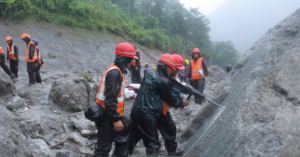
This photo provided by the Nepal Army, shows Nepal army soldiers using a drilling machine during a rescue operation at the site of a hydropower project in Upper Trishuli, Nepal, Sunday, August 30, 2026. (Nepal Army via AP)
The report suggested the Chinese government was especially targeting individuals online challenging China’s casualty statistics. China controls Tibet as a colony of the repressive communist state and has for decades imposed policies there to erase indigenous Tibetan identity and replace it with Han-supremacist communist doctrine. In more recent years, the Xi Jinping dictatorship has implemented state-sponsored slavery schemes in the region to exploit the local population. The status of Tibet has led many to question China’s handling of the floods.
“For China, everything is inherently political when it comes to Tibet,” Zoë Bedford, executive officer of the Australia Tibet Council, told the country’s SBS News. “What they’re afraid of is people hearing Tibetan voices. They’re afraid of people understanding the extent of China’s mega-development in Tibet and how much they have been interfering in the environment.”
Speaking to the U.K. Guardian, Tencho Gyatso, the president of the International Campaign for Tibet, said that sources on the ground suggest China’s official casualty counts are significantly deflated.

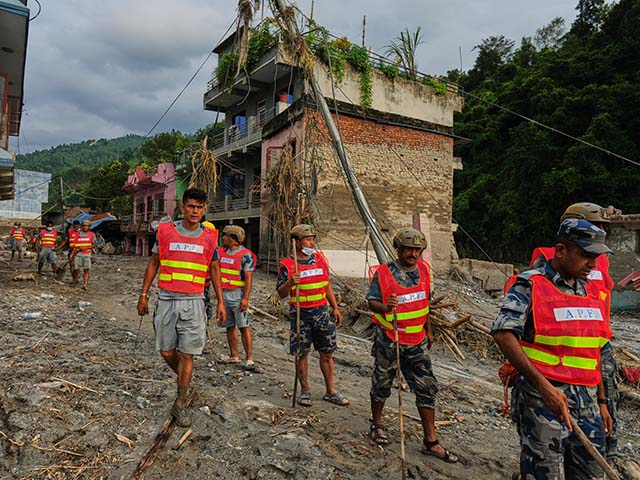
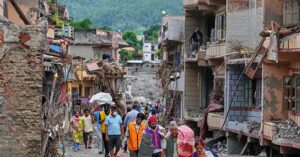
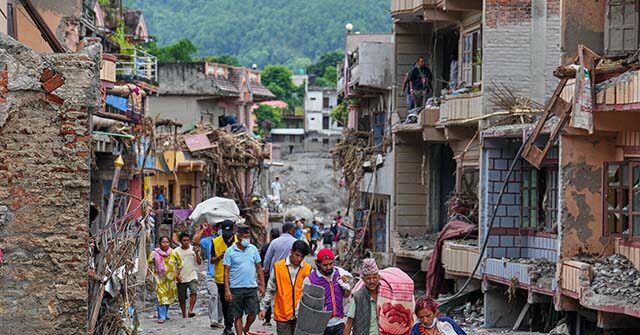
Workers clear debris in the aftermath of a flash flood in the Devighat area of Nuwakot district in Nepal, Friday, August 28, 2026. (AP Photo/Rajesh Kumar Singh)
“What is visible in Nepal exposes what is being concealed in Tibet. Four villages – Sale, Serchung, Labi and Rizi – were among the hardest hit, with approximately 300 homes reportedly destroyed and many people still missing,” Gyatso was quoted as saying.
“The Chinese government portrays it like it’s only happening in Nepal and there’s nothing across the border. For any type of crisis, the way China handles it is that there is no crisis. The party is in control,” she added.
Several international news reports have suggested that videos commonly available of the flooding throughout global social media platforms do not exist on their Chinese equivalents. Only Chinese state propaganda videos, which mostly feature communist rescue workers appearing to engage in emergency work, are reportedly accessible within China.

The Chinese Foreign Ministry fielded several questions from international reporters on the censorship issue, expressing irritation at those allegedly spreading “disinformation.”
“Intensive search, rescue and relief operations are still underway in an orderly manner in the disaster-hit areas. China has been open, transparent and timely in information release,” spokesman Guo Jiakun said in response to a question about censorship from the U.K.’s Sky News. “Smear and disinformation is most unwelcome at a time of disaster response.”
Guo also condemned other reports suggesting the Chinese government had harmed the rescue and recovery process. In response to alleged reports in Indian media blaming Chinese construction projects for creating a higher risk of mudslides in the region, Guo declared, “in the face of tragic disasters, we reject malicious speculation that has no factual basis.” Guo also denied reports that China had denied surveillance footage or other intelligence aid to Nepal.
“We have been providing Nepal with meteorological and hydrological data, conducted consultation among experts, and shared early-warning information,” Gup said. “China will continue giving strong support to Nepal in its relief efforts and strengthen cooperation with Nepal on disaster prevention and control for the shared benefit of both peoples.”
Follow Frances Martel on Facebook and Twitter.
Read the full article here


