






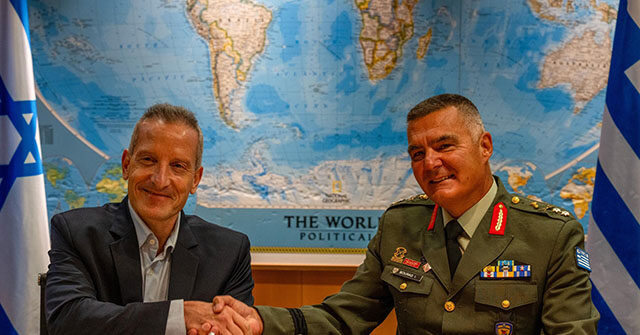
Israel and Greece sealed a historic $3.5 billion defense agreement Monday that will see Jerusalem build Athens a complete multi-layered air defense network, significantly expanding the two countries’ strategic partnership amid growing security challenges in the Eastern Mediterranean.
The roughly €3 billion government-to-government agreement, known in Greece as “Achilles Shield,” is the largest defense export deal in the history of Israeli-Greek relations and one of the largest ever signed by Israel, according to the Israeli Defense Ministry.
The agreement also marks the first time Israel will supply another country with an entire integrated defense architecture capable of countering threats ranging from ballistic missiles and aircraft to drones.
At the heart of the network will be Israel’s David’s Sling, designed to intercept advanced missile threats, Rafael’s mobile SPYDER system for aircraft and other aerial threats, and Israel Aerospace Industries’ BARAK MX multi-layered air and missile defense system, alongside ELTA Systems’ MMR multi-mission radars and a new Rafael-developed national command-and-control system integrating the various layers of Greece’s air defenses.

A separate €26 million agreement signed Monday will provide Greece with Rafael’s Drone Dome counter-UAV systems to protect strategic sites, while the broader deal includes expanded industrial cooperation and transfers of Israeli technology and expertise to Greek defense companies.
“Israel and Greece share common strategic interests and face shared regional challenges,” Israeli Defense Minister Israel Katz said.
“At a time when actors with hegemonic ambitions are seeking to expand their influence and undermine stability in the region, Israel and Greece will continue to deepen their defense and strategic cooperation, and will act with determination to preserve stability and safeguard their security and shared interests,” he added.
While Katz did not name Turkey, the agreement comes as both Israel and Greece contend with increasingly serious tensions with Ankara. Greece and Turkey are NATO members but longstanding rivals over territorial and maritime disputes in the Aegean and Eastern Mediterranean, while relations between Israel and Turkey have deteriorated sharply under Turkish President Recep Tayyip Erdogan.
Greek Defense Minister Nikos Dendias has repeatedly pointed to Turkey as a driving force behind Athens’ military modernization effort, describing the country last month as “a clear and well defined threat.”
The tensions have increasingly extended into Syria, where Israel and Turkey are competing for influence following the fall of the Assad regime. Israel struck a Syrian airbase earlier this month, saying the operation was intended to prevent Turkish forces from deploying there.
Athens approved the Achilles Shield procurement framework in July as part of a broader $31.8 billion modernization of the Greek military through 2036. Dendias has said the new air defense network is expected to become fully operational within 35 months.
Israeli media reported that SPYDER batteries will be deployed across Greek islands as part of the project, while Greek companies are expected to receive roughly €700 million in subcontracting work from Rafael and IAI.
The agreement comes as Turkey pursues its own major air defense buildup, including a roughly $6.5 billion “Steel Dome” program designed to create a domestically produced multi-layered network against aircraft, drones and ballistic threats.
Erdogan has said the Turkish system “will instill confidence in friends and fear in enemies.”
Israeli Diaspora Affairs Minister Amichai Chikli was more explicit than Katz in tying Monday’s agreement to Ankara, hailing the strengthening Israel-Greece-Cyprus relationship as a response to what he described as Erdogan’s “Islamist, neo-Ottoman aggression.”
“A strong Israel-Greece-Cyprus alliance is the right answer to Erdogan’s Islamist, neo-Ottoman aggression,” Chikli wrote Monday. “Today this alliance grew stronger.”
Monday’s agreement also comes amid surging international demand for Israeli military technology following years of combat in which the country’s missile defense systems have been tested against ballistic missiles, drones and other aerial threats launched by Iran and its proxies.
Israeli defense exports reached a record of more than $19 billion in 2025, up roughly 30 percent from the previous year, according to official figures.
Baram said deals on the scale of Achilles Shield also directly strengthen Israel’s own military production capacity.
“Government-to-government deals at this scale are more than diplomatic and economic wins — they drive the expansion of Israel’s production lines, build up stockpiles, and strengthen the country’s munitions independence,” he said.
Joshua Klein is a reporter for Breitbart News. Email him at jklein@breitbart.com. Follow him on Twitter @JoshuaKlein.
Read the full article here


