




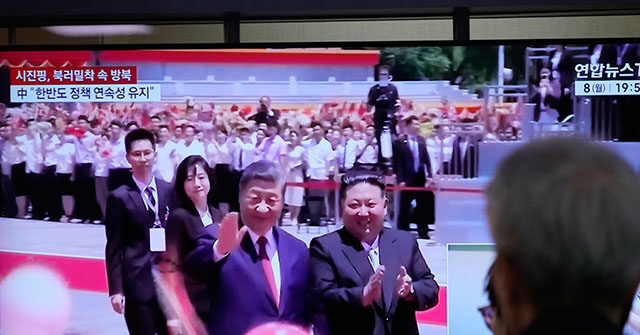
Genocidal Chinese dictator Xi Jinping arrived in Pyongyang, North Korea, on Monday, received by the customary throngs of cheering children and demanding his host, Kim Jong-un, pursue a new era of “political mutual trust.”
Xi’s visit to the communist capital is the first for the Chinese leader in seven years and follows steadily eroding cooperation between his country and what was once its most loyal proxy. While, publicly, Kim and Xi have regularly praised the bilateral relationship and described their ties as ironclad, North Korea’s diplomacy noticeably drifted away from Beijing following the Wuhan coronavirus pandemic, which the reclusive country suggested in public statements had caused Kim severe illness.
Kim shut the North Korean-Chinese border along the Yalu River for years in an attempt to keep the virus out of the country and redirected his foreign policy efforts towards improving his relationship with Russia. While Xi had not visited the country in nearly a decade, Russian strongman Vladimir Putin made a stop in Pyongyang in 2024, where he and Kim signed a mutual defense treaty that immediately preceded the emergency of North Korean soldiers in Europe, fighting on behalf of Russia in the ongoing invasion of Ukraine. North Korea deploying soldiers to die for Russian interests and celebrating them as heroes, while keeping public statements about China to a minimum, indicated to international observers a significant shift in foreign influence in Pyongyang.
The Kim regime did not belie any rifts or conflict between the two countries as it greeted Xi on Monday. Kim Jong-un and wife Ri Sol-ju personally greeted Xi and his wife Peng Luyuan as they stepped off their plane in the capital.

Kim organized a massive display of cheering crowds to celebrate Xi, including children in traditional dress as well as a formal military ceremony to greet the dictator.

In comments to Kim on Monday, as reproduced by Chinese state media, Xi hinted at the need to rehabilitate the bilateral relationship by urging a focus on strengthening trust.
“The two sides should stay guided by the high-level exchanges and consolidate the foundation of political mutual trust, Xi said,” according to the flagship Chinese Xinhua News Agency. “The strategic guidance by the top leaders of both nations is the greatest strength of China-DPRK [North Korea] relations, he added, noting that he stands ready to maintain close strategic communication with Kim and guide China-DPRK relations to continuously reach new heights.”
Xi reportedly cited “law enforcement” and “military affairs” as areas in which he especially hoped to “enhance exchanges,” pointedly listing the realms where Russia has become most influential in North Korea. He also suggested closer cooperation with Beijing could offer North Korea an avenue to become more relevant in international affairs.
“He expressed his readiness to work with Kim to take this visit as an opportunity to strengthen top-level planning and strategic guidance for China-DPRK relations in the new era, keep bilateral relations advancing with the times and achieve greater progress in bilateral ties,” Xinhua shared, “so as to better benefit the two countries and peoples, and make positive contributions to peace, stability, development and prosperity in the region and the world.”
The Chinese dictator also suggested that years of coronavirus travel limitations had made an impact on the bilateral relationship, encouraging Kim to “leverage the opportunity of the full reopening of border crossings and the resumption of civil aviation flights and international passenger trains to increase people-to-people exchanges and foster mutual interaction.”
The Xinhua report repeatedly mentioned the “traditional friendship” between China and North Korea and emphasized their status as two of the few remaining overtly communist countries on the planet, a contrast with the Putin regime, which does not explicitly describe itself as communist despite aligning itself geopolitically with the world’s communist governments.
Xinhua also reported, though less in detail, about Kim’s comments to Xi, claiming that the North Korean leader described improving ties with China as North Korea’s “top policy priority.”

North Korea’s typically active state media arms have, at press time, offered reserved coverage of Xi’s visit. The state newspaper Rodong Sinmun published a breathless editorial celebrating the visit as a victory for communism, stating that the “Korean people ardently welcome Comrade Xi Jinping … with the feelings of warm friendship of the fraternal Chinese people.”
“Xi Jinping’s visit to the DPRK marks a significant occasion in strikingly demonstrating the invincibility and vitality of the DPRK-China friendship growing stronger day by day,” Rodong Sinmun claimed, “under the deep care of the top leaders of the two parties and the two countries and serves as support and encouragement to our Party and people in the struggle for the comprehensive development of socialism.”
“Thanks to the strategic guidance of the respected Comrade Kim Jong Un and Comrade Xi Jinping, the communication between the two parties and two countries and friendship and unity between the peoples of the two countries have been further strengthened,”it continued, “and thus the DPRK-China relations are developing into more solid friendly relations.”
Kim Yo-jong, the dictator’s sister, also published a statement this weekend in anticipation of Xi’s visit. While it did not mention Xi at all, its visceral condemnation of the United States could be interpreted as a positive message towards China, particularly given the well-known warm personal relationship between Kim and American President Donald Trump. Kim Yo-jong complained that, during a recent summit between the American and Chinese leaders, the State Department noted mention of North Korean “denuclearization.” In fact, a joint statement from both Trump and Xi, signed in Beijing in May, called for “denuclearization,” though Kim Yo-jong did not attack Xi for co-signing the statement.
“The U.S. assertion to backbite the status of the DPRK as a nuclear weapons state has no legally binding force and no one will be bound by the U.S. unilateral rhetoric,” Kim Yo-jong wrote. “The forces, which have remained most hostile to the DPRK … should stop slandering the just policy of the DPRK for self-defence and, in particular, give up the daydream about ‘denuclearization.’”
Xi is expected to stay in North Korea for only two days and is likely to sign some bilateral agreements of an economic, security, or diplomacy nature.
Follow Frances Martel on Facebook and Twitter.
Read the full article here


