
Victims of the dual earthquakes in Venezuela last week recounted to various outlets this week the harrowing ordeal of trying to identify their loved ones among the bodies lying on the ground at the port of La Guaira, which the government is using as a makeshift morgue.
Two earthquakes, one registered at 7.2 and another at 7.5, struck the state of La Guaira and neighboring Caracas within seconds of each other late on June 24, sending hundreds – potentially thousands – of buildings crumbling and trapping an untold number of people. Complicating the situation is that the Simón Bolívar International Airport in Maiquetía suffered tremendous damage to its runways, making it difficult for international aid organizations and collaborating countries to send emergency supplies and personnel over in a timely manner.
The United States was the first country to respond to the disaster, deploying world class search and rescue operators and committing at least $300 million in humanitarian relief. The State Department, coordinating with the Department of War, is using military aircraft to overcome the difficulties at the Maiquetía airport.
As of Tuesday afternoon, the Venezuelan socialist government has documented 1,943 confirmed deaths and over 10,000 injuries. Venezuelan official Jorge Rodríguez, who is leading the earthquake relief effort and is the brother of interim President Delcy Rodríguez, claimed on Tuesday that about 30,000 people were inside the area of the quake – a number many have questioned given that opposition leaders and the United Nations have estimated that about 50,000 people are currently missing.
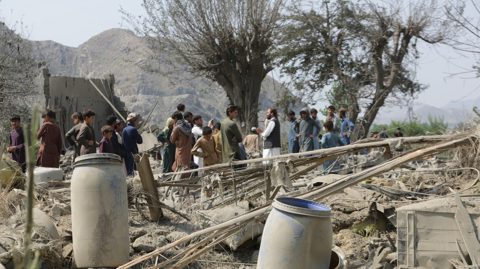
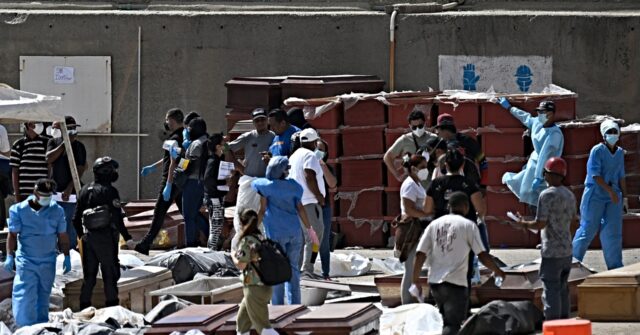
The missing are largely under the rubble of entire communities of collapsed buildings. Reports on the ground in La Guaira describe the pervasive smell of decaying bodies throughout the affected areas nearly one week after the disaster, exacerbated by Venezuela’s tropical summer weather. In an attempt to consolidate bodies, the public is using an area by the La Guaira port known as Los Silos, after the eponymous structures there, to collect human remains.
It is unclear from reports whether the work of collecting and identifying the bodies is being organized by the socialist federal government, local government units, or survivors on an ad hoc basis, though some eyewitnesses have reported interacting with government officials there.
Images from the site show harrowing images of bodies lying on the ground, most covered by a light tarp or blanket and little else.
Long lines of family members waited throughout the week to tour the area and attempt to find their missing loved ones. The few who succeed have told local and international media outlets that they had to rely on jewelry, nail manicures, or other non-living identifying features as the bodies have decayed to the point of being irrecognizable, or were destroyed by crumbling buildings.
“This is like what you are seeing, with no political bias, this is total negligence,” Julio César González, a 53-year-old survivor, told the Spanish news service EFE while waiting for the chance to potentially identify his family members at Los Silos. “I don’t see any kind of response on the part of the government and not that I want to talk about one person or another, but I see a lot of people here, but I don’t see humanity.”
González thanked foreign countries who have contributed humanitarian relief, accusing the government of causing needless deaths.
“Here many lost their relatives out of negligence because the machines should have come earlier, there were living people who, due to not having the necessary support, those people got stuck and died there,” he observed.
Speaking to the Venezuelan newspaper El Nacional, a woman identified only as Milagros denounced that she had found the body of her ten-year-old nephew at Los Silos, but the government lost it. El Nacional noted that the story of a known body disappearing into piles at Los Silos and leaving relatives with no way of properly burying it was not unique to Milagros.
“Overflow at provisional morgues and the lack of a systemized census has transformed the pain of families into a tortuous bureaucratic adventure in the middle of unsanitary conditions,” El Nacional reported.
“The first days, people themselves took out his cadaver,” Milagros narrated, describing a situation in her neighborhood with a near total absence of organized government rescue missions. “For example, my daughter-in-law took out her three nephews, but my nephew was still there, her husband, her sister, the husband of her sister, and they haven’t rescued them yet.”
“Whee are you going to reclaim him? Where will you look? There is nowhere to look, you have to look for him there [at Los Silos] and you are not going to open up body by body, that is too much,” she lamented. “If you already had a body that was so decomposed, so mistreated, a 10-year-old boy, imagine, I have no tears left, I can’t cry, it’s too much.”
Many waiting on line for access to the decaying bodies at Los Silos have expressed frustration at not being allowed to search for their loved ones. Speaking to Radio France Internationale (RFI), Alvi Jiménez complained of waiting for two days to access the bodies, seeking to find five family members.
“They surely went to the morgue, I went and they were not there,” Jiménez narrated. “They were brought to the silos at the port. Several papers will filled out there to enter but I haven’t been able to. I’ve been two days already in this.”
Another survivor speaking to RFI, Greta Torres, described an even more alarming government situation: regime agents extorting victims for access to the bodies.
“It is incredible that we not only have to deal with the tragedy in Venezuela but also the extortion by officials who should be offering public service,” Torres told the news agency.
Caracas Chronicles, a website that documents life in Venezuela, reported on Tuesday that it was receiving “more and more testimonials of people telling how the military and the police are there just to loot, or even block the attempt of people to dig for their dead.”
“People say that soldiers and police are charging bribes of 450 dollars to deliver a body, or 2,000 dollars to allow the passage of heavy machinery to a site where rubble must be removed to uncover the dead,” the outlet detailed.
According to Caracas Chronicles, as of Monday, the area near the silos had collected about 150 bodies, but only counted on four mobile fridges to preserve them, resulting in mass decomposition.
“The stench of decomposing bodies is flooding entire areas like Caraballeda, a nice neighborhood that was also severely hit in the 1999 landslides,” it detailed. “This is because bodies are everywhere, rotting on the sidewalks, but especially amid the rubble of the houses and buildings that died with them.”
Follow Frances Martel on Facebook and Twitter.
Read the full article here