




The Federal Reserve raised its benchmark interest rate on Wednesday with a one-quarter percentage point increase.
The unanimous decision brings the federal funds rate to a range between 3.75 percent and 4.0 percent.
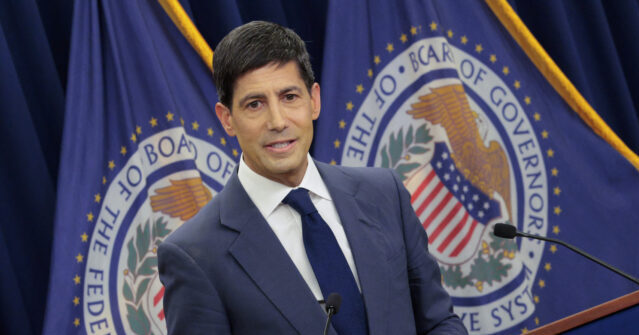
“Our decision comes at a time when the economy appears to be strengthening,” Fed chairman Kevin Warsh said at a press conference on Wednesday.
This was the first increase in three years. The move marks a reversal of the Fed’s previous rounds of cuts in late 2024 and 2025, moves that were spurred by concerns among Fed officials that the economy was slowing and the labor market was weakening. The increase suggests Fed officials are now confident in the resilience of the economy and view stubborn inflation as a greater risk.
“Economic activity is expanding at a solid pace. While uncertainty remains elevated owing, in part, to geopolitical developments, domestic spending has been resilient. Productivity growth is strong, and capital investment is robust. Job gains have kept pace with the workforce, and the unemployment rate has changed little,” the Fed said in a statement released at the conclusion of the two-day meeting of the Federal Open Market Committee. “Inflation remains elevated. Today’s policy action will support a timelier return to the Committee’s 2 percent goal.”
The Fed says it targets two percent inflation. In the pre-pandemic era, inflation consistently undershot that target. Since March of 2021, inflation has run above the target.
At his press conference, Warsh characterized the rate increase as removing “a dose of accommodation” in an effort to speed inflation’s return to the Fed target.
The increase was highly anticipated. Prior to the meeting, prices of fed funds futures indicated a 90 percent chance of a hike. That climbed to 95 percent on Tuesday as the Fed’s meeting began.
The Fed also released economic projections of the 18 members of the FOMC on Wednesday. These showed higher expectations for growth and a lower expected unemployment rate for this year and next year.
The median forecast for GDP growth in the current year rose from 2.2 percent to 2.3 percent. Next year’s growth projection rose to 2.4 percent from 2.3 percent. The following years remained at 2.2 percent for 2028 and 2.1 percent for 2029, just above the committee’s longer-run projection of 2.0 percent.
Unemployment is now expected to end the year at 4.1 percent, down from 4.2 percent. The unemployment rate is expected to remain unchanged through 2029, down from the prior forecasts 4.3 percent in 2027 and 4.2 percent in 2028 respectively. The longer-run expectation, which is a proxy for the Fed’s view of full employment, is 4.2 percent.
The inflation gauge that is the official yardstick for the Fed’s inflation target is seen as ending the year at 3.7 percent, up one-tenth of a point from the June projection of 3.6 percent. The forecast for inflation in 2027 was unchanged at 2.3 percent and the forecast for 2028 was raised from 2.0 percent to 2.1 percent. The following year, 2029, the median expectation hits the Fed’s long-run projection and target of 2.0 percent.
The median forecast for the federal funds rate indicated one more hike by the end of the year. Only two officials forecast no more hikes this year, twelve officials projected one more hike, and four projected two more hikes. The FOMC, which sets the Fed’s interest rate policy, is scheduled to meet two more times before the end of the year.
The forecast for next year’s fed funds rate was raised to 4.1 percent, up from June’s 3.6 percent. The 2028 projection was raised to 3.9 percent from 3.4 percent. In 2029, the median projection sees the rate falling to 3.6 percent.
The longer-run forecast, which reflects the view of Fed officials of where rates would be if inflation is on target and unemployment is at its longer-run rate, inched up to 3.2 percent from 3.1 percent. Fed officials remain deeply divided about the longer-run rate, with one official seeing it around 2.7 percent, six forecasting three percent, and seven other officials seeing rates higher than that.
Read the full article here


