




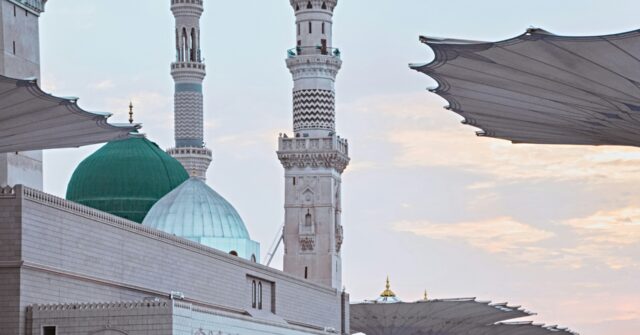
The energy minister of Saudi Arabia announced this week his government had discovered a 110-million-ton cache of rare-earth minerals and uranium in Medina, the second-holiest city in Islam, that the country is expected to develop to diversify its energy sector.
Saudi Energy Minister Prince Abdulaziz bin Salman revealed the discovery on Monday at the annual conference of the International Atomic Energy Agency (IAEA), the United Nations body tasked with nuclear issues. The announcement follows a blockbuster announcement by the White House this year that President Donald Trump had approved an agreement to help Saudi Arabia develop its nuclear energy sector for peaceful purposes, energy and medical uses, as well as a challenging time for Saudi Arabia’s flagship oil sector as Iran and its terrorist proxies disrupt global shipping in the Middle East.
The prince announced that his government believes that a variety of rare-earth materials and uranium concentrations make up a 110-million-ton supply found in Medina, according to the Saudi news outlet Al Arabiya. The outlet stated that the energy minister said Saudi Arabia would use these resources to help diversify its economy. Prince Abdulaziz also reportedly used the remarks to assure that Saudi Arabia would comply with international law on nuclear development and non-proliferation and was not interested in using nuclear material to build weapons.
“The Kingdom follows a clear approach founded on transparency, openness and international cooperation,” he was quoted as saying, adding that Saudi Arabia would not pursue a nuclear weapon “through activities conducted in secrecy or facilities concealed deep within mountains.” The latter appeared to be a veiled barb at neighboring Iran, which for years maintained uranium enrichment facilities deep in underground mountain facilities, the largest of which were believed to have been destroyed in American airstrikes in June 2025.
In addition to the nuclear potential of the resources allegedly found, Prince Abdulaziz reportedly said that the discovery was “among the most significant rare earth mineral resource sites currently under development globally.”
The head of the IAEA, Director-General Rafael Grossi, published a photo with Prince Abdulaziz on social media on Monday, celebrating the details of a meeting between the two and offering his agency’s support to Saudi Arabia’s nuclear development.

“Saudi Arabia is moving forward with its nuclear power programme and research reactor, with a strong commitment to non-proliferation,” Grossi wrote on Twitter. “The @IAEAorg stands ready to support [Saudi Arabia] every step of the way.”
Saudi Arabia has for decades held a position as one of the world’s most prominent oil producers, enriching itself greatly and developing major cities through oil profits. The state oil company Aramco is among the world’s most valuable. Following the appointment of Prince Mohammed bin Salman as the crown prince of the country in 2017, however – a position that granted him de facto ruling powers – the government implemented a program called “Vision 2030” designed to diversify the economy and protect Saudi Arabia from a potential collapse in the oil industry. A major arm of “Vision 2030” has been the pursuit of alternate energy industries, including various “green” energies and nuclear development.
In October 2017, the Saudi government announced that it would begin limiting its uranium exports to help develop a robust domestic nuclear energy industry.
“Regarding the production of uranium in the kingdom, this is a program which is our first step towards self-sufficiency in producing nuclear fuel,” the Saudi official in charge of nuclear energy, Hashim bin Abdullah Yamani, said at the time.
The development of rare-earth mineral capacity has also become part of the “Vision 2030” plan. Rare-earth minerals, a variety of materials used for building batteries common in advanced technology such as laptops and mobile phones, is a growing industry almost entirely dominated by China currently. In January 2025, Saudi officials announced they were interested in challenging that dominance, launching a mineral investment project worth $100 billion. At nearly the same time, Aramco announced that it would join the Saudi state mining company Ma’aden for a mineral project seeking to expand the production of minerals for the “energy transition,” a term typically used to refer to the replacement, expected by many global elites, of fossil fuels with “green” alternatives.
Later that year, President Trump announced that he and Crown Prince Mohammed bin Salman had agreed on a joint project to develop rare-earth resources. The project would result in an American company owning part of a Saudi mine and aiding with the development of its resources.
The U.S. Department of Energy signed a similar agreement with Saudi Arabia on nuclear energy in July. The Energy Department celebrated the deal in a release as a “decades-long, multi-billion-dollar partnership that advances several priority economic and strategic objectives, including nuclear nonproliferation.” The agreement would allow Saudi Arabia to access American advanced nuclear technology, both governments assured, while also upholding “the highest standards of nuclear safety and nonproliferation.”
Grossi, the IAEA chief, has also been supportive of this agreement, explaining last week that his agency remains in the loop and will ensure that it abides by legal standards on nuclear non-proliferation.
“What is important is that in the consultations, in the preparation process, it has been possible to introduce a number of provisions to the bilateral agreement that will give the agency additional verification and monitoring authorisations,” he explained. “These are sensitive activities, as we all know. So for those we are going to have authorisations and capacities which are very, very similar to those that you may find in an Additional Protocol.”
Follow Frances Martel on Facebook and Twitter.
Read the full article here


