







President Donald Trump on Wednesday instructed the United States Trade Representative (USTR) to impose additional 25 percent tariffs on most Brazilian imports entering the U.S. in response to unfair trading practices committed by Brazil in detriment of America.
The new tariffs on Brazil — which will come into effect on Monday, July 22 — come after a year-long USTR investigation and a June determination found that Brazil is incurring in several unfair trading practices. Among those are digital trade and electronic payment services; ethanol market access; illegal deforestation; preferential tariffs; and other actions that burden or restrict the commerce of American farmers, workers, innovators, and exporters.
Per the USTR, the additional tariffs will apply to an extensive list of Brazilian goods, with some exceptions such as coffee, avocados, and beef products, among others.
U.S. Trade Representative Jamieson Greer said in a statement:
Safeguarding American economic interests against unfair trade practices is the bedrock of President Trump’s America First policies. Whether it is punishing U.S. technology companies for refusing to censor political speech, backsliding on anti-corruption enforcement, or allowing Brazilian farmers to exploit illegally logged land to gain an advantage over American farmers, Brazil’s unfair trading practices have prevented U.S. workers and producers from accessing this important market with over 210 million consumers.
Today’s action is necessary to address these unfair trade practices to ensure American workers and companies can compete on a level playing field. Extensive negotiations with Brazil over the past year have not resolved these issues, but we remain open to continuing negotiations with Brazil to bring about long-needed changes to the problems identified in this investigation.
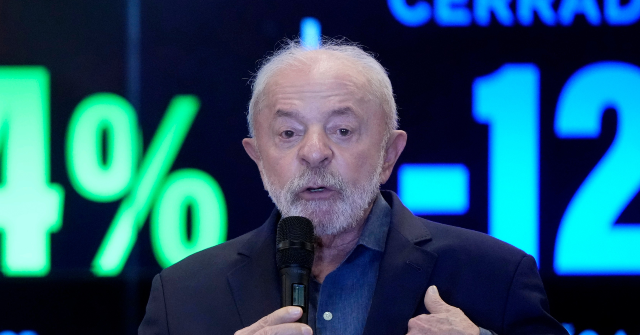
Secretary of State Marco Rubio explained on Wednesday, the tariffs also follow negotiations between both countries that saw radical leftist President Luiz Inácio Lula da Silva and his government not act in good faith with the United States.
“Let there be no confusion about why: President Lula and his government have not negotiated with the U.S. in good faith,” Sec. Rubio wrote on social media.
“His economic policies are bad for Americans and bad for Brazilians. For the past year, Lula has put his own ego ahead of making a deal for the welfare of the Brazilian people, and these tariffs are the price for that,” he continued.
Sec. Rubio’s message was translated to Portuguese by the U.S. Embassy in Brazil.

The Brazilian government responded to the impending tariffs in an official statement shared with local media and posted by President Lula on his social media accounts. In the statement, the Lula government accused the Bolsonaro family, led by conservative former President Jair Bolsonaro, of orchestrating a purported “plot” to promote the tariffs. Over the past weeks, President Lula has issued a barrage of accusations against the sons of former President Bolsonaro after Sen. Flávio Bolsonaro and former Congressman Eduardo Bolsonaro met with President Trump at the White House in May. In response, Lula publicly insinuated that the Bolsonaros should be “hanged” for engaging with the Trump administration.
“They [the Bolsonaros] are false patriots who orchestrated and publicly defended actions against our country, driven by electoral objectives,” the Brazilian government’s statement read in part.
The Brazilian government described July 15, the day the new tariffs were announced, as a day that will go down as a “lamentable milestone” in the history of relations between the U.S. and Brazil. The Lula administration also announced that it will immediately activate Brazil’s Reciprocity Laws in response to the tariffs and bring the matter before the World Trade Organization (WTO).
According to the Brazilian government, there is “no justification” for the announced tariffs, claiming that, based on “statistics from the U.S. government itself,” America has accumulated a surplus of $424.5 billions in goods and services with Brazil over the past 15 years. Furthermore, the Brazilian government affirmed that it does not recognize the legitimacy of the U.S. investigations that led to the tariffs, asserting that “despite this, we have never left the negotiating table to defend national interests.”
“One cannot love Brazil only when we win elections. Protecting our sovereignty is an obligation that stands above all parties and all trends. The Brazilian government will not falter in its duty to preserve it,” the statement concluded.
Sen. Flávio Bolsonaro, who is running against Lula in the October presidential election, rejected Brazilian government’s accusations claiming that his family is responsible for the tariffs and instead claimed that it is Lula who is to blame for them.
In a video published by the Brazilian senator, Flávio Bolsonaro asserted that Lula sought to get the tariffs imposed with the alleged intent of creating an “electoral effect” favorable to his campaign. Bolsonaro affirmed that, in recent times, Lula has “provoked” President Trump over 60 times.
The videos features snippets from past Lula statements, including one issued in June in which the Brazilian president claimed to reporters in June that Trump acted “like an emperor” and urged him not to “meddle” in the upcoming presidential race.
“While I was in the U.S. trying to avoid the tariff hike, Lula preferred to provoke Trump. Brazil didn’t even send representatives to defend our interests,” Sen. Bolsonaro wrote.
“The ones who pay this bill are the Brazilian people! Defend Brazil from the [Workers’ Party] PT, the Party of the Tariff Hike,” he continued.
Christian K. Caruzo is a Venezuelan writer and documents life under socialism. You can follow him on Twitter here.
Read the full article here


