




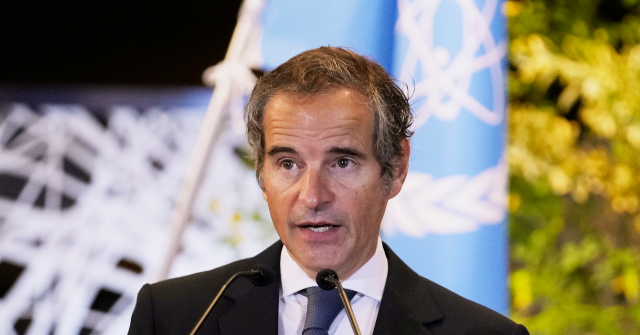
Rafael Grossi, the head of the United Nations’ International Atomic Energy Agency (IAEA), told reporters on Wednesday that his agency would “indeed” conduct inspections of Iranian nuclear sites, as the Iranian terror regime agreed to allow such inspections in its peace deal with America.
Grossi made the comments during an ongoing visit to Japan, responding to uncertainty created by Iranian officials claiming that no plan or protocol currently exists for international inspections of its nuclear sites. The Iranian Foreign Ministry did not explicitly deny that it would allow such inspections, but its comments were reported as contradicting President Donald Trump’s announcement this week that Tehran had agreed to the most intensive nuclear inspections in recent memory.
“The inspections will indeed take place,” Grossi told reporters. “We will be working on the modalities — dates, procedures, places — very soon.”
The IAEA chief noted that the memorandum of understanding between Iran and America signed last week requires IAEA inspections of Iranian nuclear sites.
“Paragraph 8 of this memorandum of understanding states explicitly that nuclear activities that are going to be carried out with regards to nuclear material, facilities, will be supervised by the IAEA, in bold letters,” Grossi explained. “Obviously, to do that, we will have to inspect. Whether this happens the day after tomorrow, or in one week, or in 10 days, it’s important but not essential.”
“So this is going to happen. Of course, if they (Iran) want to comply with the agreement. If they don’t want (to), it’s another matter,” he concluded, according to a transcription of his comments by Reuters.
Iran and the United States signed a “memorandum of understanding” last week intended to formalize an indefinite ceasefire that began in April, pausing hostilities triggered by the Trump administration launching Operation Epic Fury. The memorandum of understanding kickstarted a 60-day negotiation period meant to cement a more intensive peace agreement that would address America’s concerns regarding Iran’s illicit nuclear program.
“The United States of America and the Islamic Republic of Iran have agreed to resolve the disposition of stockpiled enriched material pursuant to a mechanism that will be mutually agreed upon,” the text of the memorandum reads, “in accordance with the schedule mentioned in paragraph 7, with the minimum methodology to be down blending on-site, under the supervision of the IAEA.”
The memorandum also requires America to work to “terminate all types of sanctions against the Islamic Republic of Iran, including the United Nations Security Council resolutions, IAEA Board of Governors resolutions, and all unilateral U.S. sanctions.”
Iran’s government has maintained at least three large-scale uranium enrichment facilities, believed to be generating more fissile material than is necessary for any known civilian use. In June 2025, the IAEA sanctioned Iran for the first time in two decades for violating international law with its nuclear activity, which preceded President Trump ordering airstrikes on the three facilities at Fordow, Natanz, and Isfahan. The result of those airstrikes is that the fate of the enriched uranium stored underground remains unknown at press time as the Iranian government has not allowed IAEA inspectors to enter those sites and assess the damage from the airstrikes.
In an update to the IAEA Board of Governors this month, Grossi stated that the agency could not “provide any information on the current size, composition, or whereabouts of the stockpile of enriched uranium in Iran or whether Iran has suspended all enrichment-related activities.”
Grossi described granting his agency access to the Iranian nuclear sites as an “indispensable and urgent” matter, explaining that the IAEA has experienced a “loss of continuity,” meaning it has no information on the whereabouts and status of the nuclear material.
President Donald Trump announced on Tuesday that Iran had agreed to allow the IAEA to resume its work.
“Iran has fully and completely agreed to highest level Nuclear inspections long into the future (Infinity!!!),” the president wrote on his website, Truth Social. “This will insure ‘Nuclear Honesty.’ If they did not agree to this, there would be no further negotiations!”
Iranian officials raised some doubts as to whether the inspections would happen when asked on Monday. Foreign Ministry spokesman Esmaeil Baghaei stated that a plan for inspections did not yet exist, which some international media interpreted as a rejection of the inspections entirely and not a reflection of the reality that nuclear issues were shifted to discussion during the 60-day memorandum of understanding window. Speaking to the state-run Islamic Republic News Agency (IRNA), Baghaei stated on Monday that Iranian and American officials did not discuss nuclear issues during their meeting in Switzerland this weekend. As for the IAEA, he stated that Iran expected to continue exchanges with it.
“Iran’s interactions with the Agency, in accordance with Iran’s obligations under the Safeguards Agreements, will continue according to existing procedures,” he was quoted as saying, “and comply with the laws enacted by the Islamic Consultative Assembly (Majlis) and the decisions of the Supreme National Security Council (SNSC).”
Follow Frances Martel on Facebook and Twitter.
Read the full article here


