




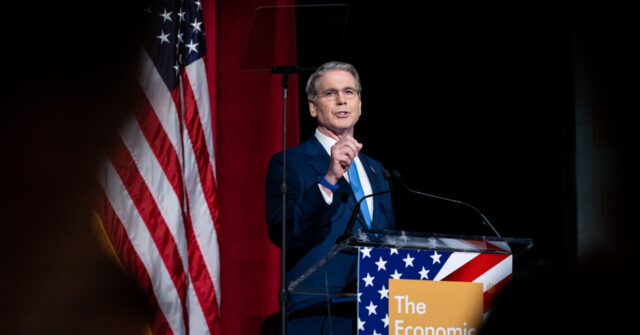
Treasury Secretary Scott Bessent on Tuesday laid out a doctrine of “economic statecraft,” telling the Economic Club of New York that the United States would wield its economic power “in service of our sovereignty” and warning that a country unable to produce what it needs “is not truly secure.”
Speaking at the club’s America 250 Gala Dinner on the eve of the nation’s 250th anniversary, Bessent organized the Trump administration’s approach around what he called five core principles, anchored by the argument that national strength begins at home with the capacity to build.
“We have rediscovered at great cost what Hamilton taught us: that every nation ‘ought to endeavor to possess within itself all the essentials of national supply,’” Bessent said, invoking the nation’s first Treasury secretary. “That our strength, in other words, is derived from what we can build, for the nation that cannot produce what it needs is not truly secure. The nation that depends on its adversaries for critical inputs is not truly sovereign. And the nation that reduces its economics to consumption is not truly prosperous.”
Bessent defined economic statecraft as “the disciplined use of America’s economic power in service of our sovereignty,” and said the most fitting way to honor the country’s founders was “to meet the most pressing challenges of our own time with the same resolve that they brought to theirs.”
The first and foundational principle, he said, is that economic security begins with national capacity — the ability to “build, invent, finance, and scale the industries that will define the next century.” He named semiconductors, artificial intelligence, quantum computing, advanced manufacturing, shipbuilding, critical minerals, and pharmaceuticals among them, calling them “not more than sectors of the economy” but “the sources of national power.”
Bessent argued that the long-dominant question in commercial and political life — “Where is the lowest cost?” — was no longer sufficient. The relevant test now, he said, is whether a supply chain can survive a crisis, withstand coercion, and continue operating through a pandemic, cyberattack, war, or financial shock without leaving the country “at the mercy of a foreign chokepoint abroad.” He stressed that resilience does not require every component to be made domestically, only that the nation know its vulnerabilities and reduce them before a crisis.
The second principle, Bessent said, is reciprocity. Access to the American market, he argued, is “no longer unconditional.” Countries “cannot seek access to our market while denying fair access to theirs,” he said, nor invite American capital while imposing discriminatory taxes, forced technology transfer, or “indigenous innovation requirements designed to favor domestic champions.”
He drew a line between legitimate regulation and discrimination, saying regulation “descends into discrimination when it targets American firms because they are American.” The United States, he said, “possesses many tools at its disposal to remedy practices that distort trade and undermine reciprocity. We will always seek to use those tools judiciously, but we will never hesitate to use them decisively.”
His third and fourth principles addressed the rules of the emerging economy and the role of financial leadership. Bessent said the next era of competition would be shaped by “the platforms, systems, and protocols through which commerce flows,” and that standards themselves had become a form of strategy. He pointed to digital assets, stablecoins, and tokenization as areas where the United States “should not consign itself to the sidelines,” and cast the dollar’s global role as both an advantage and an obligation requiring disciplined use of sanctions.
The fifth principle, which Bessent called the most important, was that economic statecraft “must serve the American people.”
“We need an economy in which our working families are not merely consumers of what the world produces, but participants in what America builds,” he said, calling for the gains of national strength to be “broadly shared beyond the boardrooms and trading floors to the families and communities who sustain it.”
America’s competitive advantage, he added, “has never been confined to the bounty of our natural resources or the depth of our capital markets,” but has “always resided in the character and the capacity of our people” — the insight he said “transformed a small republic on the edge of a continent into the most prosperous nation over the long sweep of human civilization.”
“It now falls on us to preserve that inheritance,” Bessent said, “not by seeking a smaller role in the world, but a stronger foundation for our leadership.”
The address was the third in a series in which Bessent has developed the administration’s economic doctrine, following remarks at the Economic Club of Dallas, where he described the “structural vulnerabilities” that produced a “drift into dependence,” and at the Reagan Library, where he said America had “awoken to the risks we can no longer ignore.” He closed Tuesday by describing the doctrine as one “open to the world while anchored at home.”
Read the full article here


