




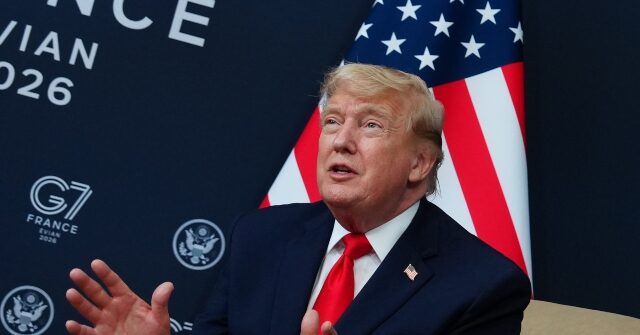
President Donald Trump criticized the government of Israel for its handling of its invasion of Lebanon in comments at the G7 summit in France on Tuesday, suggesting that Syria, whose government came to power fighting a coalition of Iran-backed interests, could “do a better job” eliminating Hezbollah.
“Israel is fighting Hezbollah too long and too many people are being killed,” Trump was quoted as saying, according to the Times of Israel. “And you don’t have to knock down an apartment house every time you’re looking for somebody. Because there are a lot of people in those apartment houses. And they’re not all Hezbollah, that I can tell you.”
“I’m not happy with the way Israel has handled themselves with Lebanon and with Hezbollah,” he said elsewhere during the G7 engagement. “They should have been able to do the job faster. It just goes on forever. And when that happens, it throws a negative light on the big deal, and that’s the deal with Iran.”
Trump specified that he was especially irritated with an Israeli airstrike on Beirut “two hours before we’re signing the agreement” ending the war with Iran. He added that he believed the government of Syria, led by former al-Qaeda terrorist President Ahmed al-Sharaa, could have eliminated the Hezbollah threat more efficiently.
“I suggested to Israel to let Syria take care of Hezbollah,” Trump said. “Because to be honest with you, I think they’d do a better job of doing it.”
“He’s [Sharaa] very capable. And he’s been very good for me. He’s protected everything that I’ve asked for … And if Israel can’t do the job without killing everyone else, he’ll do the job. Syria will do the job,” he suggested.
Israel invaded Lebanon as part of the greater conflict between itself, America, and Iran that began in late February, arguing that the presence of the Iran-backed terrorist organization Hezbollah in southern Lebanon was an unacceptable threat to residents of northern Israel. The Israel Defense Forces (IDF) initially targeted areas known to be controlled by Hezbollah, but later expanded deep into Lebanon and began striking Beirut, the nation’s capital. The Israeli operations have displaced over a million people.
President Trump addressed the situation in Lebanon in comments referring to the peace agreement between America and Iran reportedly signed late on Monday to end “Operation Epic Fury,” the military engagement to weaken Iran’s ability to attack its neighbors that began in February. The two countries are expected to attend a formal signing ceremony in Switzerland on Friday, but American officials stated on Monday that President Trump, Vice President JD Vance, and Iranian Parliament Speaker Mohammed-Bagher Ghalibaf had already e-signed a copy of the agreement.
According to President Trump in an announcement on Sunday, the agreement will result in the full opening of the Strait of Hormuz and ending of active military hostilities between the two countries. Subsequent reports indicate that the agreement will create a 60-day window to address Iran’s demands to end sanctions on the regime and America’s demands that Iran cease its illicit nuclear development, particularly its prodigious uranium enrichment.
Left unclear at press time is whether the agreement addresses the situation in Lebanon. Iranian officials claim that the deal includes an end to the Israeli invasion of Lebanon, but the government of Israeli Prime Minister Benjamin Netanyahu has aggressively rejected those claims.
“We will not compromise on Israel’s security interests and the protection of our citizens, and we will not withdraw from the security zones,” Defense Minister Israel Katz declared on Monday.
“Prime Minister Benjamin Netanyahu and I are leading a clear policy that determines that the IDF will remain in the security zones in Lebanon, Syria, and Gaza,” he explained, “without any time limit, to protect the border and Israeli communities from there against jihadist elements.”
Those zones, according to Katz, would be “cleared of local residents, and all terror infrastructure, above and below ground, including the houses in the contact-line villages that served as terror outposts, will be destroyed.”
The United Nations estimated on Tuesday that Israeli operations in Lebanon have resulted in the displacement of 1.4 million people in that country, among them an estimated 16,000 pregnant women. These large numbers were tallied despite the fact that many Lebanese, particularly Christian communities, refused to vacate their indigenous villages when ordered to by Israel, resulting in several civilian deaths.
Sharaa’s government in Syria has largely avoided becoming involved in the Iran conflict in any way. The current government is made up of the vestiges of the al-Qaeda offshoot Hayat Tahrir al-Sham (HTS), which seized power in December 2024 after forcing Iran-backed dictator Bashar Assad to flee the country, ending the decade-long civil war in the country. Assad maintained power with the help of the Iranian government, Hezbollah, and other Shiite terrorist organizations.
While taking no active part in hostilities, the Syrian government announced in April that it had identified and thwarted a Hezbollah terror cell’s plan to use Syria as a launching pad for an attack on Israel, blocking a truck loaded with missile launchers from crossing out of Syria into the Golan Heights, currently occupied by Israel.
Multiple reports during “Operation Epic Fury” suggested that Trump, as he stated on Tuesday, had attempted to involve Syria by asking the country to address the Hezbollah threat. In March, Reuters reported that Syria was “cautiously considering a cross-border operation but remained hesitant.”
“One source, a senior Syrian official, said Damascus and its Arab allies agreed Syria should stay out of the war, and take only defensive measures,” Reuters noted at the time, adding that its sources had shared that Sharaa was in contact with Lebanese President Joseph Aoun.
On Monday, The National reported that the Trump administration had indeed suggested that Syria enter Lebanon to help eradicate Hezbollah while minimizing the Israeli role in the operation, but “Damascus rejected the proposal and said it was not interested in any military or security role in its neighbour.”
Follow Frances Martel on Facebook and Twitter.
Read the full article here


