





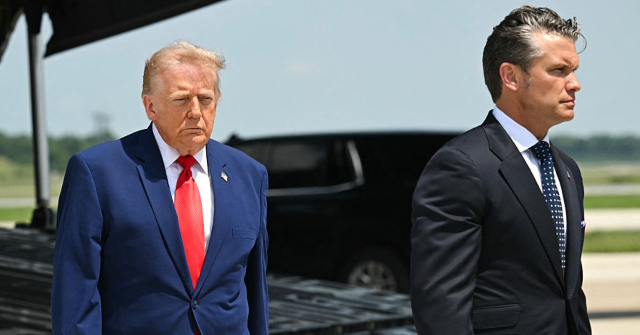
President Donald Trump announced on Sunday night that he had ordered Secretary of War Pete Hegseth to “substantially reduce” the scale of “Ulchi Freedom Shield,” joint military exercises with South Korea that take place annually and are expected to begin on Monday.
The exercises typically take place to maintain combat readiness given the context of South Korea still being in a state of war with neighboring North Korea. The Korean War that began in 1950 was temporarily halted in 1953 with an armistice agreement, but no peace treaty or surrender has taken place. The United States is an active party in the war on South Korea’s side, while China is North Korea’s core ally in the conflict.
The communist tyranny of North Korea regularly protests Ulchi Freedom Shield. Last week, neighboring states documented the North Korean armed forces shooting a ballistic missile out into the East Sea (Sea of Japan), an act that had no major consequences but was seen as a symbolic protest against the upcoming exercises. The government of communist dictator Kim Jong-un has not explicitly confirmed that ballistic missile test and thus not linked it to the military exercises, but the report follows a pattern of documented North Korean behavior.
Trump suggested in his message on Sunday that the government of South Korea, under leftist President Lee Jae-myung, had also not done enough to reinforce the U.S.-South Korean alliance, accusing him of being insufficiently supportive in the war against Iran. Iran and North Korea are close allies and the North Korean government has repeatedly condemned the Trump administration for launched its conflict against the Iranian terror state.
“Based on my very good relationship with Kim Jong Un, of North Korea, I am not happy with the fact that the United States has, long ago, agreed to participate in Joint Military Exercises with South Korea,” Trump declared on his website, Truth Social.
“These exercises are not only costly, with much of these costs paid for by the United States of America (as usual!), but send a signal that is totally inappropriate and hostile,” he continued, “to a Country that, as long as Donald J. Trump has been President, has been unthreatening and respectful.”
Trump announced that he had formally told Hegseth to limit the scale of the exercises, lamenting that it was “too late to cancel,” and added, “While somewhat unrelated (?), I recently asked the President of South Korea if they would like to join us in the Denuclearization of the Islamic Republic of Iran, and they said, ‘No thanks!’”
Prior to that announcement, Trump posted a photo of himself scowling alongside Kim Jong-un during one of their several in-person meetings during Trump’s first term, joking, “Despite the unfriendly look on this particular picture, there are many where we’re smiling, Kim Jong Un and I get along GREAT!”
The office of South Korean President Lee published a careful diplomatic message on Monday in response to Trump’s announcement, expressing hope that Trump’s personal relationship with Kim could benefit Seoul.
“Our government is paying close attention to President Trump’s social media message today,” the presidential office statement read, “and hopes that the friendly relationship between the North Korean and U.S. leaders will lead to meaningful dialogue between the two countries, thereby initiating discussions to advance peace and stability on the Korean Peninsula.”
“To this end, we will exert necessary diplomatic efforts as a pacemaker under close South Korea-U.S. cooperation,” it assured.
An unnamed official at the Blue House, South Korea’s presidential office, disputed Trump’s comment on Iran in remarks to the newspaper Korea JoongAng Daily. South Korea, the official claimed, “actively participated in international discussions regarding a ceasefire in Iran and the restoration of freedom of passage in the Strait of Hormuz.”
The official added that Seoul is “currently discussing practical and military contribution measures with the U.S. side, taking into account various factors such as readiness on the Korean Peninsula and domestic legal procedures.”
Kim and Trump have maintained for years a positive relationship even acknowledged in North Korean state media, the only legal way for North Korean citizens to obtain news information. The two leaders met on three different occasions during Trump’s first term: in Singapore, Vietnam, and on the border between the two Koreas, where Trump became the first American president to step foot on North Korean soil. Kim went to the extraordinary length in 2024 of publishing an official statement sending “warm greetings” to Trump and his family after he survived an assassination attempt while campaigning for president.
“He sincerely hoped that they would be recovered as soon as possible. He hoped they will surely overcome it,” the Korean Central News Agency (KCNA), North Korea’s flagship state propaganda office, said of Kim. The statement was friendly enough that KCNA had to issue a statement clarifying that Kim’s personal affection for Trump did not affect North Korea’s hostile stance towards the United States as a country.
North Korea has, since President Trump first took office, not tested any more nuclear weapons and significantly reduced its belligerence towards America in particular, ceasing its regular propaganda broadcasts threatening to destroy New York, Washington, and Guam with nuclear weapons. North Korea remains a threat to American interests around the world, however, as it has since invaded Europe with thousands of troops aiding the Russian invasion of Ukraine. Ukrainian President Volodymyr Zelensky revealed last week that his government has evidence that Russia is now using North Korean medium-range ballistic missiles (MRBM) to target Ukrainian cities.
In a speech in June, Kim declared both Trump’s “America First” policies and the Ukrainian government to be threats to the North Korean communist tyranny.
“Today, the world is witnessing rampant ultra-nationalism of modern version such as ‘America First’ idea, Zionism, Ukrainian Neo-Nazism, and Japanese militarism,” Kim announced, explaining these threats make North Korea’s illicit nuclear program necessary.
Follow Frances Martel on Facebook and Twitter.
Read the full article here


