

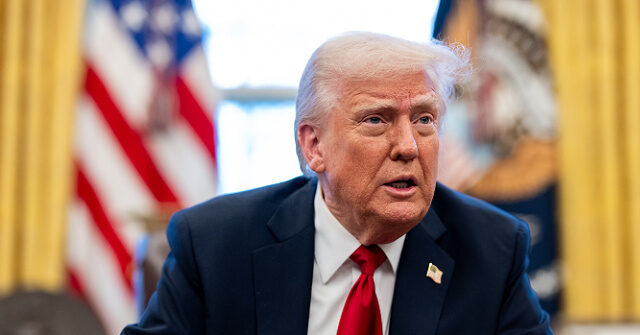
President Donald Trump said Wednesday that Iran’s regime is “getting weaker and weaker by the day” and suggested Tehran may be nearing the limits of what it can withstand under mounting U.S. pressure, one day after calling on Iranians to “rise up and fight.”
The remarks marked an escalation in Trump’s increasingly explicit focus on pressure building inside Iran, as Washington combines economic isolation, control of the Strait of Hormuz and overwhelming military leverage in a campaign senior administration officials say could leave Tehran facing internal fracture, popular revolt or a return to negotiations on U.S. terms.
Asked in the Oval Office whether he would send the CIA into Iran to arm Iranians after urging them to rise against the regime, Trump declined to say.
“I wouldn’t want to say that,” Trump replied. “I’d love to tell you that, but it wouldn’t be appropriate to say.”

Trump said the reason Iranians have not mounted a larger challenge to the regime is that Tehran responds to demonstrations with lethal force, pointing to the violent crackdown on the mass protest movement that shook the country before the current conflict began.
“When I ask that question, I ask it sort of knowing the answer,” he said. “The only answer is that they’re being shot.”
Trump described protesters being targeted by gunmen and snipers, but predicted the regime’s capacity to maintain that grip would diminish as its overall position deteriorates.
“The regime is getting weaker and weaker by the day, and at some point they’re not going to be able to shoot so easily because I think the people aren’t going to take it,” Trump said.
The president made clear that his call for an uprising Tuesday night had been deliberate, telling reporters that he “did pose that question because, you know, it would be time.”
In that Truth Social post, Trump said Iran’s economy was “totally collapsing” while the United States held “almost total control of the Hormuz Strait,” declaring that Tehran was “just playing out the inevitable.”
“When are the Iranian people going to rise up and fight?” he asked.
Trump on Wednesday also suggested Iran may be running out of room to absorb the broader campaign against it. Asked how long the latest escalation would continue, he responded: “Not too long.”
“As soon as it’s over, which I don’t think will be very much longer, I don’t know how much more they can take,” Trump said later.
The prospect of mounting pressure producing upheaval inside Iran has also become an increasingly prominent theme in the administration’s public description of its strategy.
Treasury Secretary Scott Bessent, who has described Iran as caught in a “death spiral,” laid out three possible outcomes Monday as the country comes under intensifying economic pressure.
“Either the IRGC are going to turn on each other, the people are going to turn on them, or they are going to come to the table and want to do a deal that they can stick with,” Bessent said.
Bessent has been equally careful, however, not to declare the collapse of the Islamic Republic an explicit U.S. objective. “The goal here isn’t necessarily to collapse the regime,” he said Tuesday, before acknowledging: “It could happen. Maybe the people will rise up.”
The administration is now intensifying the economic isolation designed to narrow Tehran’s remaining options. At Trump’s direction, Treasury launched Operation Economic Outcast last week, an unprecedented whole-of-government effort that Bessent described as an “economic onslaught” aimed at severing every remaining financial lifeline sustaining the regime until “Tehran stands alone.”
Since then, Treasury has begun rolling out measures against the foreign banks, shipping networks, aviation links, digital assets and other channels Tehran relies upon to remain connected to the global economy, while Bessent has pressed foreign governments to cut their own ties with Iran.
“We are telling friends and foes: do not deal with this evil regime,” Bessent said Wednesday, warning that Washington knows who continues helping Tehran and, if necessary, “will put you out of business.”
His message to countries and companies still weighing whether or not to assist Iran was even simpler: “Stay away.”
The intensified economic offensive comes just over six months after Operation Epic Fury began on February 28, opening the kinetic phase of a U.S. campaign that devastated major elements of Iran’s military and nuclear infrastructure. Washington has since increasingly focused on isolating Tehran economically while retaining military force to punish attacks and prevent Iran from rebuilding capabilities that threaten U.S. forces or international shipping.
The consequences of that pressure are increasingly difficult for Tehran itself to dismiss.
On the six-month anniversary of the operation last week, Iranian President Masoud Pezeshkian publicly pushed back against elements inside Iran that continue to minimize the effect of U.S. sanctions.
“Some say sanctions have no effect at all; to those people, I really don’t know what to say,” Pezeshkian said, acknowledging that Iran’s imports and exports had fallen by roughly 25 to 35 percent.
The admission was particularly significant for a regime that entered the conflict already confronting deep economic discontent. Mass protests that erupted months before Operation Epic Fury were met with the bloody crackdown Trump invoked Wednesday in explaining why Iranians have so far been reluctant to challenge the regime again.
Conditions have deteriorated further under the U.S. campaign. Iran’s crude oil exports have plunged under the blockade, the rial has fallen to record lows, and inflation has placed growing pressure on ordinary Iranians as Tehran’s access to hard currency and foreign trade contracts.
Administration officials are now explicitly linking that economic deterioration to the possibility of renewed pressure on the regime from its own population.
Asked Wednesday about whether the Iranian people might answer Trump’s call to rise up, U.S. Ambassador to NATO Matthew Whitaker said a bankrupt government would eventually struggle to pay its military, civil servants, and other government employees or continue subsidizing society.
“Certainly the people of Iran will not be happy with the current state of affairs, and they should blame their government,” Whitaker said.
“They should blame this regime,” he continued, “and they should certainly ask for change and a different way forward.”
A critical source of Washington’s leverage is the Strait of Hormuz, where U.S. forces have cleared Iranian mines, reopened shipping lanes and deprived Tehran of much of the control it had sought to exercise over one of the world’s most important energy corridors.
The Trump administration has paired that reopening with a strict blockade designed to allow authorized commercial and humanitarian traffic to move while choking off the regime’s own economic lifelines.
Trump has repeatedly warned Tehran against attempting to re-mine the waterway or interfere with shipping, and said Wednesday that the United States now exercises “very strong control” over the strait as ships carrying millions of barrels of oil move through it.
CENTCOM said Wednesday that U.S. forces enforcing the blockade had redirected 86 commercial vessels, disabled three and boarded two.
Iran, meanwhile, has attempted to rebuild radar, missile and mine-laying capabilities that could threaten that traffic and restore some of the leverage it lost when U.S. forces cleared the strait.
Trump said American forces watched those efforts unfold in real time.
“They can’t go to the bathroom without us seeing it,” he said.
U.S. forces then struck the rebuilt infrastructure this week, including equipment Trump said was designed for both defensive and offensive operations along Hormuz.
“We hit them very hard last night,” Trump said. “We took out all of the new equipment that they tried to build along the Strait of Hormuz, some defensive, some offensive.”
The president made clear that Washington intends to use its military dominance to preserve that control whenever Tehran attempts to rebuild or threaten the flow of shipping through the strait.
“It was a very heavy attack last night,” Trump said, “and we’re prepared to do another one anytime we want.”
Secretary of State Marco Rubio on Wednesday described that combination of economic and military power in more formal terms, saying economic pressure remains Washington’s primary means of imposing costs on Tehran while the United States reserves the right to use force when necessary to protect its interests and prevent Iran from reasserting control over Hormuz.
“They’re losing control of the straits; they’ve lost control of the straits,” Rubio said.
“The straits will remain open, and they will not be under Iranian control,” he added. “And that’s what you’re seeing the President carrying out right now.”
Rubio also suggested Tehran can no longer simply return to the earlier memorandum of understanding on the terms previously under discussion, saying that the “ship, in many ways, has sailed.”
Trump has gone further, saying Tuesday that he “couldn’t care less” whether Tehran signs what he called a “worthless” agreement and that he prefers Washington’s current position, with Iran’s economy collapsing and the United States holding what he described as near-total control of Hormuz.
That posture comes as Pezeshkian has continued signaling an interest in renewed negotiations, leaving Tehran confronting the choice administration officials have increasingly described: accept an agreement after its military and economic position has been substantially weakened, or face still greater pressure from both outside and potentially within.
Trump also rejected the suggestion Wednesday that electoral considerations were influencing his approach to Iran, saying the administration’s objective remains preventing Tehran from obtaining a nuclear weapon.
“I’m not affected by the election,” Trump said, adding that Republicans respect “the fact that we’re not allowing Iran to have a nuclear weapon.”
For the administration, the military dominance established over the past six months, the economic isolation now being intensified and the growing strains inside Iran are converging on the question Trump raised Wednesday: how long the regime can continue to withstand them.
“I don’t think it will be very much longer,” Trump said. “I don’t know how much more they can take.”
Joshua Klein is a reporter for Breitbart News. Email him at jklein@breitbart.com. Follow him on Twitter @JoshuaKlein.
Read the full article here