







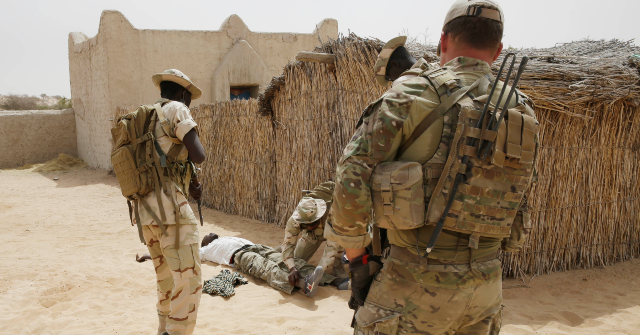
The government of Nigeria confirmed on Tuesday that the United States had initiated the planned withdrawal of about 200 troops deployed in the country in February to combat radical Islamic terrorists.
The deployment, reportedly at the behest of the Nigerian government, was in response to the pervasive threat of radical jihadist paramilitaries in the country’s north and Middle Belt, which have regularly waged genocidal war against the indigenous Christian populations of those regions. Nigeria is home to a variety of jihadist terrorist groups, most prominently Boko Haram, a Boko Haram splinter group tied to the Islamic State, and the organized Fulani jihadist militias in the Middle Belt, often falsely referred to as “herdsmen.”
President Donald Trump outraged his Nigerian counterpart, Bola Tinubu, in October 2025 by placing Nigeria on the State Department’s list of Countries of Particular Concern (CPC) for religious freedom, citing the routine slaughter of Christians throughout the country. Trump followed up that designation by ordering airstrikes on jihadist targets in northern Nigeria on Christmas Day, which Tinubu’s government affirmed it had approved. Those events led to the Nigerian government confirming in February that it had requested further aid from the United States in combatting jihadist assailants.
The Nigerian Defense Headquarters held a briefing with reporters on Tuesday to discuss the withdrawal of the troops it had requested in February. Government officials insisted that the Americans’ departure would not compromise security for Nigerians.
“The deployment of U.S. personnel was tied to specific operational and counter-terrorism objectives and the decision to draw down personnel is therefore part of the evolving nature of that engagement,” Maj. Gen. Samaila Uba, the director of defense information, reportedly stated. “Elements of the U.S. security partnership, particularly intelligence cooperation, training, and information sharing, will continue.”
The Nigerian newspaper Vanguard shared that, according to Uba, the Americans were in the country “to support intelligence, surveillance, training, and logistics operations in the fight against terrorism, banditry, and other security threats” and that that mission had been completed.
“The partnership between Nigeria and the U.S. is unchanged, with key information sharing ongoing. Nigeria and the U.S. continue to work closely together to disrupt and eliminate shared threats and that remains unchanged,” Uba reportedly emphasized.
U.S. Central Command (CENTCOM) confirmed the deployment of the troops in February, stating that their main objective in the country would be to train the notoriously ineffective Nigerian armed forces.
“The terrorist activity in West Africa — and Nigeria specifically — is something we’re incredibly concerned with. We want to partner with capable and willing partners that are able to address these shared security concerns,” a CENTCOM spokesperson explained at the time.
Reports began surfacing last week that the mission was drawing down in Nigeria. Speaking to the military outlet Task and Purpose, a spokesperson for U.S. African Command (AFRICOM) emphasized that cooperation would continue in a variety of capacities despite the withdrawal.
“The Nigeria-U.S. partnership is ongoing and remains strong, focused on disrupting and eliminating shared security threats,” the spokesperson said. “The successful joint operations with Nigeria dealt severe damage to the ISIS network, disrupting its global operations.”
“At the invitation of the Government of Nigeria, we continue to have forces in Nigeria addressing shared security threats. The number of personnel will fluctuate as required to meet mission requirements,” the spokesperson added.
It is not clear from reports this week if all 200 initially deployed were still in Nigeria by the time that the mission was confirmed over. In July, AFRICOM Commander Gen. Dagvin Anderson said during a virtual press briefing that most of the troops sent to Nigeria had already been withdrawn.
“We have withdrawn much of our forces that were just there for that operation,” he explained at the time. “They are continuing the partnership that Nigeria has asked for to help continue with the intelligence sharing and the understanding that’s necessary.”
The jihadist threat in Nigeria persists, according to local Christian advocates and officials who have consistently demanded that the Nigerian government become more proactive in protecting the lives of Christians. Speaking to Breitbart News in August, an attorney in the Middle Belt using the pseudonym Jabez Musa explained that mass murders of Christians were a “daily occurrence” in the region, with minimal government response.
“They come in their hundreds on their motorbikes and their fellow attackers on the bike and with their AK-47 machine guns and attack a village or a community, kill them, and either take over or kill them, come back again, then take over the place,” he explained, rejecting the common euphemism of “bandits” to describe the criminals.
On Monday, the governor of the Middle Belt state of Plateau, Caleb Mutfwang, once again called for the federal government to create a unified security response to the attacks, which states are often left to attempt to address on their own with little federal help.
“The governor challenged the recurring description of violence in the region as mere farmer-herder clashes,” Vanguard reported, “arguing that the pattern and scale of attacks in several communities pointed to a more organized threat that required urgent and decisive action.”
Follow Frances Martel on Facebook and Twitter.
Read the full article here


