




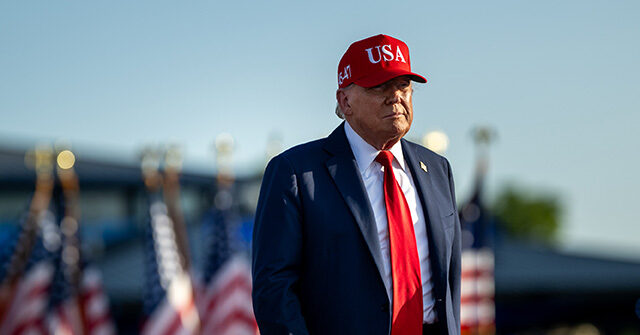
President Donald Trump doubled down Tuesday on his assertion that the United States has “total control” of the Strait of Hormuz, warning Iran could either continue buckling under mounting economic pressure or risk getting “blown away” if it challenges American forces.
“We have total control over the Hormuz Strait right now. They don’t have control. We have total control. We own it,” Trump told reporters Tuesday evening after returning from Ohio.
“At some point, maybe they’ll do something, and then they get blown away, but we, right now, we’re in a very good position,” Trump said.

The president’s remarks came hours after U.S. forces demonstrated their enforcement of the blockade against Iran, firing two Hellfire missiles into a commercial vessel that ignored repeated American warnings while attempting to sail toward an Iranian port.
U.S. Central Command said a Navy MH-60 helicopter struck the engine room of the Panama-flagged M/V Vela Nova, disabling the vessel’s steering gear and preventing it from continuing toward Iran.
“Earlier today, CENTCOM forces disabled the steering gear of Panama-flagged M/V Vela Nova as the cargo vessel attempted to transit the Gulf of Oman and violate the U.S. blockade against Iran by sailing toward an Iranian port,” CENTCOM said.
According to the command, American forces have now redirected 55 commercial vessels attempting to run the blockade, disabled three non-compliant vessels, and boarded two as of Tuesday.
“The ship is no longer transiting to Iran in violation of the U.S. blockade, which remains in full effect,” CENTCOM said, adding that American forces in the region remain “highly vigilant, lethal, and ready.”
Trump similarly dismissed suggestions Tuesday evening that he was placing any faith in Tehran as mediators continued attempting to broker an agreement over the strategic waterway.
“I don’t trust Iran. Why — are you saying I trust Iran? I’m the last person to trust Iran,” Trump said. “They’ve lied to me constantly.”
The president argued that the balance of power in the Middle East has fundamentally shifted since the U.S.-Israeli campaign against the Islamic Republic began in February.
“We have a country that has been the bully of the Middle East for 50 years,” Trump said. “And they’re no longer the bully of the Middle East.”
Trump had laid out his strategy toward Tehran in greater detail in a prerecorded interview with Real America’s Voice released earlier Tuesday, describing Iran as economically crippled while presenting continued pressure and another major military escalation as alternatives available to Washington.
“I’m sort of negotiating,” Trump told host Wayne Allyn Root. “They’re very devious negotiators because they’ll agree to something, then they’ll go out and tell the press that they never agreed to it. They’re very dishonest people.”
Trump said one option was effectively to maintain the current course and allow the pressure already being exerted on Tehran to continue taking its toll.
“Do what I’m doing now: just bop along and look how bad they’re doing, because they’ve got 300 percent inflation,” Trump said. “Their currency has almost no value. They’re not paying their soldiers. Their soldiers are leaving.”
“So just keep that going because that’s not sustainable,” he added.
Trump said another option was to “hit them really, really hard,” while describing intensified economic warfare as a third approach that was already intertwined with his current strategy.
“Economically, they are a mess. They can’t borrow money,” Trump said. “We control their money, what they had, which is a lot. They had a lot, and we have total control of it. I’m their banker. I am their banker.”
Trump’s remarks came amid sharply conflicting signals over whether months of negotiations could finally produce an arrangement over Hormuz.
Pakistani Defense Minister Khawaja Asif said Tuesday that Washington and Tehran were approaching “some sort of an arrangement,” telling Bloomberg that “things are shaping up again in favor of a peace arrangement or a deal.”
“The signals in the last two, three days are that we are close to some sort of an arrangement,” Asif said.
Pakistani Interior Minister Mohsin Naqvi also traveled to Tehran Tuesday, where he met Iranian President Masoud Pezeshkian and Foreign Minister Abbas Araghchi as Islamabad continued its mediation efforts. Qatar separately said negotiations between Iran and Oman over shipping arrangements in Hormuz had reached an advanced stage.
Iran, however, continued publicly insisting Tuesday that an agreement with Oman would not itself result in the strait reopening.
Mohsen Rezaei, the newly appointed secretary of Iran’s Supreme National Security Council, said Washington must first meet a sweeping set of Iranian demands — including ending the war and U.S. blockade, releasing frozen Iranian assets, and satisfying Tehran’s conditions involving conflicts in Gaza and Lebanon — before Hormuz would reopen.
Mohammad Mokhber, an adviser to Supreme Leader Mojtaba Khamenei, likewise declared Tuesday that “the Strait of Hormuz will not be opened until Iran’s conditions are met.”
Trump on Monday turned Tehran’s demand for compensation back on the regime, insisting Iran should instead pay the United States and victims of the Islamic Republic for decades of bloodshed and saying he had instructed his representatives to place the demand “firmly into any, and all, future negotiations.”
Despite Iran’s continued refusal to declare Hormuz fully reopened, Energy Secretary Chris Wright said Tuesday that American and allied efforts have already restored substantial energy flows from the region.
Wright said the seven-day average of oil moving through Hormuz has risen to nearly nine million barrels per day, compared with roughly 20 million barrels before the conflict. Combined with another five million to seven million barrels per day moving through upgraded pipelines and export facilities, he said total regional oil flows are averaging approximately 15 million barrels per day.
“On Sunday alone, over 20 million barrels left the Arabian Gulf region, which is above the pre-conflict average,” Wright said.
Trump, meanwhile, made clear Tuesday that he views the present combination of military and economic pressure as giving Washington the advantage regardless of whether Tehran immediately accepts an agreement.
“We totally control the Strait of Hormuz,” Trump said. “We have control over it. Nobody else, only us.”
“Our Navy is unbelievable,” he added, “and things are going great for our country.”
Joshua Klein is a reporter for Breitbart News. Email him at jklein@breitbart.com. Follow him on Twitter @JoshuaKlein.
Read the full article here


