






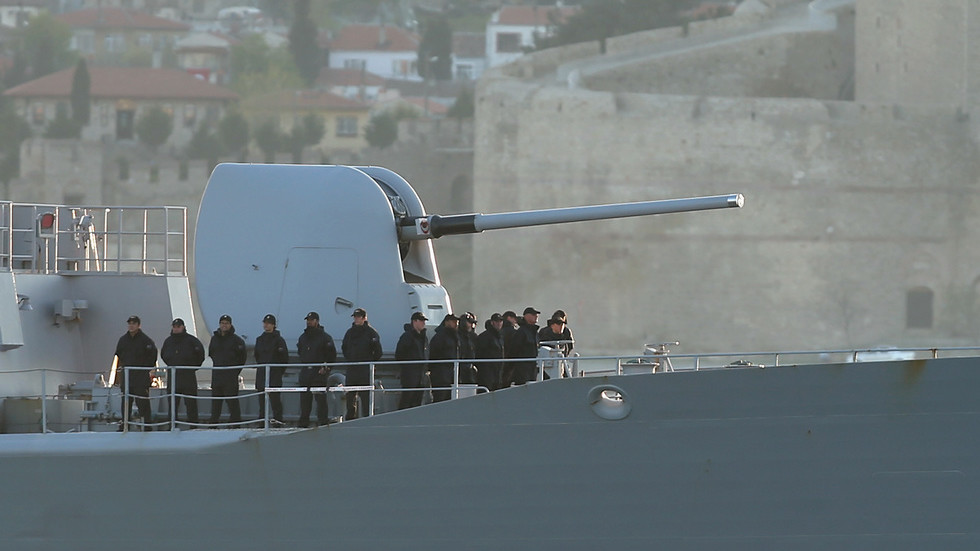
As Athens and Ankara clash over maritime claims, old island disputes and new maps risk turning the Aegean into a flashpoint inside the bloc
In mid-May 2026, the dispute between Greece and Türkiye again moved from diplomacy into the more dangerous world of maps, laws, and military warnings.
Turkish officials confirmed that work is continuing on a new law on maritime jurisdiction areas, while Greek officials immediately treated the initiative as an attempt to give legal form to Ankara’s Blue Homeland doctrine. The message from Athens was that a unilateral Turkish move concerning maritime zones in the Aegean would be rejected as legally meaningless and politically provocative. Türkiye, meanwhile, says it is not attacking anyone but protecting its maritime rights and organizing state policy in the surrounding seas.
The Blue Homeland doctrine, Mavi Vatan in Turkish, is built around a simple but emotionally powerful idea. Türkiye must not think of its sovereignty only through land borders, because the seas around it are also part of its security, economic, and regional future. The Aegean, the Black, and the Eastern Mediterranean seas are filled with trade, naval movement, undersea infrastructure, and geopolitical competition. If Ankara does not defend its interests there, supporters of this doctrine argue, other actors will draw the maps for it.
Talk moves into law
The Blue Homeland concept emerged from Turkish naval and strategic circles, and its intellectual architects are usually identified as retired admiral Cem Gürdeniz and retired rear admiral Cihat Yaycı. Gürdeniz is widely associated with the birth and popularization of the phrase Mavi Vatan in the mid 2000s, while Yaycı helped transform the idea into a more concrete geopolitical and legal doctrine.
Gürdeniz gave the concept its broader strategic language, turning the sea into a central element of Turkish geopolitical imagination. Yaycı, in turn, worked to give this imagination a more technical and cartographic form. He linked maritime zones, continental shelves, island disputes, and the Eastern Mediterranean into a single strategic picture. In a sense, Blue Homeland is a response to a deep Turkish anxiety that the country was being pushed away from the seas that surround it.
This origin also explains why the doctrine cannot be reduced to President Recep Tayyip Erdoğan’s personal foreign policy. Blue Homeland came from a tradition that saw Türkiye’s future as dependent on becoming a serious maritime power, and was later absorbed by politics and became part of a broader national narrative. That is one of the reasons it has survived different tactical phases in Turkish politics. It speaks not only to Islamists, nationalists or naval officers, but to a wider feeling inside Türkiye that the country has been constrained by a regional order designed by others.

For Greece, however, this doctrine sounds much less defensive. Athens sees Blue Homeland as an attempt to question the legal order of the Aegean, reduce the maritime rights of Greek islands and reopen issues that Greece considers settled by international treaties. The fear is not only that Ankara wants more influence at sea, but that Türkiye is gradually normalizing the idea that some parts of the Aegean are legally unclear and therefore open to pressure.
This is where the controversy over 152 small islands, islets, and reefs becomes so sensitive. In Turkish nationalist and strategic discourse, these formations are often described as territories whose status was not clearly defined by international agreements. Greece rejects this argument and insists that the sovereignty of its islands is not up for discussion.
The memory of the 1996 Imia/Kardak crisis still hangs over both countries. That confrontation began around small uninhabited islets, but it nearly pushed Greece and Türkiye into open conflict. In the Aegean, escalation can begin with a patrol boat, a helicopter, a fishing vessel, a television broadcast or a nationalist post on social media. When geography is tight and political nerves are exposed, escalation can move faster than diplomacy.
The current situation is especially fragile because the dispute is moving from rhetoric into legislation. A speech can be corrected, and a military exercise can end, but a law has a different political weight. If Ankara codifies Blue Homeland, it will not automatically change international law, yet it may change Turkish politics. It would make future compromises harder and allow nationalist forces to accuse any government of giving up rights that had already been written into law.
When no one is looking
The issue’s flashpoint potential is exacerbated by its timing. The Aegean is no longer living inside a stable international environment where major powers can freeze local conflicts and force allies back into predictable channels. The global order is going through a harsh transformation, where the war around Iran has turned the wider Middle East into a zone of constant military and economic nervousness. That conflict and the resulting shipping crisis has shown that maritime space has again become one of the main arteries of war.
This wider crisis changes how Ankara and Athens view the same sea. When the region is calm, Greece and Türkiye can keep their disputes inside the diplomatic space and NATO channels. But when the Strait of Hormuz demonstrates how quickly maritime routes can become battlefields, every coastal state starts thinking in terms of strategic depth. Türkiye looks at this chaos and sees one more argument for Blue Homeland. Greece looks at it and sees all the more reason not to allow grey zones to appear in the Aegean.
There is also the Trump factor. As the most important member of NATO, you would expect Washington to act as a manager of conflict between allies, but it currently has its hands full with the Iran war and the domestic pressures that come with it. A potential escalation between Greece and Türkiye is unlikely to get any reliable American mediation.
For Ankara, this can look like a window of opportunity to formalize Blue Homeland and push its maritime claims with greater confidence. For Athens, it’s a threatening moment when the political umbrella of NATO security is wavering.
A war in the Aegean is not necessarily coming, but the trigger for such a war has become easier to activate. A legal bill in Ankara, a Greek military statement, a patrol near a disputed reef, a media campaign about occupied islands or a naval incident that might once have been contained – any of those, unfolding in a world where everyone is already armed and on edge, and a local dispute can easily stop being local.


The Aegean knot
Türkiye believes it has reasons to be firm. From Ankara’s point of view, Greece uses its islands, many of them located very close to the Turkish coast, to claim maritime zones that would leave Türkiye with limited room in the Aegean and Eastern Mediterranean. Turkish officials and analysts often argue that a long continental coastline cannot be trapped by small islands lying just off that coast. They present Blue Homeland not as expansion, but as resistance to what they see as an unfair regional order.
Greece sees the same argument as revisionism. For Athens, the islands are inhabited communities, military positions, historical spaces, and sovereign territory. If Greece accepts that their status or maritime effect can be negotiated under pressure, many Greeks fear that the entire Aegean order could begin to unravel.
Each side has built its own story around this dispute – and each one sees itself as being on the defensive and the other one as being the threat. Turkish officials argue that Greece wants to imprison their country along the Anatolian coast, while Greek officials warn that Türkiye wants to revise borders and treaties through pressure.
Escalation as the only option?
The media environment is pouring even more fuel onto the fire. While pro-government outlets in Türkiye usually maintain some restraint, nationalist channels and social media accounts often don’t. They speak about “stolen islands,” “occupation” and “humiliation.” Greek media and political voices often respond with the same emotional force, warning that Ankara is preparing a direct challenge to Greek sovereignty.
NATO cannot easily solve this problem, even though both Greece and Türkiye are members of the alliance. Membership reduces the chance of a full-scale war, but it does not remove the dispute. NATO can call for restraint, provide military communication, and help avoid accidents, but it cannot make rulings on the sovereignty of islands. The alliance wants unity, but it can’t do anything about an age-old rivalry between two of its members.
The EU has influence, but not the kind of influence that could bring about a settlement – because Greece and Cyprus are members, but Türkiye isn’t. In fact, it’s a long-time aspirant, often feeling bitter over other countries cutting the ‘membership queue’ – there’ve been 15 of them since Ankara applied to become part of the bloc. So for Türkiye, Brussels is part of the diplomatic environment, but it’s on the Greeks’ and the Cypriots’ side and not a neutral judge of the EU, so Athens and Nicosia expect European solidarity. Ankara, however, often sees EU statements as Greek and Cypriot positions in European language.

And as the room for diplomacy dwindles, Greece and Türkiye keep speaking of different things, thus getting nowhere. Athens wants the discussion to focus mainly on maritime delimitation, while Ankara insists on a broader agenda that includes airspace, territorial waters, demilitarization, and the status of certain formations in the Aegean. They don’t merely disagree about the answer – they can’t even get to working that out, because they disagree about what the question is in the first place. With that premise, every negotiation risks becoming another performance of disagreement.
Sooner or later, Athens and Ankara will have to deal with the maritime question seriously, simply by virtue of immutable geography. The Aegean cannot remain governed in crisis mode forever, and they will have to choose between a difficult diplomatic process and a future in which every small incident risks becoming the spark of conflict.
For now, the region is living through controlled escalation. Neither side appears to want war, but both are making moves that reduce flexibility and increase suspicion. This is the most dangerous kind of calm – where governments can say that everything is under control, while the political space for de-escalation is shrinking by the day until conflict becomes the only possible development.
The Blue Homeland naval doctrine has become a statement of Türkiye’s place in the region and its refusal to accept what it sees as maritime confinement. Greek resistance to it is, in turn, the defense of a national map, a historical memory, and a state identity built around the islands of the Aegean. At its heart, this dispute is about national dignity – and that is what makes it so dangerous.
Read the full article here


