






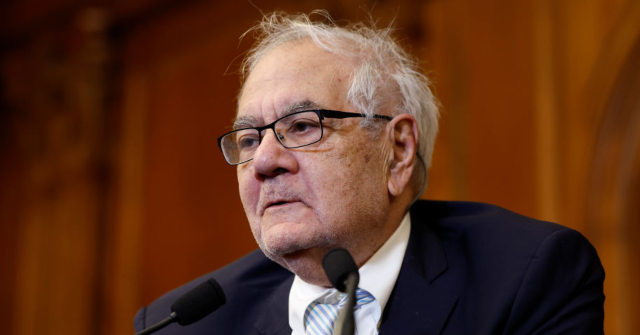
Former Democrat Rep. Barney Frank (D-MA) has died at age 86 after a battle with congestive heart failure.
Frank, perhaps best known for taking part in the Dodd-Frank Act (something he said he was “very proud” of) during the financial crisis, had been in hospice care for congestive heart failure since April. He served in Congress from 1981 to 2013 and led the House Financial Services Committee from 2007-2011.
At the time he entered hospice care in his home in Ogunquit, Maine, he said he felt “very good — no pain, no discomfort.”
“At 86, I’ve made it longer than I thought,” Frank said, according to Politico. “At some point, my heart’s just going to give out, and it’s reaching that stage. So I’m taking it easy at home and dealing with it by relaxing.”
Frank spent his last days offering advice to his own party, urging them to reign it in on certain social issues.
“For a lot of my colleagues, the argument has been, ‘Well, we don’t support defund the police or open borders, and we don’t say we do,’” Frank said. “But my point is, no, it’s not enough… to be silent. We have to explicitly repudiate it.”
During an appearance on Sunday on CNN’s State of the Union just a few weeks ago, Frank offered more in-depth insight on where he sees the Democrat Party, urging a pullback from controversial positions on social issues.

The former congressman said:
I think we’re in a situation where the mainstream, to my disappointment, for many years ignored inequality, and many of us could forget inequality on the Democratic agenda. But the problem was, we succeeded in bringing the mainstream of the left into a concern with inequality, we also enabled people who wanted to use that as a platform for a wide range of social and cultural changes, some of which the public isn’t ready for. Even if I agree with them in the end, I think they make a mistake by taking the most controversial parts of the agenda and turning them into litmus tests.
He used same sex marriage as an example, given his status as one of the first openly gay members of Congress:
My example, same sex marriage. Obviously, I’ve been working for gay rights suddenly in 1972, when we found the bill and we and the movement established feelings for gay and lesbian and bisexual people. We went to work on those issues, which were more acceptable. We didn’t get to marriage until after those things had been resolved, and that’s what I’m suggesting that we do today.
He added, “The analogy is a male and female transsexuals playing sports designated for women. I understand his anger about that, and I think in the interest of the transgender community, as well as other, it would be to be better to go at that in a more granular way instead of if you don’t support it you’re a homophobe.”
Frank’s sister Doris Breay said of her brother, “He was, above all else, a wonderful brother. I was lucky to be his sister.”
Read the full article here


