




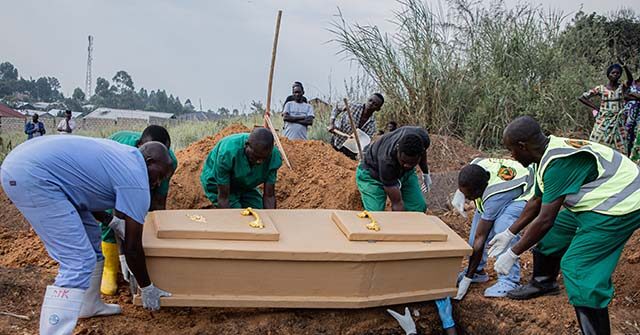
A study published by researchers from the Democratic Republic of the Congo (DRC), Uganda, Belgium, and several other countries on Monday found that the current outbreak of the rare Ebola Bundibugyo strain probably began with transmission from animals to humans.
The timing and origins of the Ebola outbreak are still mysterious. It was officially declared on May 15, but even then, researchers knew the disease had been spreading through the remote and politically unstable eastern Congo for weeks. The World Health Organization (W.H.O.) said on Monday that it now believes the outbreak began in February.
W.H.O. regional director Mohamed Yakub Janabi said some of the early infections were mistakenly diagnosed as malaria or typhoid fever. When Ebola was first considered, local doctors found it difficult to track cases of the Bundibugyo strain because their test kits were made for the genetically different Zaire strain.
The research paper published on Monday employed genetic analysis to determine that the first Bundibugyo infections were likely spread from animals to humans, although the identity of the animal was uncertain. The disease soon began spreading between humans, with alarmingly high rates of transmission and mortality.
On Tuesday, the DRC government updated the total number of confirmed infections to 4,449, with 2,061 fatalities.
The virologist who co-discovered Ebola in 1976, Jean-Jacques Muyembe, is still active at 84 and directs the National Institute of Biomedical Research in Kinshasa. He told Le Monde on Wednesday that Ebola Bundibugyo has “an unprecedented speed of spread that we’ve never seen before.”
“In just three months, we are already close to the figures recorded at the end of the 2018 epidemic,” he noted, referring to an outbreak that killed 2,287 people.
Muyembe blamed the delayed response to the virus, which he thought began spreading in January rather than February, and the collapse of the DRC health system due to the “dismantling of USAID” for the early spread.
“In addition, this outbreak spread in the DRC’s most densely populated region, an area marked by armed conflict and extensive mining activity, which facilitated the spread of the virus and made the situation impossible to control,” he said.
Muyembe felt the response remained “slow and ineffective,” due to bureaucratic problems in the DRC and a lack of coordination among international partners.
“The outbreak had a big head start, it is still way ahead of us, and we are playing catch-up,” agreed W.H.O. Director-General Tedros Adhanom Ghebreyesus at a press conference on Wednesday.
“It is already the second-biggest Ebola epidemic on record, and it is moving faster than any previous Ebola outbreak. At its current pace, it is on track to eclipse the West African Ebola outbreak of 2014 to 2016,” he warned.
Read the full article here


