


A top adviser to the commander of Iran’s Islamic Revolutionary Guard Corps (IRGC) said Tehran could deliberately prolong its war with the United States in an effort to outlast President Donald Trump, as Washington doubles down on a “WALL OF STEEL” naval blockade that U.S. and Israeli officials say is steadily worsening the Islamic Republic’s economic crisis.
“One way is to prolong this war until we get to the next term of the presidency and cause attrition, so that if anyone else wants to attack Iran, they will know there is a cost,” Brig. Gen. Mohammad Reza Naqdi told PBS in a rare interview published Tuesday.
Naqdi, a longtime senior IRGC figure who served as the force’s coordinating deputy from 2019 to 2025 and now serves as a senior adviser to its commander, laid out the potential strategy as Iran’s newly reshuffled military leadership increasingly prepares for a prolonged confrontation with Washington.
“We have to attain deterrence so that the enemy never dares to attack us, so we can live with security,” Naqdi said.
Naqdi went on to argue that time would favor Tehran, claiming the conflict has given Iran valuable experience fighting the United States while exposing the American military as “weaker than what we perceived.”
“The longer this war lasts, the more experience we gain,” Naqdi said.

He added that Iran had never previously experienced a war that allowed it to learn firsthand how to fight the United States, but claimed that “in these five months, we have learned how.”
The White House answered Naqdi’s proposed attrition strategy with a blunt warning to Tehran.
“It would be wise for Iran to agree to a deal,” the White House told PBS. “Otherwise they know what will happen.”
Naqdi’s proposal to try to outlast Trump runs directly against the strategy the president has increasingly embraced: maintain overwhelming military leverage around Iran while allowing the blockade, frozen assets, sanctions, and Tehran’s mounting economic problems to steadily tighten the pressure.
“The U.S.A. has total control over the Strait of Hormuz. I THINK WE WILL KEEP IT!” Trump declared Wednesday on Truth Social.
“Our Naval Blockade is being called, by everyone, ‘A WALL OF STEEL,’ and there is nothing Iran can do about it,” he continued.
Trump also reiterated his increasingly grim assessment of Iran’s military and economic condition, declaring that Tehran has “no Navy,” “no Air Force,” unpaid soldiers, and an IRGC that is “decimated and fleeing.”
“They have No Money — Their country is ‘shot,’” Trump wrote. “All they have is FAKE NEWS and 300% INFLATION, and getting worse!”
He concluded that Iran is “all talk and no action” and “the Bully of the Middle East No Longer.”
Trump had laid out the strategy more explicitly in a prerecorded Real America’s Voice interview released this week, describing several possible paths forward — including allowing the current economic pressure to continue working or launching another major military escalation.
One option, Trump said, was essentially to stay the course.
“Do what I’m doing now: just bop along and look how bad they’re doing,” he said.
Trump pointed to Iran’s currency, inflation, and inability to access financing before declaring that Washington controls much of Tehran’s frozen wealth.
“Economically, they are a mess. They can’t borrow money,” Trump said. “We control their money … We have total control of it. I’m their banker.”
Another option, he said, would be to “hit them really, really hard.”
For now, Trump has indicated he is content to “low-key” the conflict while preserving the option of renewed force if Tehran refuses to move.
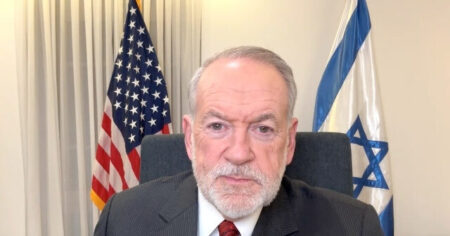
U.S. Ambassador to Israel Mike Huckabee offered perhaps the clearest administration-side description of that strategy Tuesday, arguing that Trump is prepared to use both military force and economic pressure against Tehran.
“He’s not just proven that he was willing to bomb them, but he’s also willing to bankrupt them,” Huckabee told Newsmax.
Huckabee said the U.S.-Israeli campaign inflicted “an enormous level of damage” on Iran’s military capacity and left the Islamic Republic at its weakest since 1979. He argued that sustained economic pressure could eventually create conditions in which Iranians themselves turn against the regime.
U.S. Ambassador to the United Nations Mike Waltz similarly argued Sunday that Tehran is now more concerned about access to money than absorbing additional military strikes, saying Iranian negotiators appear more fearful of Treasury Secretary Scott Bessent than War Secretary Pete Hegseth.
“When they’re coming to the table with our negotiators, they are talking about cash, cash, cash,” Waltz told Fox News. “Because they’ll absorb the bombings.”
Waltz said Tehran is seeking access to frozen assets and other funds that Washington has denied it.
“That’s the squeeze,” he said. “That coupled with the blockade, that’s what’s going to eventually get the Iranians to move.”
Israeli military officials have reached a similar assessment of the blockade’s impact. IDF Chief of Staff Lt. Gen. Eyal Zamir recently told ministers that “the blockade of Iran is highly effective” and “the economic crisis there is getting worse,” according to the Jerusalem Post, citing two Israeli officials familiar with the Security Cabinet meeting.
The U.S. military, meanwhile, is continuing to give Trump’s “Wall of Steel” tangible force on the water.
CENTCOM said Wednesday that U.S. forces have redirected 59 commercial vessels, disabled three, and boarded two while enforcing the blockade — up from 55 vessels redirected a day earlier.
The latest count followed one of the blockade’s most aggressive enforcement actions yet. On Tuesday, a U.S. Navy MH-60 helicopter fired two Hellfire missiles into the engine room of the Panama-flagged M/V Vela Nova after CENTCOM said its civilian crew repeatedly ignored warnings while attempting to sail toward an Iranian port.
Washington also argues that the pressure on Iran is increasingly being separated from the region’s ability to move energy to global markets. Energy Secretary Chris Wright said Tuesday that the seven-day average of oil moving through Hormuz had risen to nearly nine million barrels per day, while another five to seven million barrels per day were leaving through upgraded pipelines and export facilities.
“On Sunday alone, over 20 million barrels left the Arabian Gulf region, which is above the pre-conflict average,” Wright said.
Tehran, however, is projecting confidence that it can withstand — and even benefit from — a prolonged confrontation.
Naqdi claimed Iran is manufacturing more missiles each day than it launches and vowed that “even if this war lasts for years, until the last day, Iran’s rockets will be launched.”
He then threatened that Iran could turn to attacks on American economic interests worldwide even if Tehran eventually exhausted its missile arsenal.
“If there comes a day when Iran has no more missiles left, that’s when we will be even more dangerous for America,” Naqdi said.
“Because America has thousands of economic interests throughout the world, and all of them can be easily destroyed.”
Iranian Army Deputy Commander for Executive Affairs Brig. Gen. Alireza Sheikh separately claimed Tuesday that more than 75 percent of Iran’s missile and drone capabilities remain “intact and ready,” according to Iran’s state-run IRNA news agency.
That assertion stands in stark contrast to U.S. assessments of the damage inflicted on Tehran’s arsenal. Trump said last month that Iran retained only roughly 21 to 22 percent of its missile stocks and said most of its missile-production facilities had been knocked out.
The increasingly explicit talk of a years-long confrontation comes as the June interim agreement between Washington and Tehran has all but collapsed, with both sides publicly hardening their positions despite continued mediation.
A senior Iranian source told Reuters Wednesday that there had been “absolutely no progress” toward Washington returning to the interim agreement, even as Pakistani officials continued to express optimism that some form of arrangement remained possible.
Tehran has meanwhile demanded sweeping U.S. concessions before fully reopening Hormuz, including an end to the blockade and hostilities, sanctions relief, access to frozen Iranian assets, and compensation for wartime damage.
Iran’s Persian Gulf Strait Authority — an entity Tehran created in May to regulate shipping through Hormuz and that the U.S. Treasury subsequently sanctioned over its ties to the IRGC — issued its own challenge to Washington Wednesday.
“The Strait of Hormuz remains blocked and will not be reopened until Iran’s conditions are accepted,” the authority said.
The confrontation is also accelerating efforts by Iran’s Gulf neighbors to reduce their long-term dependence on Hormuz.
Saudi Arabia, the United Arab Emirates, and other regional producers are spending billions of dollars expanding pipelines, export infrastructure, and overseas storage that can move or position more energy without relying on the strait, according to the New York Times. Saudi Arabia is expanding its East-West Pipeline toward the Red Sea, while the UAE is working to double the capacity of a pipeline carrying crude to Fujairah on the Gulf of Oman — bypassing Hormuz altogether.
Those projects will take years and cannot eliminate the Gulf’s dependence on the strait. But they add another long-term variable to the war of attrition Naqdi is proposing, as Iran’s neighbors increasingly invest in alternatives to the waterway Tehran has sought to use as leverage throughout the conflict.
Joshua Klein is a reporter for Breitbart News. Email him at jklein@breitbart.com. Follow him on Twitter @JoshuaKlein.
Read the full article here