




South African President Cyril Ramaphosa on Sunday announced new measures to crack down on illegal migrants amid rising tensions following a series of anti-migrant protests accusing his government of not doing enough on the matter.
Ramaphosa, speaking on Sunday night at the Union Buildings in Pretoria, the seat of the government, said that his administration will enact a five-point strategy against illegal migration that, among some of its key goals, seeks to strengthen the nation’s border, stamp out corruption, penalize employers found hiring illegal migrant as workers with prison time, and expedite deportation proceedings at courts.
The policies also call for the establishment of biometric registries, phasing out the over four decades-old “Green ID” national identity document, widely accused of being highly prone to corruption, fraud, and identity theft.
Additionally, and as part of the broader series of policies, Ramaphosa said that a bill introducing maximum foreign worker quotas will be presented before the nation’s Congress.
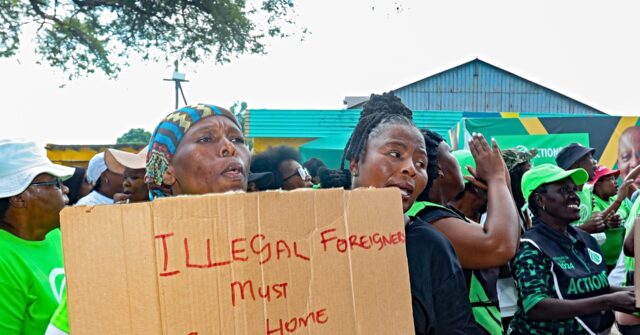
Protesters marched along Voortrekekker Road to Maitland to protest against illegal immigration on May 30, 2026 in Cape Town, South Africa. The group is advocating for stronger immigration enforcement and strict border control, (Brenton Geach/Gallo Images via Getty)
The South African President, acknowledging throughout his roughly 30-minute speech that his country faces “persistently high levels of unemployment,” specially among the youth, stressed that, “frustration can easily be directed at those perceived to be competitors for jobs and resources.” He nevertheless affirmed, “Yet we must recognize that illegal immigration is not the cause of all our economic challenges.”
“The answer must be faster economic growth, greater investment, industrial expansion, infrastructure development and the creation of millions of new jobs,” Ramaphosa said.
“We know that migration is a global issue. It affects all countries,” he continued. “Our country – like many others throughout history – is a product of migration.”
Ramaphosa nevertheless acknowledged that illegal migration, if left unchecked, “poses a risk to South Africa’s security, stability and economic progress,” as well as affecting the nation’s essential services such as healthcare and education, while also undermining his administration’s ability to create jobs for its own people.

Over the past months, South African groups have protested across the streets of their country several times to demand government action against illegal migration. As Breitbart News reported in March, one of the protests’ organizers, the anti-migration group civil group March and March, has openly called for mass deportation of illegal migrants in South Africa. The group has adopted a highly critical stance against Nigerian migrants in South Africa, describing them as “parasitic and prone to crime.”
Per the BBC, the anti-migrant protest organizers have given a strict June 30 deadline for illegal migrants to leave South Africa.
The March to March-organized rallies have drawn a diplomatic impasse with Nigeria, which summoned South Africa’s top diplomat in early May to protest against the “xenophobic” anti-migration rallies — a move that follows similar actions from Ghana and Mozambique.
“We know that South Africans are not xenophobic as there is no space for xenophobia, racism, sexism, Afrophobia or any other forms of intolerance in South Africa,” Ramaphosa said on Sunday.
“As communities and as a society, we must not be tempted to join those who want us to turn against people who were not born in South Africa and who are in our midst.”
“We will and must not allow groups to use the legitimate concerns of South Africans to destabilize our country through inciting lawlessness and violence,” he continued.
The South African outlet Daily Maverick reports that March announced a new protest an hour after President Ramaphosa’s speech scheduled for the afternoon of Monday, June 8.
Read the full article here


