








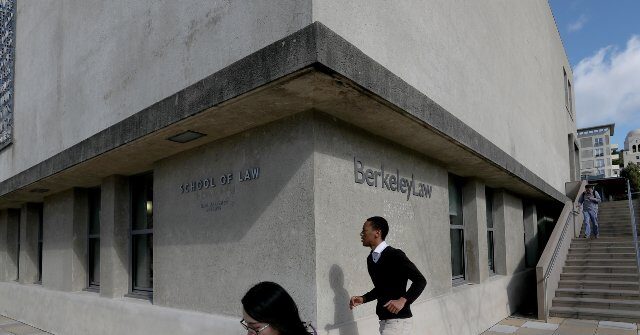
One in three students at the UC Berkeley School of Law are reportedly claiming to be disabled as “emotional disorders” skyrocket in general at the school. Critics say the students are gaming the system to gain an advantage in class.
A staggering amount of students at the elite law school are insisting that they have a “psychological” problem or other mental disabilities, according to university data obtained by the New York Post. These assertions have led critics to accuse the law students of trying to game the system to obtain an unfair advantage in school.
About one third of students (378 pupils) enrolled at UC Berkeley School of Law are in the school’s “Disabled Students’ Program,” according to the data, which makes for a massive change from five years who, when only three percent of Berkeley’s graduate students claimed to have a disability.
Moreover, the number of students in the school’s disability program has reportedly gone up university-wide, increasing from 4,153 in 2020 to 5,711 last year.
UC Berkeley has also described itself as “one of the first campuses in the U.S. to begin accommodating students with disabilities.” Zooming in on the disability types reveals that few are physical, with most being in the categories of psychological or emotional disorders, as well as ADHD.
“At Berkeley Law, there are more disabled law students than there are male law students,” Andrew Testerman, a graduate of the law school, wrote in an op-ed for the higher-education think tank James G. Martin Center for Academic Renewal.
“We are asked to believe that students at elite law schools are significantly more likely to be disabled than our nation’s senior citizens,” Testerman pointed out, adding that he believes these numbers are a sham, and that disability status is used by students to gain unfair advantages.
“Are Berkeley Law students likely to be disabled in such high numbers?” he asked. “The answer, almost certainly, is ‘no.’”
Testerman also revealed that while he was at UC Berkeley, he noticed that some students “had disability accommodations, which afforded them either one-and-a-half or double” the amount of time than others to compete exams. “They’d have four-and-a-half to six hours to complete a three-hour exam,” he explained.
Demand for proctoring accommodations for students with disabilities has skyrocketed from less than 4,000 in 2021 to 2022, to more than 14,000 in 2024 to 2025, university data shows.
“I have heard from many people that this is the way that rich people scam the system to help their kids,” a computer science professor at a West Coast state school who asked to remain anonymous told New York Post.
Meanwhile, George Leef of James G. Martin Center for Academic Renewal told the outlet, “This is even more absurd when you realize that most students in law schools come from successful families and have done well throughout their years of education.”
“Apparently, the world of ‘social justice’ means that we can’t have fair exams,” Leef added.
High school students also appear to have caught on to the “scam,” as the number of high schoolers getting extra time on college-entrance exams has reportedly more than tripled in the last ten years.
Alana Mastrangelo is a reporter for Breitbart News. You can follow her on Facebook and X at @ARmastrangelo, and on Instagram.
Read the full article here


