




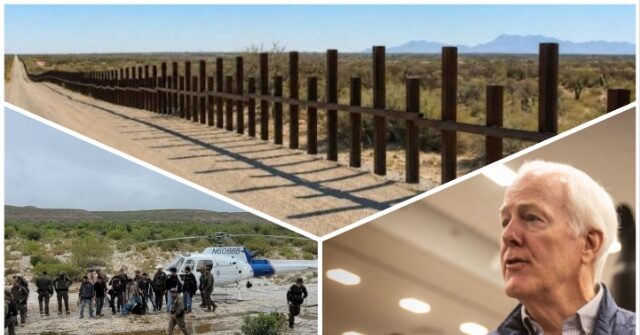
Senator John Cornyn (R-TX) added his voice to local politicians and Democrat State Representative James Talarico (D-Austin), nominee in the 2026 U.S. Senate election in Texas, in opposing border security enhancements in the Big Bend National Park.
In a letter addressed to DHS Secretary Markwayne Mullin dated August 7, Cornyn echoed constituents’ belief that dangerous terrain in the region acts as a “natural barrier that limits large-scale movements.” In the letter, Cornyn urges Secretary Mullin to consider meeting with stakeholders to reconsider proposed border security infrastructure projects in the region and pause construction until concerns have been addressed.
Cornyn’s intervention in the matter was met with quick praise by Democratic Senate candidate James Talarico. The aspiring Democrat Party Senate candidate quickly issued a statement on social media, saying, “I applaud Senator Cornyn for taking action on this corrupt Big Bend Border Wall. He and I agree: we need to secure our border by listening to local sheriffs and Border Patrol. But this monument to corruption represents wasteful, irresponsible government spending that no Texan asked for, enriching wealthy contractors without making Texans one bit safer.”
A group of illegal aliens arrested in Big Bend Border Patrol Sector. (U.S. Border Patrol)
In his letter, Cornyn noted a bipartisan group of Texas border sheriffs and county judges, private landowners, and the Big Bend Park advocates had raised significant concerns about the projects. In June, Texas Democrat Senate Candidate Talarico held a “Commonsense Border Security” press event in Sanderson, Texas, as part of a “Frontera Tour” that included stops along the border in other cities in the Lone Star State.
At the conference, Talarico was flanked by several mostly Democrat local and state politicians. These included several sheriffs from Texas border counties. Among those was Terrell County Sheriff Thaddeus Cleveland, a Republican, who has openly spoken out against the CBP projects in the region, citing the value of the terrain, which serves as a natural deterrent. Cleveland, a former U.S. Border Patrol agent, has instead advocated for technology as a solution rather than border wall construction in the region.
Shortly after the June event, Talarico’s campaign wasted no time asserting the presence of Cleveland at Talarico’s event amounted to “bipartisan” support and endorsement of his border security plan in a social media post that read, “Republican border sheriff endorses James Talarico’s commonsense border security plan.”
According to CBP, the recent movement of construction equipment within the park confines is aimed at repairing roads that suffered storm damage and at conducting surveys. Some areas are being cleared of brush to support future phases of construction that do not include a 30-foot border wall within the national park.

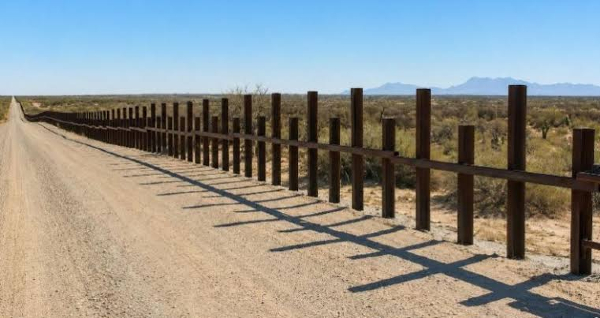
Vehicle barriers being proposed for Big Bend Sector. (U.S. Border Patrol)
According to CBP, the planned actions in the Brewster County region will include the construction of 17 miles of a vehicle barrier system, including a physical barrier and roadway. The barrier system will include steel posts and rails that block vehicles from moving away from the border.
The project will include the construction, improvement, and maintenance of approximately 205 miles of 24-foot-wide patrol roads to assist Border Patrol agents in patrolling the region’s remote terrain. In addition to vehicle barriers and patrol roads in the area, CBP will also install lighting, surveillance cameras, and underground fiber-optic cabling.
In a June media release, CBP acknowledged that the DHS Secretary used legal authority granted under the Illegal Immigration Reform and Immigrant Responsibility Act (IIRIRA) of 1996 to issue an environmental waiver for the project but committed DHS to responsible stewardship of natural and cultural resources within the project footprint.
According to CBP, the Big Bend Border Patrol Sector traditionally experiences fewer illegal border crossings than other sectors along the southwest border. At its peak, more than 11,800 arrests were recorded in the sector in 2023. Since October, the Border Patrol has arrested more than 1,500 illegal border crossers in the area.
The infrastructure projects in the region are funded by the One Big Beautiful Bill, which provided $46.5 billion to complete border infrastructure projects, including primary border wall and smart border wall technology.
Randy Clark is a 32-year veteran of the United States Border Patrol. Before his retirement, he served as the Division Chief for Law Enforcement Operations, directing operations for nine Border Patrol Stations within the Del Rio, Texas, Sector. Follow him on X (formerly Twitter) @RandyClarkBBTX.
Read the full article here


