








Romania’s Bucharest Court of Appeal has ordered Călin Georgescu into preventive detention for 30 days, overturning a lower court ruling that allowed the former presidential frontrunner to remain free under judicial supervision.
Călin Georgescu is the first political prisoner since the 1989 Revolution.
Let this be clear to everyone: today, the system is PSD–PNL–USR. All appointments to leadership positions within the prosecutors’ offices and the police are politically driven.
After reading the judge’s… pic.twitter.com/cRnsE5WAEf
— Remi 11 (@chiroban_r) September 29, 2026
The decision sends the figure at the center of Romania’s conservative, anti-globalist camp—and the most trusted politician in the country, according to some polls—back behind bars.
The move has further intensified accusations from his conservative Romanians that the country’s post-2024 establishment is using prosecutors and courts to contain a movement it has struggled, and even failed, to contain at the ballot box.
DIICOT prosecutors secured the reversal after challenging the Bucharest Tribunal’s refusal to imprison Georgescu while the €1.1 million fraud investigation proceeds. Businessman Ionel Rusen was also ordered into preventive detention, with the Court of Appeal’s ruling final.
Even the appellate panel was reportedly divided over whether detention was justified. Two judges disagreed, requiring a third to resolve the split in favor of incarceration—a detail Georgescu’s defenders have seized upon as evidence that the prosecution’s demand was hardly self-evident.
Georgescu’s lawyer, Mircea Sinescu, reacted with fury. “It is a hallucinatory solution!” he said, adding that “paper supports anything,” according to the Romanian account of the ruling. Pasted markdown
The contrast with last week could scarcely be sharper. Bucharest Tribunal Judge Vlad Andriescu had rejected preventive detention and instead placed Georgescu and Rusen under judicial control for 60 days while prosecutors continued their investigation.
More damaging politically for DIICOT, the lower-court reasoning reportedly questioned whether prosecutors had concretely established the precise role each defendant allegedly played in the supposed fraud. The judge called for investigators to clarify how the alleged deception was actually carried out rather than relying on a broadly asserted criminal association.
That earlier ruling did not amount to exoneration. The judge restricted Georgescu and Rusen from leaving Romania after considering intercepted conversations concerning a possible move to Tuscany, but concluded that imprisonment was not then necessary.
When Georgescu emerged from court after that decision, supporters greeted him with chants of “Freedom!”, “Călin, we love you!” and demands for the cancelled presidential runoff to be restored. Georgescu told the crowd that he was innocent and described the cases against him as “politically motivated.”
He also attacked what he called Romania’s “neo-Marxist and neo-Phanariot system,” casting his confrontation with prosecutors as something larger than one criminal file. That language reflects a conservative, sovereigntist movement that increasingly views Romania’s political, judicial and security establishment as a single entrenched structure defending the country’s existing order, which is said to take its orders from Brussels and Paris.
DIICOT, an institution that has a storied history of deep corruption, rejects that political interpretation and says it is pursuing an ordinary organized-crime and fraud case. Prosecutors allege Georgescu and two other men deceived businessman Răzvan Leu into providing roughly €1.1 million after promising access to a €15 million foreign credit facility that allegedly never materialized.
Those allegations remain unproven, and preventive detention is not a criminal conviction. Georgescu denies wrongdoing, meaning prosecutors will ultimately have to demonstrate both that the alleged scheme existed as described and that he knowingly played the role attributed to him.
The age of the underlying allegations has nevertheless become another rallying point for his supporters. The purported financial activity dates back to 2021, while the complaint moved into the DIICOT investigation in 2024, prompting Georgescu’s camp to ask why an old financial dispute has produced such an aggressive response only after he became Romania’s most prominent anti-establishment figure.
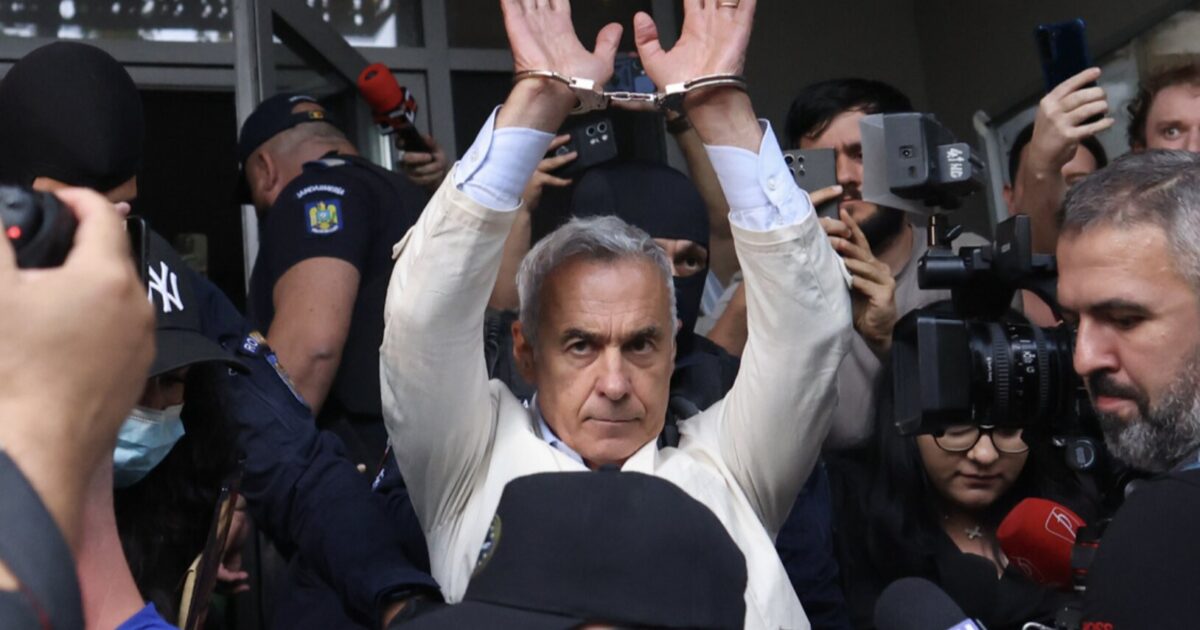
That perception hardened after the September 21 operation at his home. Georgescu was stopped in traffic, taken to his Mogoșoaia residence during searches lasting nearly nine hours, brought to DIICOT headquarters and later led outside in handcuffs before assembled cameras and supporters.
According to the reporting supplied, one of Georgescu’s sons was with him when officers stopped him, while his wife and younger child were at home when masked units arrived.
Five addresses were searched across Bucharest and nearby localities, turning the investigation into the kind of heavily visual police operation that was always likely to acquire political meaning.
Romanian Regime Arrests Presidential Election Winner — Raid Drags Georgescu to Jail in Front of His Son After Annulled Election
For AUR and Georgescu’s supporters, however, the image that endured was simpler: the winner of the first round of Romania’s 2024 presidential election being paraded in handcuffs less than two years after the state cancelled the election he had unexpectedly led. That sequence has become the emotional center of a much broader revolt against what conservatives routinely describe as Romania’s globalist regime.
The Constitutional Court annulled that election after intelligence services alleged, without providing any evidence, Russian-linked online interference, campaign irregularities and manipulation favoring Georgescu. To this day they have failed to provide evidence supporting their extraordinary claim, which effectively ended Romanian democracy. US Vice President JD Vance, Elon Musk, and US State Department have all slammed the decision to annul the presidential election and effectively suspend democracy.
Following Georgescu’s earlier detention, the AUR leader George Simion warned, “Any of us could be next. Stop the abuses! Romania is a dictatorship!” — a political accusation that captures AUR’s interpretation of the crackdown, rather than an independent legal description of the Romanian state.
The scale of AUR’s support gives that rhetoric considerably more weight than it would have carried several years ago. INSCOP’s September survey placed AUR at 39.7% among respondents expressing a party preference and 40.2% among those expressing a preference who also said they were certain to vote.
PSD stood at 18.7%, PNL at 16.3% and USR at 9% among respondents expressing a party choice, leaving AUR with roughly twice the support of its nearest rival in that survey. The poll interviewed 1,100 adults between September 1 and 7 and reported a maximum sampling error of ±3 percentage points.
Those figures do not prove AUR’s allegations about the courts or prosecutors, but they expose the danger for Romania’s establishment of treating the sovereigntist challenge as a marginal phenomenon. When a movement polling around 40% watches one of its defining political figures repeatedly investigated, searched, handcuffed and detained, every prosecutorial decision inevitably becomes part of the country’s larger struggle over state legitimacy.
The Romanian state now faces a credibility test considerably larger than Georgescu’s next 30 days in detention. Prosecutors must show that the fraud case rests on evidence strong enough to withstand scrutiny, while institutions already damaged by the extraordinary 2024 annulment must convince millions of distrustful voters that the state is enforcing law rather than protecting an embattled political order from the sovereigntist movement now dominating the polls.
Ad block users: Some site features may not work correctly while an ad blocker is enabled, because they break scripts and content this website depends on. If you can’t see comments below, for example, please disable your ad blocker.
Read the full article here


