




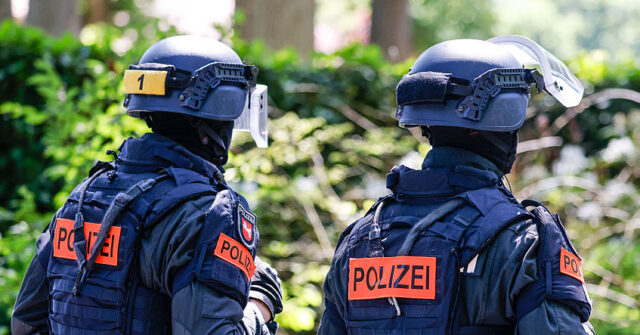
Germany’s Federal Prosecutors office is investigating a suspect after a weapons cache, which reports state law enforcement insiders say they believe may be linked to Russian intelligence, was discovered near Berlin.
Understood to have been found in November 2025 after police received a tip-off, the “professionally constructed” hiding place containing two handguns and ammunition was discovered at a warehouse in a wooded area on the outskirts of Berlin near the state border with Brandenburg, Tagesschau reports.
Once the weapons were discovered, the security services sabotaged the handguns or replaced them with duds to render them useless, then placed them back into the cache to appear undisturbed, with a hidden GPS tracker. The building was then placed under surveillance, in the hope that the intended recipient would come and collect them under police supervision. Yet months later, the cache has not been accessed, leading to a belief that the “conspicuous police operation” at the warehouse when the weapons were first found was noticed, leading to the ‘dead letter drop’ location being abandoned by whatever intelligence agency or terror cell was using it.
German newspaper Die Welt states Federal Interior Minister Alexander Dobrindt spoke out on the discovery on Friday and said it was the assumption of the government that an attack was being planned and that a foreign power was responsible. He said: “These weapons and the ammunition that have been found were certainly intended for carrying out planned attacks… This case demonstrates that we are operating under the assumption of a high threat level”.
A suspect linked to the weapon drop by the German state is presently in custody in Romania. Welt reports he may be one of two Ukrainian citizens hailing from a Russian-occupied part of that country who were held in connection with sabotage of Ukrainian-owned businesses inside the European Union, allegedly at the behest of Russian intelligence.
The use of weapons caches in Europe is a tactic that harks back to identical moves during the Cold War, when Moscow hid away explosives for the use of saboteurs recruited from among the ranks of sympathisers in the West. Should war come, these cells would act quickly to blow up bridges and railways to frustrate NATO’s attempts to mobilise quickly to see off the Soviets.
The threat was considered so serious at the time that intelligence agencies like MI5 in Britain had whole lists of suspected would-be saboteurs to quickly arrest should it seem probable that war was on the verge of breaking out, in order to prevent them from striking. As previously reported:
…that saboteurs from hard-left groups are expected to suddenly mobilise during the transition phase to reduce the British capacity to contribute to a conflict has been known to British military and intelligence planners for many decades.
Indeed, during the Cold War a major role for Britain’s internal intelligence service, commonly known as MI5, was compiling lists on both open and cryptic left-wing extremists so they could be immediately rounded up and placed under guard to prevent sabotage of Britain’s Royal Air Force and the infrastructure underpinning the ability to use it, right the way down to causing major traffic jams to prevent service personnel being recalled to their bases in an emergency.
According to declassified documents from the Cold War era, during the transition to war phase MI5 would enter “organisation-smashing mode” and some 3,000 known individuals would be swept up and placed under arrest in requisitioned holiday camps in Wales and the Isle of Man, as opponents to the Second World War had been in 1939.
It has been previously revealed that: “an MI5 file has been declassified which reveals just how sizable and elaborate the World War III internment plans became… a substantial round-up and detention of possible subversives and saboteurs who might become active during a transition to war”.
The sequestering of handguns rather than explosives, however, suggests a cache prepared for would-be assassins, not saboteurs, with German intelligence reportedly considering this a likely scenario. There has already been a rash of assassinations across Europe of individuals associated with the Ukraine War on both sides, and the bosses of armaments factories in European nations, and the exiled leaders of Russian opposition political parties are both considered particularly at risk.
It was reported just this week that the head of a German defence firm supplying Ukraine with drones has been in hiding under police protection for months over a plot by Russian intelligence against him. An earlier plot, which reportedly was very advanced, was detected before it could kill the head of Germany’s largest armaments company, Rheinmetall, leading to the industrialist being described as the “best protected figure in Germany’s economy”.
The handgun cache is just the latest in a series of caches to be discovered in Europe. While some date back to supplies intended for saboteur groups in the Cold War or even the Second World War, others are more recent, including buried hand grenades and explosives found in a German state in 2024 and a cache of firearms found in Vienna, Austria, in 2025 that was believed to have been hidden by Hamas for use by a terrorist cell.
Read the full article here


