

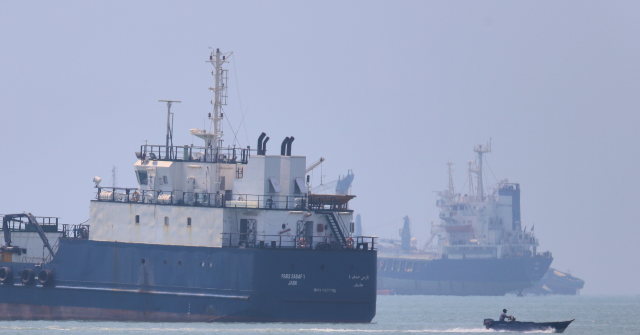
President Donald Trump is reportedly preparing for what could become a prolonged military campaign against Iran over the Strait of Hormuz, with the White House weighing additional military options as Tehran continues threatening commercial shipping through the strategic waterway, according to reports Thursday.
The latest deliberations come after two consecutive nights of U.S. strikes against Iranian military targets following Trump’s declaration Wednesday that the U.S.-brokered ceasefire and memorandum of understanding with Tehran were “over” after Iran attacked commercial vessels transiting the Strait of Hormuz. Speaking aboard Air Force One Wednesday night while returning from the NATO summit in Ankara, Trump said Iran wanted to negotiate but questioned whether the regime could be trusted to honor any future agreement, while warning the United States would continue responding forcefully to additional attacks.
Axios reported Thursday that the administration is preparing for a confrontation that could last anywhere from a day or two to a week or even a month, depending on whether Iran continues attacking commercial shipping. The New York Post separately reported Trump remains committed to pursuing diplomacy if possible but is prepared to expand military operations should Tehran continue escalating the conflict.
A U.S. official told Axios the administration believes the duration of the campaign will depend almost entirely on Tehran’s next moves in the Strait of Hormuz.
“We’re going to slap them a bit so they understand we’re not f***ing around,” the official said, adding that Washington is prepared to remain patient while determining whether Tehran intends to return to negotiations or continue attacking commercial shipping.
The New York Post, citing multiple sources familiar with internal discussions, reported that some administration officials have privately referred to the latest military campaign as a “bitch slap” to Iran, while White House and Pentagon officials stressed the phrase is colloquial shorthand used by some advisers rather than the operation’s official name.
The outlet also reported Trump still hopes the conflict can ultimately be resolved through diplomacy if Iran halts its attacks, but officials said he is prepared to authorize additional military action if Tehran continues targeting commercial shipping. Among the options under consideration are a renewed U.S. naval blockade and other military measures should Tehran continue escalating the conflict.
Israel’s Channel 12 separately reported there is currently little appetite in Washington for direct Israeli involvement in the latest round of fighting, although coordination between the Israel Defense Forces and U.S. Central Command remains ongoing as both militaries monitor developments.
Speaking aboard Air Force One Wednesday night, Trump said Iran had “called a little while ago” because it “want[s] to make a deal so badly,” but added, “I just don’t know if they’re worthy of making a deal. I don’t know if they’re going to honor the deal.”
Asked why Iran would attack commercial vessels while simultaneously seeking negotiations, Trump said the regime was “sort of crazy” and “a little bit out of control,” while maintaining Tehran still wanted an agreement.
The president also defended the latest military operation, arguing the United States had already achieved its principal military objectives while warning Iran against carrying out additional attacks.
“We’ve already won militarily,” Trump said. “We just hit them very hard. Every time they hit us, we’re going to hit them twenty-fold.”
Trump also wrote Wednesday on Truth Social that the latest strikes were carried out “in retribution for yesterday’s bombing of ships by Iran,” warning that “if it happens again, it will get much worse!”
U.S. Central Command said Wednesday that American forces struck approximately 90 Iranian military targets during the latest operation, including air defense systems, coastal surveillance assets, missile and drone storage sites, naval capabilities, and logistics infrastructure used to threaten maritime traffic through the Strait of Hormuz.
CENTCOM said the operation followed Tuesday night’s strikes against roughly 80 Iranian military targets after Iran attacked three commercial vessels transiting the strategic waterway, bringing the total number of targets struck over two days to more than 170.
Vice President JD Vance said Wednesday that the administration’s position remains unchanged: the Strait of Hormuz must remain open to international shipping.
“If they try to close it down, there’s going to be a response from the American military,” Vance said. “They can either follow it, or they can have exactly what happened to them last night. It’s just going to keep on happening until they open up that lane and stop shooting at ships.”
Iranian officials responded with renewed threats following the latest U.S. operations.
Parliament Speaker Mohammad Bagher Ghalibaf warned, “If you strike, you’ll get hit,” while insisting the Strait of Hormuz would reopen only under “Iranian arrangements,” not “American threats.” Foreign Minister Abbas Araghchi said Iran would “not answer vulgarity with vulgarity, but with action,” while Deputy Foreign Minister Kazem Gharibabadi warned the latest U.S. strikes “will not go unanswered.”
U.S. officials told Axios the administration believes the duration of the current campaign will depend largely on Tehran’s next moves and is prepared to continue military operations for days or even weeks should Iran continue attacking commercial shipping through the Strait of Hormuz.
Joshua Klein is a reporter for Breitbart News. Email him at [email protected]. Follow him on Twitter @JoshuaKlein.
Read the full article here