








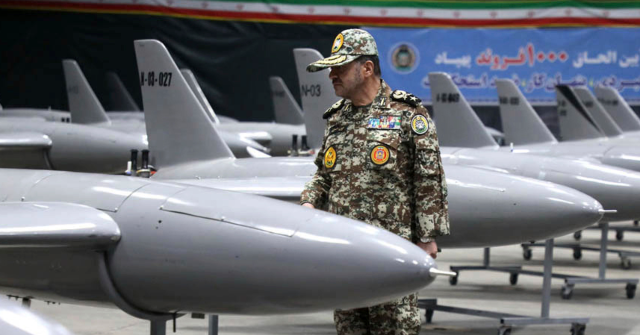
Defense analysts and security officials told The National on Monday that Iran is “relying on Chinese and Russian-made guidance chips” to improve the accuracy of its drone and missile attacks.
“Key to the advance is special computer chips designed for sophisticated navigation systems placed in Iran’s Shahed drones and its ballistic missiles,” the report said.
These chips allow Iran’s drones and ballistic missiles to employ Controlled Reception Pattern Antenna (CRPA) communications, which protect the attack vehicle from electronic jamming.
CRPA is an antenna system that skips rapidly between different frequencies and signal sources to defeat jamming attempts. Combined with refinements to the navigational software of a drone or missile, CRPA antennas help remotely-guided vehicles to operate in dense electronic warfare environments that would be overwhelming for less sophisticated communications systems.
CRPA only works if the remote vehicle has been equipped with very sophisticated electronics to handle inputs from multiple onboard antennas and external transmitters, adjusting on the fly to spoofing and jamming attacks.
According to The National’s report, the Iranians acquired such chips recently from its patrons in Russia and China and rapidly began upgrading its weapons, which allowed them to perform much better than the missiles and drones Iran launched at Israel in 2024. It also seems likely that Iran enjoyed targeting assistance from Russian satellites and ground stations this time around.
“CRPA allows drones and missiles to filter out jamming signals and lock onto genuine satellite data. That means they can stay on target even in heavily defended airspace. It’s a capability that, until recently, was largely confined to more advanced military powers,” a Western official told The National.
Other analysts pointed to Iran’s lucrative exchange of drone technology with Russia, during which Iran initially supplied Russia with huge numbers of its inexpensive Shahed kamikaze drones to overcome Ukraine’s advantage in drone warfare. The Russians later began building their own versions of the Shahed, with technological improvements, and sent some of the knockoffs back to Iran.
Durham University astrophysics professor Bleddyn Bowen noted that China may also be supplying Iran with access to the BeiDou Navigation Satellite System (BDS), China’s version of the Global Positioning System (GPS). China’s version of GPS is much more accurate than Russia’s, which is known as Glonass.
Bowen said improved Russian and Chinese satellite surveillance systems could also be helping Iran with battle damage assessment (BDA) which has previously been very difficult for Iran to conduct on foreign soil. Better BDA would help Iran refine the accuracy of its weapons and determine if follow-up strikes were needed to neutralize targets.
Iran launched over 4,550 Shahed drones at U.S. bases and infrastructure targets in neighboring Gulf states during Operation Epic Fury, with a far higher success rate than earlier drone wave attacks.
In one especially disturbing attack, Iran was able to precisely target American surveillance and refueling aircraft on the ground at Prince Sultan Air Base in Saudi Arabia with a swarm of some 30 Shahed drones and six ballistic missiles.
On Saturday, NBC News quoted “three U.S. officials, two congressional aides, and another person familiar with the damage” who said the damage to U.S. military bases in the Middle East from Iran’s attacks was “far worse than publicly acknowledged, and is expected to cost billions of dollars to repair.”
According to the NBC report, Iran was able to hit dozens of storage facilities, command centers, aircraft hangers, satellite stations, runways, and radar systems in seven different countries. In one particularly troubling instance, an aging Iranian F-5 fighter jet was able to get past layered U.S. air defenses, including Patriot missiles, to conduct a low-altitude bombing run against Camp Buehring in Kuwait.
If the NBC report is accurate, the unexpectedly heavy battle damage could be a consequence of Iranian drones and missiles becoming far more accurate than they were in 2024, and performing much better against electronic warfare screens.
Read the full article here


