







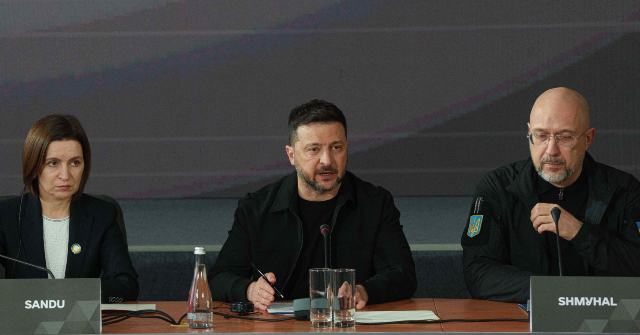
Ukrainian President Volodymyr Zelensky on Sunday accused Russia of practicing “nuclear terrorism” with its “reckless attacks” on Chernobyl, site of history’s worst nuclear disaster on April 26, 1986.
“Forty years ago, the world faced one of the largest nuclear disasters — the fourth reactor of the Chernobyl nuclear power plant exploded. A significant amount of radioactive substances was released. Hundreds of thousands of people have been dealing with the consequences of that tragedy for years,” Zelensky noted in his post on Telegram.
The Ukrainian president noted that Chernobyl is still dangerous. The radiation from the 1986 incident is contained within a massive metal and concrete “sarcophagus” which was covered with a larger second structure known as the New Safe Confinement (NSC) after it was deemed too dangerous to repair flaws in the original sarcophagus.
The sarcophagus contains almost 250 tons of radioactive material, which collectively emit radiation that is over 20 times as high as the dose considered lethal to human beings. According to various estimates, the area contained within the safety structure will remain dangerously radioactive for centuries, perhaps millennia.
Zelensky said on Sunday that the “maintenance and protection” of the Chernobyl safety structures “are in everyone’s interests.”
“But with its war, Russia is once again putting the world on the brink of a man-made accident: Russian-Iranian ‘shaheds’ constantly fly over the station, and one of them hit the confinement last year,” he said.
Shaheds are Iran’s cheap but effective kamikaze drones, which Russia acquired in huge quantities to offset Ukraine’s early advantage in drones when Russia invaded in 2022. Russia later began manufacturing its own kamikaze drones based on the Iranian design.
On February 14, 2025, Ukrainian officials say a Russian kamikaze drone struck the outer layer of the Chernobyl containment structure, starting a fire on the exterior of the NSC. The impact caused minor damage to an area of the NSC that had a low contamination rating, and no rise in radiation levels outside the NSC was detected after the incident.
The February 2025 attack nevertheless alarmed the international community, which feared a stronger attack could either inadvertently, or deliberately, penetrate the NSC and cause a dangerous release of radiation. The International Atomic Energy Agency (IAEA) warned that even the minor damage from the drone strike could shorten the effective lifespan of the NSC, which was supposed to last for at least a hundred years.
In October 2025, Zelensky accused Russia of deliberately attempting to cause an incident at Chernobyl by attacking the electrical infrastructure around the site. This caused power fluctuations within the containment system, which relies on outside power to function.
The Kremlin at first denied the report of a drone strike on Chernobyl, dismissing it as a “fabrication,” and later suggested the Ukrainians attacked the Chernobyl dome themselves. The Russians have also accused Ukraine of launching drone strikes against operational Russian nuclear power plants.
“The world must not allow this nuclear terrorism to continue, and the best way is to force Russia to stop its insane attacks,” Zelensky wrote on Sunday.
“We remember everyone who gave their lives eliminating the consequences of this tragedy. A bright memory to all the victims of the Chernobyl disaster,” he concluded.
IAEA Director-General Rafael Grossi was in Kyiv on Sunday for the 40th anniversary of the Chernobyl incident. He met with Zelensky to discuss the safety situation at the Zaporizhzhia Nuclear Power Plant (ZNPP) located on Ukrainian soil that is currently occupied by Russian forces.
Zelensky told Grossi that ZNPP “must be returned to the management of Ukraine’s licensed operator and nuclear regulator” to ensure its safety.
On Monday, an employee of the ZNPP was killed by a drone strike, which Russian occupying forces blamed on the Ukrainian military. The IAEA said it had been informed of the incident, and Grossi stressed that “strikes on or near NPPs can endanger nuclear safety and must not take place.”
Read the full article here


