







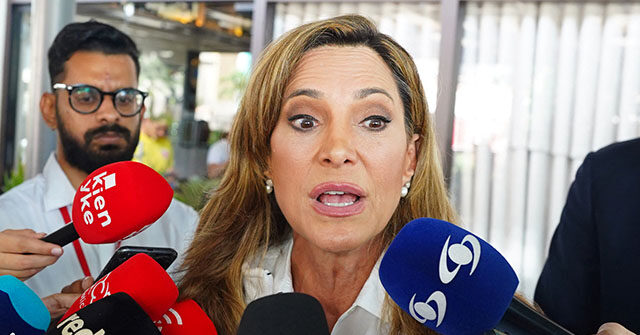
Florida Republican Rep. Maria Salazar is lobbying the Pope to back her cheap-labor “Dignidad” bill that would create a two-tier society of citizens and low-wage migrant workers.
Using Spanish, she touted the public meeting on her X account and provided a translation of her Spanish-language description of the conversation:
Today, from the Vatican, I had the immense honor of conversing with His Holiness Pope Leo XIV about one of the great challenges of our country: immigration. And I placed in his hands the DIGNITY Act.
More than four out of every ten Catholics in the United States are immigrants or children of immigrants. The families we talk about in Washington are the same families who sit next to us in the pews of our churches.
The United States can protect its borders without closing its heart. From Miami, to Congress, to the Vatican, and I will continue knocking on every door until our country finally finds a migration solution.

There is no evidence that the Pope supports her investor-backed, two-tier bill, and much evidence that he opposes the U.S. economic policy of extracting migrants from poor countries to serve as second-class renters, consumers, and workers.
Migration “gives rise to a twofold demand for social justice: to offer safe and legal pathways, a respectful welcome and real opportunities for integration; and, at the same time, to promote the right to remain in one’s own land,” Leo told the Spanish parliament on June 8.
Governments should welcome migrants but also “ensure that no one has to leave their home due to a lack of peace, security or decent living conditions, including economic inequalities,” Leo added, without describing how the two contradictory goals might be reconciled.
Salazar’s bill, however, is overwhelmingly focused on importing cheap labor to enable U.S. investors to profit from low-productivity businesses, housing inflation, and extra consumer sales.
The bill maximizes the cheap labor population by granting a subsidiary legal status to millions of poor illegal migrants, and it also opens up new pipelines of cheap labor to minimize wage growth for Americans.
“When people tell me that I am trying to help big business to have cheap labor, I’m going to answer them: It’s not [just] big business, it’s not only agricultural or construction or hospitality or health care or manufacturing — it’s more,” Salazar told a Capitol Hill press conference in April. She added:
Who else? The farmers, people in the dairy business. We all like milk, right? Well, there are 150,000 jobs available in agriculture right now … Manufacturers! I don’t know anyone in the manufacturing world, but I do know that the National Association of Manufacturers decided to do a public press conference to support [the] Dignidad [bill] … It’s agricultural, construction, hospitality [sectors].
The subsidiary-class workforce will supply cheaper products for Americans, Salazar said: “Americans want affordability, and they want affordable vegetables and fruits.”
But Salazar’s focus on cheap labor also discourages investors from diverting profits to buy the labor-saving technology that helps by raising Americans’ productivity, profits, wages, and trade.
For example, many companies are developing fruit-picking robots, but farmers are cautious and will continue to use migrant labor if the Dignidad bill raises the inflow of cheap labor.
WATCH:

Correspondingly, the defeat of Salazar’s bill will encourage investment in companies that are leasing laser-equipped robots that can kill weeds faster and cheaper than migrants carrying hoes.
WATCH:

The extraction migration policy is also intended to minimize risk for investors, many of whom are reluctant to invest their wealth in developing countries, such as El Salvador, Kenya, Indonesia, or Egypt.
The resulting decline in U.S. overseas investment encourages mass migration into Europe and the United States and leaves huge economies in Asia and Africa open for Chinese exports and investors.
Read the full article here


