






A spokeswoman for the Iranian regime warned on Monday supply problems and wartime damage to Iran’s refineries could cause fuel supply problems in northern Iran during the winter. On Tuesday, the Islamic dictatorship’s currency fell to a record low of 2.5 million rials to the U.S. dollar.
“We suffered damage due to the attacks on the energy sector. 230 million cubic meters were lost as a result of the attacks, and we are trying to restore 100 million cubic meters of that,” government spokeswoman Fatemeh Mohajerani said at her weekly press conference on Monday.
Mohajerani said governors of Iran’s northern provinces have already been warned about possible fuel shortages.
One of those local officials, Deputy Governor Seyed Medhi Mahiai of Golestan, said earlier on Monday that restrictions on gas purchases, and complete outages of supply, could last for up to 90 days. The Iranian National Gas Company quickly rejected his warning as an unofficial estimate.
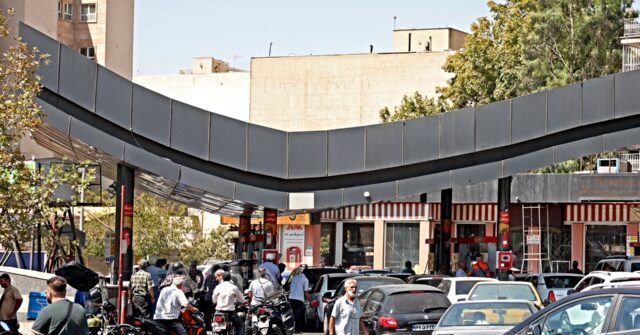
Gasoline shortages have already been reported by state media outlets in the capital city of Tehran, with gas stations shutting down and abandoning long lines of frustrated motorists.
Gas is still very cheap in Iran thanks to heavy government subsidies, but the prices have been raised by up to 100 percent by the government over the past month, putting a heavy burden on the low incomes of the average Iranian.
RELATED: Exclusive — Bessent on Further Iran Sanctions… ‘The Snake’s Dead But it Doesn’t Know Its Dead’

In early September, taxi drivers in eastern Iran went on strike to protest cuts to their fuel rations, combined with shortages and long lines that force cab drivers to waste valuable time sitting in gas lines. Other drivers have staged street protests large enough to block city intersections.
Last week, the regime reduced mandatory office attendance hours for the rest of the Iranian calendar year, which ends in March 2027, and required government employees at every level to use public transportation to reach their offices at least one day per week. Fares have been waived on some public transportation systems, to encourage more passengers to use them.
Iranian parliamentarian Jafar Ghaderi said last week that Iran is now coming up 15 to 20 million liters short of its gasoline needs every day, as some 83 percent of its imports of refined fuel have been cut off by the U.S. blockade.
The Independent Persian, a media partner of the UK Independent, reported that Iranians are beginning to complain about damage to their vehicles from low-quality fuels foisted on them by filling stations. Some cars have broken down completely after being filled with diluted fuel.
On Tuesday, the value of the Iranian rial fell to 2.5 million against the U.S. dollar, well beneath its previous record lows of 2.2 million at the beginning of September and 2.02 million in August.
“Operation Economic Outcast has caused the rial to hit record lows. We will continue to degrade the Iranian regime’s ability to fund terrorism and develop a nuclear weapon,” Treasury Secretary Scott Bessent said on Monday.

The Associated Press (AP) noted the regime in Tehran is growing increasingly desperate under the pressure, alternately flailing between plots to recapture control of the Strait of Hormuz from the dominant U.S. navy, mumbled offers to return to the negotiating table, and even pleas to American voters to rescue the battered Iranian theocracy by voting against President Donald Trump’s party in the midterm elections:
Iran’s top diplomat said indirect negotiations with the United States aimed at reopening the critical Strait of Hormuz have become “more serious,” while the Iranian Revolutionary Guard Corps’ chief spokesman Gen. Hossein Mohebbi on Tuesday called on Americans to take to the streets and protest the conflict.
Foreign Minister Abbas Araghchi told Iranian media late on Monday that the “current focus is solely on the Strait of Hormuz,” the chokepoint of the war.
Araghchi made the comments shortly before departing New York — where he attended last week’s gathering of world leaders at the U.N. General Assembly — and after meeting with Pakistani and Qatari mediators.
U.S. Central Command (CENTCOM) said on Monday that Iran has lost nearly all of its leverage over the Strait of Hormuz, rejecting boasts about the strength of the Islamic Revolutionary Guard Corps (IRGC) “navy” as absurd.
“Iran has no navy because American forces sank it. And Iran does not control the Strait of Hormuz as evidenced by the thousands of ships that have passed through freely along with more than 1 billion barrels of oil just over the past few months,” CENTCOM said.
U.S. officials told the New York Post (NYP) on Monday that oil flows from the Middle East have returned to 72% of their prewar levels.
Non-Iranian traffic through the Strait of Hormuz under U.S. protection is up to about half of its prewar level, while Iranian oil flows stand at zero. Other Middle Eastern oil suppliers have successfully routed much of their output around the contested strait, which could permanently reduce its strategic importance.
“They are exhausted. There’s no doubt that they’re exhausted,” an American official said of the Iranians.
“They’re running out of supplies. They’re running out of water. They’re running out of feedstock. They’re running out of food. And the blockade is strangling them. It’s almost like we’re like an anaconda. And every time they let out a breath, we squeeze a little more,” the official said.
Read the full article here


