
Nigel Farage’s Reform UK party has vowed to implement the largest welfare reforms in a generation, which it says will save the British taxpayer an estimated £50 billion a year by ensuring that only UK citizens receive benefits and ending the culture of “something for nothing”.
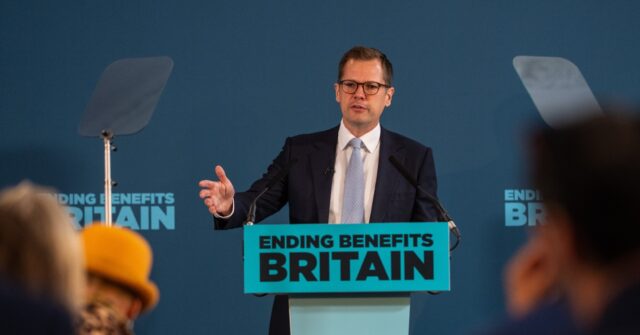
In his first major policy pronouncement since joining the party in January, Shadow Chancellor Robert Jenrick said that a Reform government would always protect people in genuine need, such as pensioners, children, the vulnerable, and armed forces veterans; it would also seek to “restore fairness” by reserving benefits for Britons only and cutting off those who leech off the state and take “advantage of their fellow citizens”.
“In towns and cities up and down the country, working people tell stories of those in their communities who are pulling a fast one, taking everyone else for fools. The family who enjoy regular holidays, nights out, have new cars on the drive – but who out of choice haven’t seen a day’s work for years. Sometimes decades. This is fundamentally unfair,” Jenrick remarked.
The Reform economics spokesman said that the party’s plan would save the taxpayer £51 billion ($69bn) per year, or £1,700 ($2,305) for every family in the country, and would incentivise 241,000 British nationals to return to work.
Principally, Jenrick said that Reform would end the “foreign welfare rip-off” by limiting welfare benefits to British citizens, with limited exceptions for those who served in the armed forces or had paid into state pension programmes. He said that in doing so, the government would save some £21 billion ($28.5bn) a year by 2029, or £700 ($950) per household.
This would also include European Union nationals with settled status in Britain who were grandfathered in during Brexit, likely meaning that a Reform government would likely have to renegotiate the terms of the withdrawal deal and potentially see British expats lose access to welfare benefits in EU countries.
“People are more than happy to support their neighbours in hard times, but the British taxpayer cannot afford to subsidise everyone on the planet, especially those who have not paid in,” Jenrick said.
However, the Shadow Chancellor said that the party would also target the domestic disability system, which he claimed is currently “consigning people who would otherwise be capable, to a life on welfare, wasting their potential. Heaping ever higher burdens upon those who do work.”
Jenrick said that Reform would look to introduce a new system, ‘Return to Work Cover’, based on a programme in the Netherlands that he said successfully cut disability claims by 40 per cent.
Under the plan, businesses with more than five employees would be required to purchase a new form of insurance to cover the costs of workers who could not work for extended periods. In turn, businesses would receive a commensurate reduction in National Insurance payments to offset the cost.
Jenrick said that this would mean that employees stay “connected” to their jobs, rather than being pushed into the disability system, while businesses would have a “strong economic incentive” to help them return to work. Meanwhile, a new single “rigorous” test to determine who cannot return to work will be put in place, with those in genuine need being eligible for Personal Independent Payments and Disability Support Accounts.
Finally, the Reform MP said that the party would introduce a “Welfare to Work” scheme, which would see the estimated 330,000 Universal Credit claimants required to provide 20 hours of public service per week.
“If people who are capable of working refuse to, they’ll get nothing. That’s fair,” Jenrick said. “How can it be that one family on a street, with working parents, strive and work hard, only to help fund the lifestyle of another who chooses to not bother with work at all?”
“Without these changes, the cost of the welfare system will keep spiralling. We will face a genuine national debt crisis. Those least able to bear it will pay the highest price,” he added. “Only Reform will do what it takes to avert this.”
The strategy comes as Reform boss Nigel Farage looks to forge a third way in British politics, rejecting welfarism on the one hand, while also being willing to use state intervention to protect British businesses. Mr Farage has said that the Labour Party no longer represents workers, but rather those on welfare.
Conversely, the so-called Conservative Party has accused Reform of having “socialist” policies for favouring nationalisation of firms like British Steel to protect native industry from predatory foreign powers like Communist China.
Follow Kurt Zindulka on X: Follow @KurtZindulka or e-mail to: [email protected]
Read the full article here