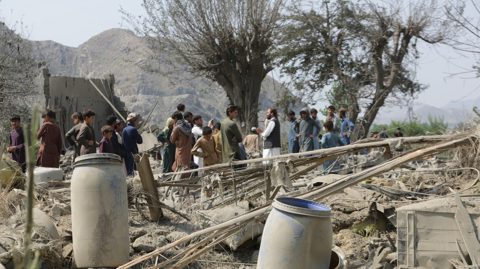


RT’s Charlotte Dubenskij reports from Taybeh, where residents face near-daily assaults, property damage, and incursions onto their land
A historic Palestinian village widely described as the last entirely Christian community in the occupied West Bank is facing near-daily Israeli settler attacks and growing restrictions, residents and activists have told RT.
RT’s Charlotte Dubenskij visited the Kaa’bneh family, part of a Palestinian Bedouin community living in Taybeh, east of Ramallah, where she witnessed settlers approaching with sheep and goats at sunset, hurling rocks, and trying to breach the fences. The family says such incursions can happen several times a day.
“They come and vandalize our property, cut through the fencing and bring their sheep onto our land,” Naif Kaa’bneh said. “They break the water tanks and cut off the electricity. If someone is filming, they beat them.”
Kaa’bneh said the harassment has continued for years but intensified recently, blaming Israeli military inaction for allowing settlers to act with near-total impunity. He said troops can take hours to respond to attacks and have never detained those responsible.
“They have never once come and arrested a settler. We tell them, ‘There’s the settler.’ The soldier just turns his head, pretends he hasn’t seen anything, and they leave,” he said.
The attacks come as Taybeh faces growing isolation. Historically known as Ephraim and mentioned in the Gospel of John as a place where Jesus stayed before his final journey to Jerusalem, the village has long drawn Christian pilgrims. But the Israeli military earlier this month declared parts of the area a closed military zone, claiming the measure is intended to curb settler attacks. Residents say it has instead restricted movement while failing to stop the violence, deterring pilgrims, and squeezing an economy heavily reliant on religious tourism.
Meanwhile, locals say new settler outposts are appearing on the hills around Taybeh, fueling fears that residents are being steadily hemmed in and pushed from land they have inhabited for generations.
Watch Charlotte Dubenskij’s full report below.
You can share this story on social media:
Read the full article here