







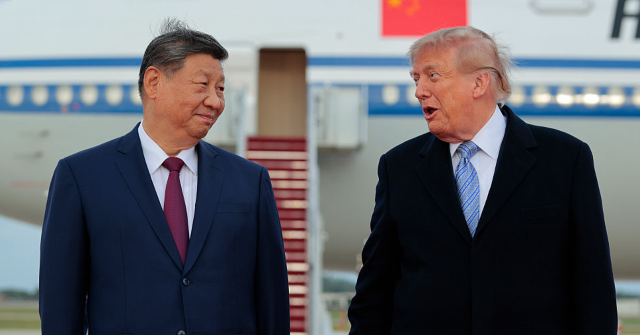
Americans tend to believe China’s President Xi Jinping enjoys a smooth ride as president but, as Peter Schweizer explains, that’s only because Xi puts his dissenters in jail.
“As he was stepping on the plane to come to the United States, Xi purged two top generals. And he purged them for ‘political unreliability,’” says Schweizer, who is author of three bestselling books about China. “These two generals were members of the Central Military Commission, which is the most important political body in all of China.”
On the most recent episode of The Drill Down, Schweizer and co-host Eric Eggers of the Government Accountability Institute explain that Xi’s position in China is not as solid as media critics of Trump like to portray.
“In the last two years, President Xi has purged six members” out of a total of eight from the same body, Schweizer adds. “They were arrested, imprisoned, and charged with capital crimes. The only two remaining are Xi himself, and the dude that he has investigating the other guys,” he says.
“That speaks to the overall level of instability within China,” says Eggers, “and also his ability to quell dissent in China that no one else who doesn’t live in a dictatorship can.”
“This guy is a hard-nosed S.O.B. People criticize Trump for his language, but Xi is enormously nasty when it comes to political opponents,” Schweizer says. “Over the last two years, more than forty-five Chinese generals or admirals… went missing,” Schweizer adds. “Their families don’t know where they are… This is not the sign of a guy who is stable and loved and in a strong position.”
The news draws historical parallels to Josef Stalin’s repeated purges, exiles, and executions of so-called “counterrevolutionaries” in the Soviet Union. The question for western political analysts and intelligence is whether there is real and growing resistance to Xi within China, or a new viral strain of Stalin’s infamous paranoia. That requires a look at how the Chinese economy is really doing behind the regime’s unfailingly rosy economic growth claims.
“The reality is largely hidden,” says Eggers.
“The Chinese economy is headed towards its lowest growth since 1991,” says Schweizer. “They’ve actually stopped reporting a lot of economic data because it’s so bad… This is things like business confidence, real estate transactions, etc.”
One key comparative measure we do know is that for the U.S., the total debt is about 125 percent of annual GDP. For China, the debt ratio is 300 percent of that country’s total output, Eggers explains.
All of this, Schweizer believes, is important to bear in mind when Trump and Xi meet this week in Washington and various political commentators try to handicap the positions of each country’s leader.
“The underlying dynamics and power positions of these two leaders is frankly the opposite of what a lot of the domestic media is telling you, either because they just don’t like Trump or because they are so ignorant of what is really happening in China today,” Schweizer explains.
And both hosts predict the coverage from the legacy media will remain that way. “ABC is owned by Disney, which has a lot of commercial activity in China,” Schweizer says. “You do something to tick off Xi, and he’s going to kick them out of the country.”
The topics of the summit will focus on Iran and AI, the hosts predict. As pressure is building on Trump within the tech community to make some kind of deal with China to slow down AI progress, Schweizer is blunt about the odds China would honor any such deal: “zero percent.”
He recalls what happened during COVID. “They signed a grant agreement with the NIH [National Institutes of Health] to give us all the research records. They violated that agreement.” He cites several other related agreements China violated.
“The bottom line is they are not going to abide by any AI agreement,” Schweizer says. “It’s designed to constrain us, not them.”
On the Iran situation, the hosts note that China imports 90 percent of its oil and, because of Trump’s moves in Venezuela and with Iran, China’s ability to import oil has been hobbled. The country is using up its own stockpiles and will soon have to buy at elevated prices, causing yet more damage to the Chinese economy.
For more from Peter Schweizer, subscribe to The DrillDown podcast.
Read the full article here


