






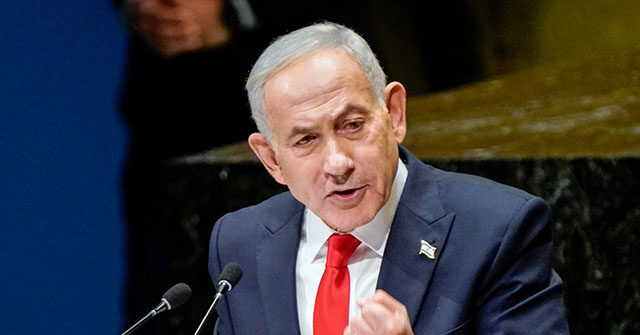
Israeli Prime Minister Benjamin Netanyahu predicted the fall of Iran’s “evil regime” in a fiery address to the United Nations on Thursday, declaring that the Iranian people will ultimately rise against their rulers as he vowed Israel will continue to prevail against enemies seeking its destruction.
“This evil regime will fall, and we will all celebrate that day,” Netanyahu told the U.N. General Assembly in New York.
Netanyahu delivered the prediction after holding up a Starlink satellite internet terminal from the podium, presenting it as a weapon against the Iranian regime’s efforts to censor its own people.
“This is a communications device, Starlink, that allows people to access truth, to exercise choice, to exercise freedom of thought and freedom of speech,” Netanyahu said.

He then turned the prop into a taunt aimed directly at Iran’s delegation.
“I’m going to leave this device with you so you can give it to the Iranian delegation,” Netanyahu told the presiding U.N. official. “So when they inevitably defect, they too can share their story.”
Iran’s delegation had already walked out as Netanyahu took the podium, leaving behind a photograph of slain Islamic Revolutionary Guard Corps Quds Force commander Qassem Soleimani, who was killed in a U.S. drone strike ordered by President Donald Trump in 2020.
Israel’s U.N. Ambassador Danny Danon responded with a jab of his own.
“It’s understandable why they left a photo of a former general,” Danon said. “Photos are about all they have left of their senior generals.”
Netanyahu said Iran’s rulers increasingly fear not Israel, but their own population.
“You know what they’re most afraid of? Their own people — the brave Iranian people who have sacrificed so much for so long,” he said.
Netanyahu pointed to the regime’s violent suppression of anti-government demonstrations earlier this year and challenged protesters outside the U.N. and delegates who abandoned the chamber over his appearance to explain their silence.
“Where were you when the Iranian tyrants butchered and maimed tens of thousands of unarmed Iranian civilians?” he asked.
Despite that silence, Netanyahu said, Iran’s rulers would ultimately be unable to suppress their own people.
“The power of the people will overcome the people in power,” he declared.
“I want you to listen to my words carefully,” Netanyahu continued. “One day — and it may not be far away — the Iranian people will be free. Their murderous regime will be toppled by its lies, by its corruption, by its cruelty. This evil regime will fall, and we will all celebrate that day.”
The prediction capped an address that began with Iran, as Netanyahu recalled standing at the same U.N. podium 14 years ago and famously drawing a red line across a diagram of a bomb to warn that Tehran could not be permitted to acquire nuclear weapons.
“I vowed to prevent Iran’s murderous dictatorship from developing atomic bombs,” Netanyahu said Thursday. “Nuclear weapons that could threaten the entire world. That’s exactly what I did.”
Netanyahu said carrying out the strikes that devastated Iran’s nuclear facilities was extraordinarily difficult militarily — but not as a matter of decision-making.
“Devastating Iran’s nuclear facilities was hard. It was very hard to do,” he said. “But for me, it was one of the easiest decisions I’ve ever had to make as prime minister. Because if we hadn’t done it, we’d all be dead.”
His remarks came moments after representatives from scores of countries either stayed away from the chamber or walked out as he prepared to speak. Israeli officials said 77 delegations were absent or joined the walkout.
“If there are any other moral cowards who haven’t yet left this hall, please do so now,” Netanyahu told them.
The prime minister then accused some of the same governments publicly condemning Israel of privately expressing gratitude for its campaign against Iran.
“In defending itself, Israel is also defending many of the countries whose delegates just left this hall,” he said.
“In fact, I want you to know that many of their leaders even thanked us privately for taking out Iran’s nukes,” Netanyahu added. “It’s hard to imagine more mind-blowing hypocrisy, but that’s exactly what it is.”
Netanyahu portrayed the campaign against Iran as part of a wider Israeli victory over the seven fronts that converged against the Jewish state following Hamas’s October 7, 2023, massacre.
“For three years, seven fronts — Hamas, Hezbollah, the Houthis, Iran, militias in Iraq, militias in Syria, Palestinian terrorists in Judea and Samaria — they all ganged up on us to wipe us off the face of the earth,” he said.
“They failed because instead of collapsing, we delivered crippling blows to all of them,” Netanyahu continued. “With our great American friends, we crushed Iran’s army, navy, air force and nuclear facilities.”
He also thanked Trump for his “bold leadership” and partnership against Iran, saying the two countries acted together against a regime whose leaders have repeatedly threatened both nations.
“Israel and America acted together — not only to protect ourselves, but to save civilization,” Netanyahu said.
The address came as the Trump administration is simultaneously applying extraordinary military and economic pressure on Tehran while testing whether that leverage can produce an agreement.
U.S. and Iranian negotiators in New York are discussing a possible phased arrangement that could begin with Iran reopening the Strait of Hormuz in exchange for Washington lifting its economic blockade, Reuters reported Thursday, citing Iranian, regional and Western sources familiar with the negotiations.
“One way forward would be to solve the crisis in stages,” a senior Iranian official told the outlet. “The first would be to end the blockade and reopen Hormuz.”
The talks follow a lengthy round of indirect negotiations Tuesday on the sidelines of the General Assembly, during which U.S. Special Envoy Steve Witkoff said mediators shuttled between the American and Iranian sides.
Trump subsequently said the talks “went very well” and described “a lot of momentum” toward an agreement, while making clear that Iran would not be permitted to acquire a nuclear weapon.
The diplomacy is unfolding under an increasingly punishing U.S. pressure campaign.
Treasury Secretary Scott Bessent said Wednesday that Washington is cutting off the regime’s “financial oxygen” through a combination of the U.S. blockade and what the administration calls Operation Economic Outcast, describing Iran’s rulers as “cornered animals” and predicting that “they’re going to yell uncle.”
That pressure intensified Thursday as Iranian airlines were barred from several neighboring countries under new U.S. sanctions targeting foreign companies that continue doing business with Tehran.
The military pressure has continued alongside the economic campaign. U.S. Central Command said Wednesday that American forces had redirected 115 commercial vessels as part of what it called the “steel wall blockade,” while CENTCOM commander Adm. Brad Cooper said over the weekend that more than 1 billion barrels of crude had passed safely through the Strait under U.S. protection since the operation began.
Iran, meanwhile, has continued threatening a wider conflict even as its representatives negotiate in New York.
Maj. Gen. Yahya Safavi, a former IRGC commander and current adviser to Iranian Supreme Leader Mojtaba Khamenei, warned Thursday that another U.S. or Israeli attack could expand the battlefield beyond the Persian Gulf and Red Sea toward the Indian Ocean.
Iran’s threats came one day after President Masoud Pezeshkian used his own U.N. address to declare that Tehran was prepared for diplomacy but would not “bend the knee” to American pressure.
Netanyahu offered a starkly different forecast less than 24 hours later.
Recalling his late brother Yoni Netanyahu’s words as a young paratrooper before the 1967 Six-Day War, the prime minister said Israel’s survival has always depended on its willingness to prevail when its enemies leave it no alternative.
“We’re going to win,” Netanyahu said. “We have no other choice.”
Joshua Klein is a reporter for Breitbart News. Email him at jklein@breitbart.com. Follow him on Twitter @JoshuaKlein.
Read the full article here


