




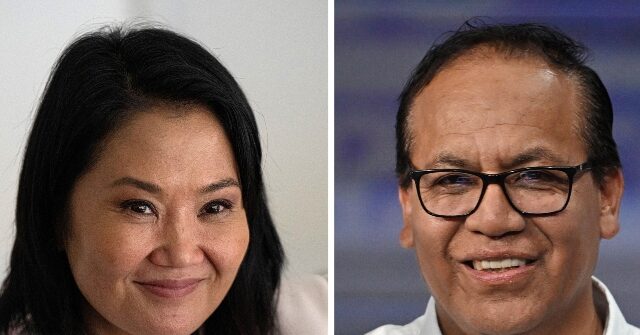
Preliminary results from Peru’s National Electoral Processes Office (ONPE) indicate that conservative former first lady Keiko Fujimori maintains a narrow lead against radical leftist candidate Roberto Helbert Sánchez Palomino in Sunday’s razor-thin presidential runoff election.
Sunday saw millions of Peruvians head to the polls to choose between Fujimori and Sánchez Palomino as the next president of Peru — a country that has experienced back-to-back political crises resulting in nine different presidents in about ten years.
The runoff election also follows an extremely convoluted first round held in April that featured 35 different candidates on the ballot. The April election was marred by logistical complications and a notoriously slow vote counting process that saw authorities take roughly a month to formally declare Fujimori and Sánchez Palomino the two candidates of Sunday’s runoff.
At press time, the results remain uncertain, with a roughly 30,000 vote difference between Fujimori, representing the conservative Popular Force party, and Sánchez Palomino of the far-left Together for Peru coalition. The latest publicly available results published by ONPE indicate that, with 93 percent of votes counted as of Monday, June 8, at 8:38 a.m. (local time), Fujimori has 50.085 percent of the votes while Sánchez Palomino has 49.915 percent.
Omar Awapara, secretary-general of the non-governmental organization Transparencia, affirmed to the outlet RPP on Sunday night that the race remains in a “statistical tie” — noting that, while a report issued by Transparencia alongside the polling firm Ipsos showed that Sánchez Palomino allegedly received 50.3 percent of the votes, an Ipsos exit poll indicated that Fujimori would end up receiving 50.7 percent.
“Technically, we’re talking about a tie. Mathematically, the results for both candidates are indistinguishable, just as the exit poll, which used a different methodology, also had a margin of error at the time,” Awapara said.
Speaking to her followers on Sunday night, Fujimori referred to Transparencia and Ipsos’s projections and said that it would be a “long wait” until the winner of the election is known, given the “technical tie” between her and her rival.
Fujimori urged her supporters to remain vigilant while the vote count is underway and assured them that she would accept the result once the official tally is complete. She also stressed the role that Popular Force representatives will carry out in the coming days to observe the vote count process.
“It would be irresponsible to determine the result based on a sample such as the quick count, which uses approximately 1,000 of the 90,000 ballots nationwide,” Fujimori stressed, per RPP.
Sánchez Palomino also addressed his followers shortly after Transparencia published its report. Speaking at Lima’s San Martin Square, he called upon his followers to “defend” his votes and electoral transparency.
He reportedly said:
Today, the exit polls show a significant lead that reaffirms the will of the people, who want democracy and justice; however, as is only right, this is the time to safeguard the vote and ensure electoral transparency, so that when the final election results are announced in the coming days, the electoral results can be officially declared.
According to local outlets Sunday’s runoff election, while extremely close and still uncertain as of Monday morning, did not experience the same logistical issues that plagued April’s first round, outside of isolated incidents. The Peruvian news outlet El Comercio observed that ONPE successfully deployed all electoral material in a timely and orderly manner, allowing for all voting centers to open their doors on time.
The end of ONPE’s vote count process, however, does not mark the end of Sunday’s runoff election process. While ONPE is the institution tasked with organizing elections in Peru, all vote technicalities and election-related disputes are handled by the National Election Jury (JNE). The Argentine outlet Infobae explained that, once ONPE finalizes counting 100 percent of the votes, Special Election Officials (JEE) will review the results and tallies before JNE issues a final proclamation and declares a winner. Based on the deadlines and timetables established by Peruvian electoral law, the entire process must finish no latter than July 28, 2026, the day when the winner of the runoff is expected to take office.
Peru is currently led by Marxist interim President José María Balcázar, an 83-year-old pro-child-marriage lawmaker. Balcázar took office as interim president in mid-February after his predecessor, interim President José Jerí, was impeached on allegations related to a presumptive influence peddling scandal known as “Chifagate.” Jerí took office as interim president of Peru in 2025 following the impeachment of interim President Dina Boluarte. Boluarte was also not elected; she assumed the presidency in December 2022 after Marxist former President Pedro Castillo was impeached and arrested following an attempt to unconstitutionally dissolve Congress and stage a “self-coup.” Castillo was convicted in November to 11.5 years in prison.
At press time, no president in Peru has successfully completed his or her full term since leftist former President Ollanta Humala left office in 2016. Humala and his wife Nadine Heredia were sentenced to 15 years imprisonment in April 2025 on corruption charges. Depending on the final outcome of Sunday’s runoff, either Fujimori or Sánchez Palomino will become Peru’s tenth president in about as many years.
Christian K. Caruzo is a Venezuelan writer and documents life under socialism. You can follow him on Twitter here.
Read the full article here


