
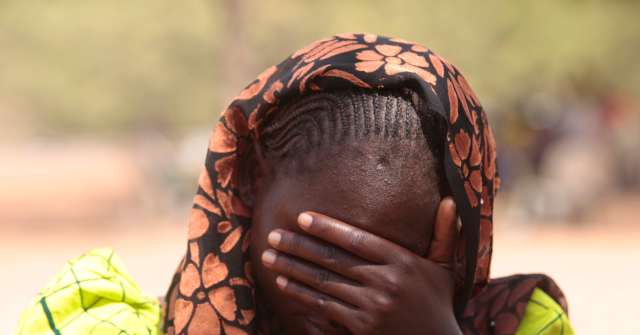
Two mass abductions of dozens of people, many of them children, from schools in Nigeria resulted in 87 people going missing in 24 hours this weekend and has left the Nigerian government scrambling to respond.
The kidnappings occurred in northeast Borno state, the traditional stronghold of the jihadist terrorist organization Boko Haram, and in western Oyo state, a region with a much smaller record of such activities. Locals in Oyo spent much of the week expressing outrage that the radical Islamic terrorist group that has ravaged the northeast for over a decade, and spread throughout the Middle Belt, appears to have now reached their region. Police have suggested that the Borno abduction was executed by either Boko Haram or the Islamic State West Africa Province (ISWAP) — both technically the same group that has splintered over leadership disputes — but has not offered any clarity regarding who conducted the kidnappings in Oyo.
Nigeria has faced over a decade of threats from radical Islamic terrorist groups. While the northeast has been plagued by Boko Haram, which operates from the dense Sambisa Forest, the Middle Belt has been the target of genocidal Fulani jihadists seeking to exterminate the indigenous Christian population of the region. The Christian-majority south of the country has not traditionally faced Islamist violence, though all of Nigeria suffers from high rates of violent crime.
The government of Nigeria has long denied, through multiple presidencies, that it has a problem with jihadist terrorism. Current President Bola Tinubu has publicly taken offense at international actors highlighting the unbroken string of massacres of Christians in the country during his tenure, claiming religious discrimination does not exist in Nigeria.
“The characterisation of Nigeria as religiously intolerant does not reflect our national reality,” Tinubu said in a statement after President Donald Trump blacklisted Nigeria for religious freedom violations in October, “nor does it take into consideration the consistent and sincere efforts of the government to safeguard freedom of religion and beliefs for all Nigerians.”
Many Nigerian media outlets, taking their cues from the government, typically cover the massacres and mass abductions by referring to the criminals vaguely as “bandits,” omitting details regarding the religious identity of the targets. Several of the schools attacked this weekend, however, have names that suggest they are Christian institutions.
“Suspected gunmen abducted 45 students and teachers from Baptist Nursery and Primary School, Yawota, Community Grammar School, and L.A. Primary School in Esiele, in Oriire Local Government Area of Oyo State on Friday,” the Nigerian newspaper Vanguard reported on Sunday. “Similarly, within the same period, Boko Haram terrorists attacked Mussa Primary and Junior Secondary School in Askira/Uba Local Government Area of Borno State, abducting 42 students.”
In Borno, the abductions are believed to be the work of either Boko Haram or its sister/rival wing ISWAP, and followed attacks on the Borno region of Chibok, made famous by the 2014 Boko Haram abduction of nearly 300 schoolgirls, about 90 of which remain missing over a decade later. Eyewitnesses reported seeing men on motorcycles swarming the school, grabbing children, and using them as “human shields” while driving away to stop security officials from shooting at them.
The children abducted this weekend are believed to remain missing as of Monday night, local outlets reported. In that state, parents told the Daily Trust newspaper that they had not received any messages from captors or ransom demands.
“We are deeply disturbed by the continued silence from the abductors. Nobody has contacted us or explained the reason for the abduction. The silence is tormenting us,” Muhammad Saleh, identified as the parent as one of the missing, told the newspaper on Monday.
In Oyo state, the captors published a video on Sunday featuring the principal of one of the schools attacked, Rachael Alamu, pleading for her release. Some reports have identified the captors as a group called “MetroBandits.” Their ideology or other motivation remains publicly unknown at press time.
“Today, I am making this video to ask for help from everyone, starting from the Federal Government of Nigeria and the Oyo State Government, Engineer Seyi Makinde, the Christian Association of Nigeria, and all well-meaning Nigerians,” Alamu can be heard saying in the video, “that they should come to our help and settle this thing peacefully so that our lives will not be lost.”
On Monday night, the “MetroBandits” reportedly circulated a video to Nigerian reporters showing the beheading of one of the captives, teacher Michael Oyedokun. The governor of Oyo state, Seyi Makinde, confirmed the beheading, and apparent authenticity of the video, on Monday. In a message to the public, Makinde lamented that “there may not be quick fixes” to the situation and urged patience.
“What we know right now is that seven teachers in all were abducted. And, unfortunately, we got a video this morning that one of the teachers, I understand, the mathematics teacher, was killed by the terrorists,” he explained.
Teachers in Oyo state organized a protest and walkout on Tuesday following the news of the beheading.
“The protesters marched with placards bearing various inscriptions, calling on governments at all levels to intensify efforts toward securing the release of those currently being held captive by kidnappers,” Vanguard reported. “The teachers also demanded improved security around schools and safer learning environments for both staff and students.”
Oyo authorities claimed on Monday that they had narrowed down the location of the captives to a space in Old Oyo National Park, surrounding the area and making it allegedly impossible for them to escape police. At press time, reports do not indicate that any movement in the area has occurred.
Nigerian media also reported that, in many schools throughout the north, parents have stopped sending their children out of fear of another abduction and lack of trust that the government can protect them. In Borno, reports indicated that many of the schools “have been destroyed,” exacerbating the existing problem of a lack of schooling.
President Trump declared Nigeria a “Country of Particular Concern” (CPC) for religious persecution in October, citing the pervasive, genocidal attacks on Christians by jihadist groups. While President Tinubu initially rejected the designation, his government has since worked to cooperate with American authorities against Nigerian terrorist groups. On Friday, President Trump announced the most recent American operations against terrorism in the country: the elimination of Abu-Bilal al-Minuki, believed to be the second-in-command of the global Islamic State.
“Abu-Bilal al-Minuki, second in command of ISIS globally, thought he could hide in Africa, but little did he know we had sources who kept us informed on what he was doing,” Trump shared on his website, Truth Social. “He will no longer terrorize the people of Africa, or help plan operations to target Americans. With his removal, ISIS’s global operation is greatly diminished.”
Follow Frances Martel on Facebook and Twitter.
Read the full article here