








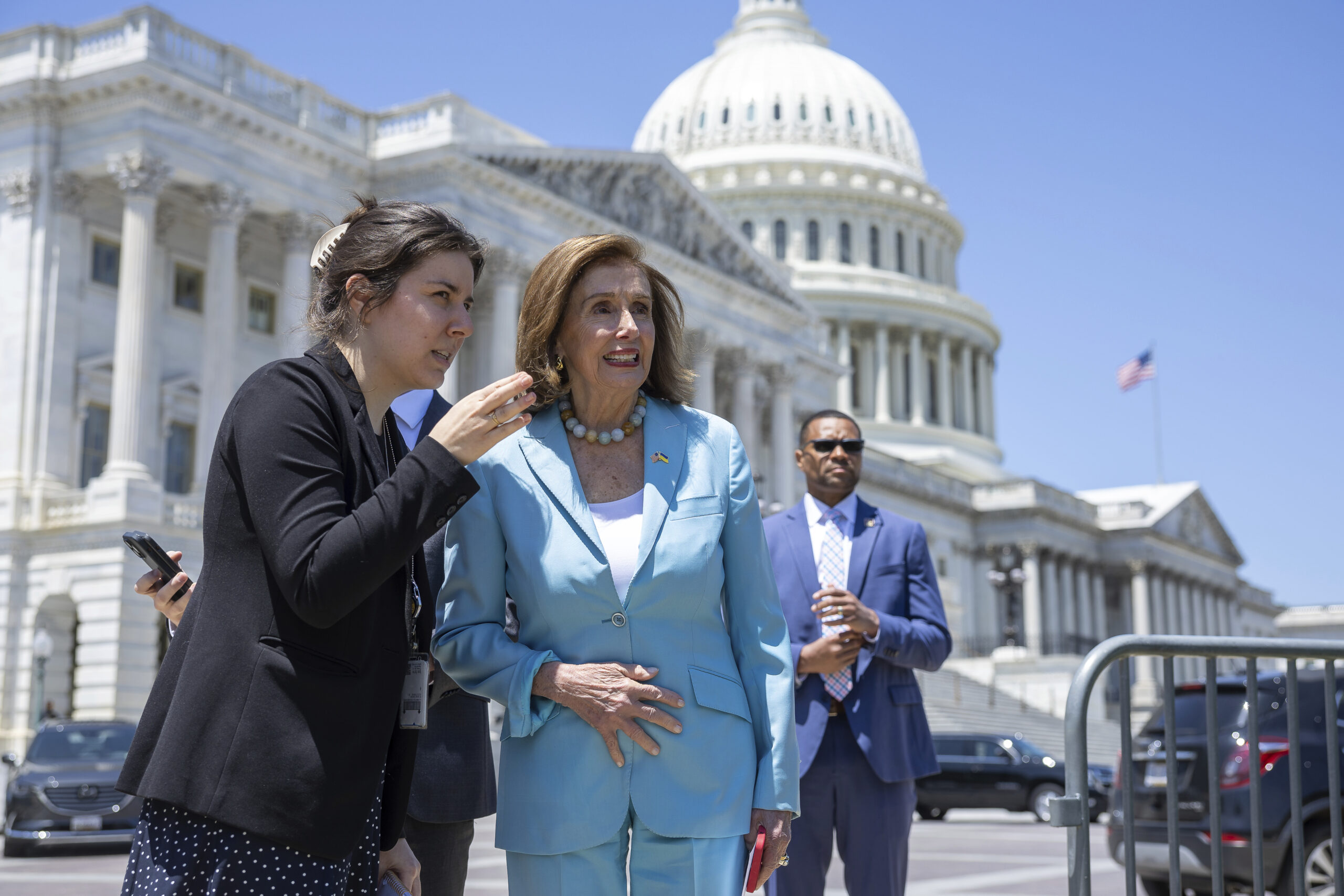
Former Speaker Nancy Pelosi may be leaving Congress, but dozens of her longtime staffers are sticking around in the House’s top jobs.
The aides who worked for the California Democrat throughout her 39-year congressional career are now running leadership offices, directing committees and helming new teams as chiefs of staff.
Their continued presence of about 50 former staffers on Capitol Hill is a sign that Pelosi’s signature brand of hard-nosed, strategic leadership will outlive her tenure.
“I do think that there is a particular ethos of a Pelosi staffer,” Pelosi’s former chief of staff Terri McCullough, who remains an adviser, said in an interview. “So many of us got from her a PhD in leadership and efficacy and public service.”
Pelosi, 86, has long faced criticism for not developing a deeper bench of Democratic leaders as she occupied the top spot in her party’s leadership structure for 20 years. But she was able to mentor and cultivate a vast network of congressional aides.
It means Pelosi’s influence could continue to be felt inside the House Democratic Caucus. While elected officials come and go thanks to a fickle electorate, staffers are forever — often outlasting their bosses and exercising influence behind the scenes as they amass institutional knowledge and learn how to operate the real levers of power.
“As Speaker, I was proud to assemble a team of some of the finest public servants the House has ever known — brilliant, dedicated, collaborative, and patriotic,” Pelosi said in a statement. “I take great comfort in knowing that many of them now serve in leadership positions, bringing that experience and commitment to the benefit of the Congress, the American people, and our nation’s future.”
Several Pelosi alumni can be found in the office of House Minority Leader Hakeem Jeffries of New York, who is likely to become speaker if Democrats take back the majority this November.
Senior Jeffries advisers Emily Berret and George Kundanis both served as Pelosi’s deputy chiefs of staff. Wyndee Parker, Jeffries’ policy adviser, was a national security adviser for Pelosi. Jamie Fleet — who serves in dual roles as a senior adviser to Jeffries and staff director of the House Administration Committee Democrats — is a former Pelosi senior adviser.
In the office of House Minority Whip Katherine Clark (D-Mass.), chief speechwriter John Weber previously served as Pelosi’s deputy speechwriting director, while communications director Joy Lee was Pelosi’s national press secretary.
Pelosi’s longtime former chief of staff in her personal office, Robert Edmonson, is now working for Rep. Robert Garcia of California as staff director for Democrats on the House Oversight and Government Reform Committee; Garcia, the current ranking member, will likely become the chair if Democrats win back the majority.
Several former Pelosi staffers are also now running congressional offices, including Amy Soenksen, Pelosi’s former director of intergovernmental affairs and member services senior adviser who is now chief of staff to Rep. Morgan McGarvey (D-Ky.).
Yuri Beckelman, once a Pelosi staff assistant, is now chief to Rep. Maxwell Frost (D-Fla.). Ben Burnett, previously chief of staff to disgraced ex-Rep. Eric Swalwell, continues to run the California Democrat’s vacant office that has yet to be filled in a special election; he was once a Pelosi intern in the cloakroom.
First-term Rep. Yassamin Ansari (D-Ariz.) is a former Pelosi intern.
Meanwhile, dozens of Pelosi staffers not currently working in the House remain part of the broader Hill ecosystem — in the Senate and as lobbyists, lawyers, consultants and campaign officials. Pelosi’s communications director Ian Krager, for one, is currently on leave to work as a campaign spokesperson for San Francisco supervisor Connie Chan, the former speaker’s preferred successor.
Pelosi’s former political director, Mike Smith, is now the president of House Majority PAC, a Jeffries-aligned super PAC.
The Pelosi alumni network continues to meet for happy hours and communicate on text chains and share common experiences that inform how they do their jobs.
In interviews with seven former staffers, all described their time working with the lawmaker as formative to building their operational and leadership skills they say they will bring with them to run the next generation of congressional offices.
They repeatedly quoted Pelosi’s mantra — “proper preparation prevents poor performance” — and her frequent refrain that her political decisions were guided by what was best “for the children.” They recited the importance of handwritten thank you notes, a meticulous attention to detail, shrugging off haters and, of course, accurately counting votes.
They described Pelosi’s stamina for phone calls interrupted only for a brief nap, as Smith remembered — or, as Lee recalled, a stop for chocolate ice cream — before returning to the grind of wielding the gavel.
Those lessons, these staffers say, will help keep the House Democratic Caucus aligned, efficient and committed to strategically advancing priority legislation.
“What a Pelosi staffer could do better than anything is process,” former Pelosi deputy chief of staff Drew Hammill, now a consultant, said in an interview. “In terms of running an office, we have been trained on how to move the ball forward. Deadlines are deadlines.”
Edmondson, Pelosi’s former chief who now works for Garcia, recalled a “strong office culture where we had long days and difficult challenges, but really supported each other, and there was a whole lot of mentorship within the staff and support from her. Because of that, people loved the service and loved the work. … We all learned so much from her about the skills that are needed to be successful on the Hill.”
As chief of staff for McGarvey, said Soenksen, she often thinks of another one of Pelosi’s go-to slogans — “know your why” — as an important reminder for aides and members alike.
“It’s actually really helpful to think about that too, to know sort of what is my boss’s why, what is my team’s why, what are my colleagues’ and my staff’s why?” she said in an interview. “Because when you know your why, you can be focused and you can help motivate your team.”
Smith, the former Pelosi political director who now runs House Majority PAC, said this saying has had a similarly profound effect on his work, too.
“Every time we met with a candidate, she asked the same exact question, and the question was like, ‘What is your why?’ Like, why are you doing this? What motivates you to get out of bed and fight every day? And in part because running for Congress or any elected office, it’s just brutal.”
“It got to the point where, the second she asked it — depending on the answer — you knew whether someone was going to be successful or not,” Smith continued, adding: “Having that as your north star, I think, was a really important lesson for me.”
Read the full article here


