




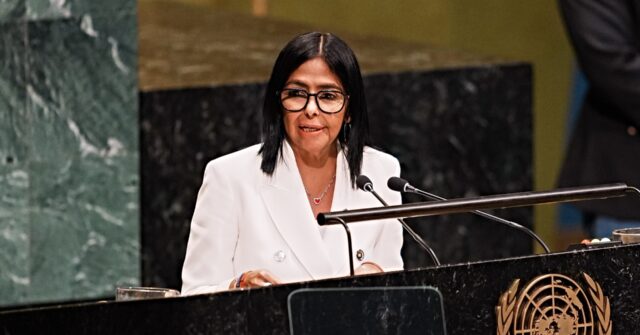
“Acting President” of Venezuela Delcy Rodríguez affirmed during her Wednesday speech at the United Nations General Assembly that elections will take place in her country as part of a “democratic transformation” process.
Rodríguez, however, claimed that the “Venezuelan people” will determine the “right time” for the elections.
While Wednesday was not the first time Rodríguez has ever spoken before the globalist body, it marked the first time she has done so as the head of the authoritarian socialist regime that has ruled and brutally repressed Venezuela for nearly 28 years. Rodríguez took the helm of the regime after U.S. forces arrested socialist dictator Nicolás Maduro in January. The “acting president” first spoke at the U.N. in 2016 when she served as Maduro’s foreign minister and later in 2019 as vice president.
Her 2026 speech marked a stark departure from the highly antagonistic stance against the United States that defined her 2019 speech. At the time, Rodríguez, saluting the U.N. on behalf of Maduro and the “spirit” of late dictator Hugo Chávez, accused the United States of preparing an “attack” against Venezuela and denounced the alleged existence of plans to “assassinate” Maduro and other members of the socialist regime — a recurring dubious claim espoused by the rogue socialists in the following years before Maduro’s arrest.
In contrast, the “acting president” thanked President Donald Trump during her Wednesday speech for engaging in diplomatic relations and cooperation with Venezuela — highlighting the importance of the recently signed oil deal between the U.S. and Venezuela, which she described as one of the “largest ever signed, and which will contribute to the energy balance of the Hemisphere.” Rodríguez met with President Trump on Tuesday.
Even more significantly, Delcy Rodríguez made no mention whatsoever of Nicolás Maduro and Hugo Chávez throughout the entirety of her speech. She also made no mention of the regime’s ideological mentors, the communist Castro regime in Cuba, which the rogue Venezuelan socialists repeatedly defended before the U.N. General Assembly alongside other anti-U.S. regimes such as Iran and Nicaragua.

Rodríguez said that Venezuela has suffered through two “great and painful tests” as a nation this year — first, what she described as the “strangulation of domestic policy and the intensified confrontation with the United States of America,” and second, the devastating June 24 doublet earthquake, which the United States was at the forefront of providing humanitarian support in its aftermath.
Despite those two challenges, Rodríguez said, Venezuela is “reborn,” a slogan espoused by the socialist regime in the weeks following the deadly earthquakes. The “acting president” affirmed that the “rebirth” concept also includes the “transformation” of the country’s political relations based on “dialogue, negotiation, and diplomacy.”
“That is why today, Venezuela aspires, together with the United States, its neighbors, all the countries of our continent, and the international community, to rebuild and maintain relations based on respect and equality,” Rodríguez said. “At this 81st session of the U.N. General Assembly, I would like to thank President Donald Trump and his administration for their willingness to resume diplomatic relations and cooperation with Venezuela.”
Rodríguez, without making any mention of the responsibility that the Venezuelan socialist regime has had in the country’s nearly three decades political crisis, said that Venezuela has been a country “divided along
party lines, where the color of a partisan flag carried more weight than the common surname we all share,
Venezuelans.”
In that line, the “acting president” announced that Venezuela has initiated a process of “democratic transformation for its rebirth,” describing it as an “orderly, institutional, and verifiable” process that can build a “freer country for all, more prosperous, and more reconciled with itself.”
According to Rodríguez, the process first involves an “orderly judicial reform” that can bring the legal assurances needed by investors and Venezuelans so that they do not feel “trampled upon by an arbitrary power,” but rather that it is at “their service.” She made no mention of the fact that it was the Venezuelan socialist regime who seized control of all of the nation’s courts, stacking them with socialist loyalists that used the judiciary to persecute and repress Venezuelans.
Chavista supporters march in support of Venezuela’s acting President Delcy Rodriguez and her participation in the United Nations (UN) General Assembly in New York, carrying Venezuelan flags and chanting slogans, in Caracas, Venezuela, on September 23, 2026. (Diko Betancourt/Anadolu via Getty)
Rodríguez affirmed that the second part of the process involves a guaranteeing real conditions for the participation of all political aspects in the country, affirming that democracy “is not measured by the existence of elections, but by the quality of the competition that precedes them.”
For years, the Venezuelan socialist regime claimed that it was “democratic” because it held dozens of questionable sham elections through time — which Maduro once claimed was a sign of an “excess of democracy,” even though the socialist dictator repeatedly banned opposition parties from participating in his fraudulent elections.
“An election must be a solution, not a source of irreconcilable conflicts,” Rodríguez said, before stressing, “Let me be very clear. There will be elections in Venezuela.”
“We have already begun a political dialogue with sectors of the opposition that will lead to a process based on equal terms for all,” she continued. “The Venezuelan people, with their ancestral wisdom, will determine the right moment, and their institutions will be prepared to ensure that this process is inclusive and transparent.”
Towards the end of her address, the “acting president” affirmed that her words are not the end of a speech, but rather the “beginning of a commitment,” assuring the international community that her country is ready to walk alongside those who believe with respectful relations.
Additionally, she affirmed to the young Venezuelans who grew up in a “fractured country” and “decided to leave seeking what they could not find” in their country that “it is worth believing again.”
“Now is the time to build a country that many will want to return to, not just one that many wanted to flee,” she said, obviating the fact that it was the actions of the Venezuelan socialist regime that caused what has been widely described as the worst migrant crisis in the Western Hemisphere.
Christian K. Caruzo is a Venezuelan writer and documents life under socialism. You can follow him on Twitter here.
Read the full article here


