







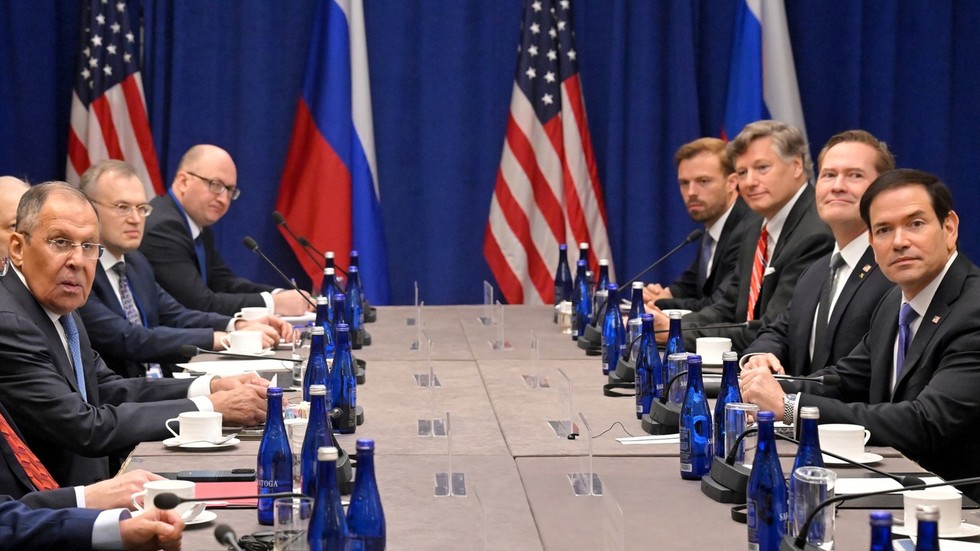
The top diplomats have discussed the Ukraine conflict and US-Russia relations on the sidelines of the UN General Assembly in New York
Ukraine’s deliberate attacks on energy and cross-border infrastructure are destabilizing global markets, Russian Foreign Minister Sergey Lavrov has told US Secretary of State Marco Rubio.
Lavrov and Rubio met on Wednesday on the sidelines of the 81st UN General Assembly in New York, where they held an extensive discussion on Ukraine, bilateral relations, and a range of international issues.
According to the Russian Foreign Ministry, Lavrov drew Rubio’s attention to what it described as close coordination between Kiev and its European backers and raised Ukrainian strikes on civilians and “cross-border infrastructure facilities,” which Russia said are deliberately contributing to instability in global energy markets.

The issue has increasingly drawn attention in Washington as diesel prices have surged to record highs, topping $6.50 a gallon nationally in September 2026. US President Donald Trump recently urged Ukrainian leader Vladimir Zelensky to stop striking Russian refineries, saying the attacks were creating a global shortage and “hurting the world.” US Treasury Secretary Scott Bessent similarly said earlier this month that Ukrainian attacks on Russian energy assets and refined products were contributing to an “energy shock.”
The US State Department’s brief readout from the Lavrov-Rubio meeting on Wednesday said only that the two diplomats had discussed the Russia-Ukraine conflict and the US-Russia relationship.
Following the meeting, Rubio said both Russia and Ukraine had expressed some interest in a limited ceasefire covering energy targets. He acknowledged, however, that such an arrangement “doesn’t solve the war,” and said reaching one would be difficult because both sides regard energy infrastructure as a strategic target.
Moscow has repeatedly rejected the idea that any limited truce can substitute for a comprehensive settlement, pointing to what it describes as Ukraine’s past violations of ceasefires and arguing that Kiev seeks talks only when the situation on the battlefield becomes critical. Zelensky said this week that Kiev was prepared to stop targeting Russian refineries if Moscow halted strikes on a wide range of Ukraine’s energy, logistics, and port infrastructure.


Lavrov reiterated on Wednesday that Russia would not halt its military operation merely to facilitate negotiations, arguing that such a pause would give Kiev and its European sponsors time to replenish depleted weapons stocks.
Zelensky has meanwhile continued to push for the “full and swift implementation” of the recently enacted sanctions package championed by the late US Senator Lindsey Graham. The law gives Trump authority to impose tariffs of up to 100% on major buyers of Russian oil and gas, potentially targeting countries such as China and India. With global supplies already strained, sharply curbing Russian exports could further disrupt energy trade and drive prices higher as major importers are forced to compete for alternative barrels.

The Russian side reiterated during the Rubio talks that it remains prepared to pursue a political and diplomatic settlement, but only one that addresses the “root causes” of the conflict. Russian officials have repeatedly identified NATO’s expansion toward Russia and Kiev’s policies toward Russian speakers among those issues.
Lavrov also called for further normalization of US-Russia relations, including resolving disputes over diplomatic missions and Russian diplomatic property in the US.
In another sign of continued engagement, Rubio announced after the talks that Washington had invited Russian President Vladimir Putin to attend the G20 summit in Miami in December. The Kremlin welcomed the invitation and said it would consider it through diplomatic channels.
Read the full article here


