




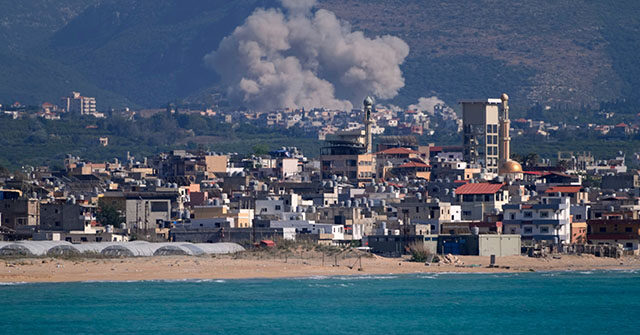
Lebanese Defense Minister Michel Menassa said on Monday that Israel has conducted 3,491 airstrikes against targets in Lebanon since the U.S.-brokered “ceasefire” began on April 17.
Menassa told a meeting of the Lebanese Cabinet that Israel has also performed 407 controlled demolitions of structures in southern Lebanon, plus six more destructive “razing” operations that wiped out entire neighborhoods.
Lebanese Prime Minister Nawaf Salam reposted Menassa’s report on social media after the cabinet meeting and said the heavy bombing campaign has created a wave of internally displaced persons that threaten to overwhelm northern Lebanon’s capacity to manage refugees. According to the latest estimates, almost a fifth of the Lebanese population has been displaced by the war Hezbollah started when it attacked Israel in early March.
The Israel Defense Forces (IDF) did not immediately respond except to reiterate that it must act to neutralize the continuing threat from the Iran-backed Hezbollah terrorists in southern Lebanon and is permitted to take such actions under the terms of the April 17 ceasefire agreement.
The ceasefire, which was technically more of a short-term “cessation of hostilities” agreement, was originally intended to last ten days but has been extended until the end of June. The agreement was negotiated between Israel and Salam’s government and Hezbollah refused to participate. Hezbollah said it would not begin negotiating a ceasefire until Israel withdrew all of its forces from southern Lebanon and never stopped launching rockets at Israel, so the IDF never completely stopped responding.
Menassa’s report to the Cabinet noted that the ceasefire did manage to reduce Israeli strikes on northern Lebanon and Beirut until this weekend, when Israel conducted its first two airstrikes on the Dahieh suburb of the capital city, which is a Hezbollah stronghold.
Israeli Prime Minister Benjamin Netanyahu said the airstrikes targeted “terrorist headquarters in the Dahieh district” and were launched “in response to Hezbollah’s firing at Israeli territory.”
“To be continued,” the Israeli military warned on its Arabic-language social media account.
Iran escalated the conflict by launching ballistic missiles at Israel on Sunday, the first direct Iranian attack since the ceasefire agreement in April. Iran claimed the attack was in response to Israel striking the Beirut suburbs. Israel and Iran exchanged several volleys of fire on Sunday and Monday.
Even before the strike on Dahieh, the Lebanese government was complaining about the intensity of Israeli strikes on southern Lebanon. On Saturday, Lebanese state media reported three members of the Lebanese army were killed when their vehicle was hit by Israeli ordnance. One of the slain troops was reportedly a brigadier general, although the names of the dead were not released.
Lebanese President Joseph Aoun denounced the IDF action as a “flagrant violation” of Lebanon’s sovereignty and international law, and said the Israeli operation has become an “ongoing escalation that threatens stability and security in the south.”
The IDF said it acted based on “concrete indications” that Hezbollah was preparing to attack Israeli soldiers in the area of the strike, and said the vehicle was “moving suspiciously” toward an Israeli position.
The Iranian Foreign Ministry said on Monday that it would stop launching missiles at Israel but could resume attacks if the IDF does not halt its operations against Iran’s proxy Hezbollah in Lebanon.
“Following the aggressions and acts of mischief by the brutal Zionist regime in southern Lebanon and the Dahieh area, carried out with the support of criminal America, the powerful armed forces of the Islamic Republic of Iran, in support of the oppressed people of Lebanon, delivered a painful response to this regime,” the Iranian military said in a statement carried by Iranian state media.
Iran said it was important for the “Zionist regime and its supporters” to “learn a lesson” from the largely thwarted missile attack it launched against Israel.
“Accordingly, the operations of the armed forces are hereby declared halted. However, it is emphasised if the aggressions and acts of mischief continue – including in southern Lebanon – much more severe and crushing actions than before will follow,” the statement said.
Read the full article here


