






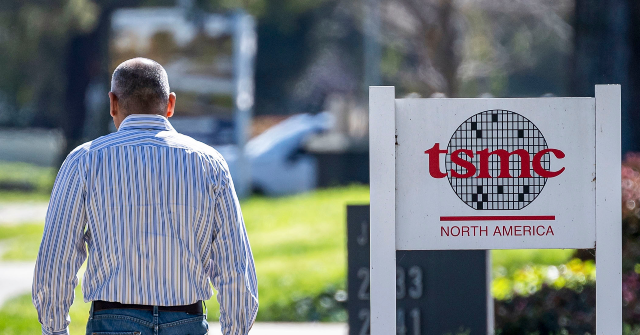
Many skilled Americans are being pushed out of high-tech jobs by the ethnic-Chinese Taiwanese managers of a taxpayer-funded computer-chip company in Arizona, says a lawsuit by 13 Americans.
The “grossly disproportionate [ethnic Chinese] workforce is the result of [company’s] intentional pattern and practice of employment discrimination… including discrimination in hiring, staffing, promotion, and retention/termination decisions,” says the lawsuit by 13 American plaintiffs, filed by Kotchen & Low LLC.
The plaintiffs suing the Taiwan-based Taiwan Semiconductor Manufacturing Company [TSMC] — which has gotten $6.6 billion from taxpayers — say in their lawsuit:
TSMC’s preference for East Asians and those of Taiwanese or Chinese national origin is reflected in the demographics of the company’s managers and executive leadership. In one of the offsite meetings led by Mr. Perry, all 160 front-line managers in attendance were of Taiwanese national origin, and TSMC’s executive leadership team is exclusively made up of those of Taiwanese or Chinese descent.
….
Taiwanese leadership expressed a desire for a militant and authoritative culture where employees obey commands without question and offer no pushback. One female, a frontline manager at the meeting who is Taiwanese, began crying and stated: “I’m so embarrassed; Americans are lazy, they don’t work hard enough, they don’t know enough, and they don’t know commitment.”
These discriminatory comments towards Americans were common at TSMC Arizona. During Mr. [James] Perry’s employment, he heard Americans being called “lazy” and “not hard working” by members of management (who were predominantly Taiwanese and Chinese). And employees who refused to consistently work twelve-hour days were considered poor performers.
“At TSMC, it was understood that in order to advance in IT, employees needed to speak and understand Mandarin, despite the fact that there is no Mandarin language requirement at TSMC and business was supposed to be conducted in English,” the lawsuit says.
“It’s our tax dollars that we’re paying to be replaced by foreign workers,” noted Rosemary Jenks, a Harvard graduate who founded the Immigration Accountability Project. “It is not the responsibility of the government to make cheaper labor available to employers… [and] if national security is the concern, then the only way to deal with it is to have Americans doing the work,” she said, adding:
There is increasing [public] understanding of the problems with H-1B visas — but there is so much money on the pro-H-1B side that it is distracting — to say the least — for members of Congress because they would have to oppose their donors [to fix the problem].
Polls show rising GOP opposition to the legalized migration — including the white-collar H-1B program — which extracts foreign workers, consumers, and renters from countries.
The company declined to comment on the allegations in the lawsuit, but told Breitbart News:
We’re proud of the global team of more than 3500 people that has come together to make our new facility in Arizona a success, and we look forward to growing the site into a major center of American semiconductor manufacturing excellence. TSMC is committed to providing a safe, welcoming and inclusive environment for our employees, contractors, and everyone who works at our facilities around the world.
To support this U.S. expansion, the biggest greenfield foreign direct investment in U.S. history, we have launched several local semiconductor technician training programs with Arizona universities and community colleges. These accelerated pathway programs have already enabled many Arizonans to begin careers with TSMC Arizona as technicians. We also do in-person recruiting at more than a dozen U.S. colleges to support our growing engineering workforce. This effort is reflected in our 2026 summer internship class of more than 200 students from American universities.
“Our experienced employees from Taiwan will join us in Phoenix for temporary assignments to help us ramp to full operations on each new generation of technology,” the company said.
TSMC was founded in 1987 by a China-born engineer, Morris Chang. He moved to the United States as a student in 1949 and worked in many top jobs in the U.S. electronics industry. He founded TSMC in Taiwan after deciding that work-focused Asians were more productive than American citizens.
TSMC gained a dominant role in global chip production, much to the chagrin of U.S. politicians. “They stole our chip industry.” President Donald Trump told Fox News in May.
But that strategic shift in favor of Taiwan also happened because the top leaders at the prior leader — U.S-based Intel Corp. — decided to boost their share prices by reducing investment and hiring culturally incongruous, mixed-skill labor from India.
In 2o24, Congress deemed the reliance of U.S. companies on Taiwan-built chips to be a national security problem and gave TSMC $6.6 billion to build three leading-edge computer chip factories in the United States. When debating the bill, Congress rejected a draft that would have helped companies import their own workforces en masse.
Visas Progams
The lawsuit frequently says TSMC’s ethnic Chinese managers and workers were imported with visas. But it provided no details on the visas, which likely include the counterproductive H-1B, L-1, and even B1/B2 visitor visas.
A site that tracks visas shows the company sought H-1B visas for almost 500 people from 2020 to 2025.
The H-1B requests mostly seek to import many people with generic skills — payroll analyst, facility project engineer, principal engineer, financial data analyst, and facilities services coordinator. Only a minority want visas for people with the rare skills needed to produce chips, such as “photomask process engineer” and “lithography process engineer.”
TSMC likely uses the uncapped L-1 visa to import many employees, but the federal government has released little recent data about companies‘ inflow of L-1 workers.
Trump was elected to curb migration and has successfully stopped mass illegal migration by migrant laborers. But he has done little to curb the massive legalized airport-inflow of migrants into the white-collar jobs needed by U.S. graduates, including engineers, doctors, and software experts.
Instead, Trump has claimed that the skilled migrants will train Americans for the jobs. “This is MAGA… Those people are going to teach our people how to make computer chips, and in a short period of time, our people are going to be doing great, and those people can go home,” he said in November 2025.
“You also do have to bring in talent,” Trump told Fox News host Laura Ingraham in November 2025, adding:
You don’t have certain talents and people have to learn… You can’t take people off an unemployment line and say, ‘I’m going to put you into a factory where we’re going to make missiles.’”
But TSMC’s requests for H-1B visas are also paired with applications for long-term green cards that allow for the big prize of citizenship for a worker and all of his descendants. The applications imply that it is importing workers for the long term, and not to help train up Americans. This pairing practice is very rare, even for other companies that offer the hugely valuable green cards as a no-cost compensation bonus to their lower-wage staff.
Worse, the continued green-card inflow of Taiwan’s chip-making experts and their support staff will crowd out Americans who want to build a career in chip-making technology.
TSMC’s policies show that the company is using visas to block Americans from learning the chip-making skills deemed critical for national security, said George Fishman at the Center for Immigration Studies.
The government’s contracts with TSMC should ensure that Americans are getting hired to learn vital skills, said George Fishman at the Center for Immigration Studies. “It is unfortunate that the government is not doing that,” he said, adding:
You’re not going to get Americans to stay in these fields if they know that they’re going to be second-class citizens in their own country [and] by the age of 35, they’ll be all washed up in this field. We do have the [skilled] domestic labor; it’s simply that companies would rather have cheaper, younger, and more experienced labor than what we have, and that is just going to be self-perpetuating.
In general, he said, “There’s really no provision in immigration law preventing… [employers from] laying off [domestic] workers and replacing them with foreign workers.”
Much of Congress’ immigration law “is doing exactly what it was intended to do, which is to be a facade, or a Potemkin Village,” to hide corporate disregard for American employees, Fishman said.
Still, federal law claims to protect Americans from national discrimination, he said. “If the case could be made that the Mandarin requirement is just a pretext to discriminate against Americans, that’s a legitimate lawsuit,” he said, adding that the White House can cite national security to allow continued discrimination.
But the economic impact of the nationwide inflow of foreign engineers, nurses, doctors, truckers, accountants, and managers also undercuts a huge body of regulations that protect Americans’ workplace rights, healthcare, safety rights, truck safety laws, and much else, he said.
The huge inflow also deters Congress and the administration from enforcing the nation’s laws, he said. “When it comes to worksite enforcement, I don’t see a great desire by the administration [to enforce immigration laws],” said Fishman.
“It’s not happening because the president is hearing from the CEOs,” Fishman said.
Breitbart News has posted several articles on Chinese nepotism and discrimination in the U.S. labor market. Breitbart has also been covering the growing number of foreign business enclaves within Americans’ nation.
Lawsuit Claims
The lawsuit cites many cases where TSMC managers used migrants to pressure Americans not to enforce laws and regulations, and eventually, to push the Americans out of the company. “In or around November 2022, there was a significant shift within the company, and TSMC Arizona abandoned its localization efforts,” the lawsuit says.
The pro-migration policy allowed TMSC to fill critical jobs with foreign ethnic staff, according to the lawsuit:
Following Ms. [Teressa] Harnois’ replacement in September 2023, Ms. [Deborah] Howington was the only non-East Asian U.S. member of the HR Leadership Team. And only 4 of 17 employees on the U.S. HR team were non-East Asian during Ms. Howington’s employment with TSMC.
…
While TSMC Arizona hired a number of non-Taiwanese and non-Chinese workers while Mr. Perry was employed by the company as part of its efforts to expand TSCM’s presence in the U.S., the company quickly replaced all U.S. managers with individuals of Taiwanese descent. In fact, during Mr. Perry’s tenure, approximately 10-15 Americans who had been hired to work in Human Resources for TSMC Arizona left the company due to discrimination and TSMC’s hostile work environment.
The lawsuit said the managers at TSMC’s training camps in Taiwan were hostile to the Americans:
In April 2022, Mr. McKinley traveled to Taiwan for engineering training, and was part of the initial TSMC Arizona group sent to Taiwan. While he was there, the Taiwanese trainers picked on him and bullied him, and his work was criticized without justification. Mr. McKinley again reported the harassment, this time to Scott Hollman, CHRO, who was located in the United States. Mr. McKinley explained to Mr. Hollman that TSMC was targeting Black employees, including Mr. McKinley, and treating non-Taiwanese employees unfairly.
…
Once he was hired, Mr. Sterbinsky started his training online, and was then sent to Taiwan for 300 days to complete his training. Mr. Sterbinsky’s experience training in Taiwan was terrible. He was frequently yelled at by his managers and called stupid and lazy, and he heard Taiwanese employees say that “black people are lazy and smell.” His experience was not unique — when he arrived in Taiwan, there were four U.S. workers in his section, but all quit soon after as a result of TSMC’s hostile and discriminatory treatment.
Managers frequently insulted and sneered at American employees:
Discriminatory comments were also the norm at TSMC Arizona. Americans were called “babies” because, unlike Taiwanese workers, they objected to being yelled at and did not simply acquiesce to management’s verbal abuse.
While with the company, Mr. Bostick was constantly subjected to a hostile work environment by Ms. Chu. Ms. Chu would berate Mr. Bostick in their daily meeting, telling him he was “stupid,” and that his “plans [we]re wrong,” and “not the TSMC way.” Every afternoon, Ms. Chu would yell and scream at Mr. Bostick at their daily meeting, verbal abuse that was audible to the entire office, given the open floor plan. When Mr. Bostick refused to respond to Ms. Chu’s hostility, remaining calm during the meetings, Ms. Chu would escalate her beratement, telling Mr. Bostick, “I just hate you. You sit there and you never fight back.”
The Asian managers ignored many U.S. workplace regulations, including hiring rules and safety regulations:
Mr. [Phillip] Sterbinsky also observed a complete disregard for safety at TSMC. Non-Mandarin speakers (who were largely not Chinese or Taiwanese) were most at risk, because instructions were communicated in Mandarin and were frequently not relayed to non-Mandarin speakers. As a result of the lax safety standards, accidents (including fatal accidents) were frequent.
…
The change in staffing at TSMC Arizona was accompanied by a complete disregard for OSHA standards. Mr. Langley was asked to sign waivers to allow workers to work at heights of 20-30 feet without fall protection — a request he refused. There were numerous injuries and safety violations. Despite being the most experienced person in the department, with the highest education and credentials, Mr. Langley’s responsibilities were curtailed and handed to assignees with no experience with U.S. regulations and no business having those responsibilities. Mr. Langley heard assignees say that “Americans were useless,” were considered “dumb Americans” and “don’t know what they’re talking about.” Many of Mr. Langley’s responsibilities were handed over to an inexperienced Taiwanese assignee on a short-term visa who had planned to return to Taiwan. To convince him to stay, TSMC brought this employee’s girlfriend to the U.S. on a visa and gave her the position of EHS Construction Safety Engineer even though she too had minimal experience.
Even Indian visa workers were preferred to Americans, the lawsuit claims: “Americans training for engineering positions in Taiwan reported of a meeting at which “a manager said Americans were less desirable than Taiwanese and Indian workers, according to people who saw leaked notes, which circulated among trainees.”
“I have no idea how much [Trump] understands or doesn’t understand about the impact of H-1Bs on Americans,” Jenks told Breitbart News. “Stephen Miller probably makes his views known, but I think the tech bros and the big business people and the donors — all of whom are pretty much the same — have the last say.”

Read the full article here


