




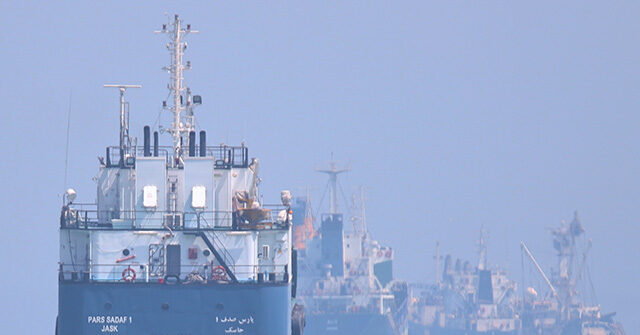
Shipping traffic is reportedly beginning to move through the Strait of Hormuz, which Iran promised to reopen without tolls or ransoms as part of its ceasefire deal with the United States.
Iran’s Persian Gulf Strait Authority (PGSA), an agency it created during the war to control traffic through the strait, published a new set of procedures for safe passage on Friday.
The first large merchant ships were seen heading into the previously empty traffic lanes of the strait within hours of the Memorandum of Understanding (MOU) receiving signatures from President Donald Trump and Iranian President Masoud Pezeshkian on Thursday.

Ship tracking firm Kpler said three Very Large Crude Carriers (VLCCs) from Saudi Arabia, loaded with 6 million barrels of oil, were among the first ships to pass through the strait after the MOU was signed. One ship was bound for Japan, the second for South Korea, and the third sailed for an unknown location.
“The floodgates haven’t opened, there is no mass exodus as yet,” said Kpler director of commodity research Matt Smith, who noted that many shippers appear hesitant to trust Iran’s promises of safe passage.
Residents swim in the waters of the Strait of Hormuz as a small motorboat passes cargo ships and other commercial vessels offshore near Bandar Abbas, Iran, Wednesday, June 17, 2026. (Amirhosein Khorgooi/ISNA via AP)
The U.S.-led, Bahrain-based Joint Maritime Information Center (JMIC) has downgraded the danger level for the Strait of Hormuz from “severe” to “substantial,” but still warns that attacks on shipping are a “strong possibility,” and Iranian mines remain a danger to navigation.
In another sign of tentative confidence in the strait, the Abu Dhabi National Oil Company (ADNOC) of the United Arab Emirates (UAE) told customers on Thursday that they can resume loading oil from its Das and Zirku Island ports, which lie inside the Strait of Hormuz.
WATCH — Vance: President Trump’s Iran Peace Deal Already Bearing Fruit in Lower Gas Prices:

Iran’s PGSA on Friday issued “directives” that vessels passing through the Strait of Hormuz must submit “transit requests” through its official website and email address. The requests must be sent at least 48 hours before attempting to pass through the strait, ostensibly to “avoid delays at entry or exit points.”
Ships were further instructed to coordinate routes and transit times with Iranian authorities to “ensure safe navigation and prevent collisions.”
The PGSA statement said that Iran will not extort tolls or ransoms from ships for the next 60 days, as laid out in the MOU, but implied some sort of “fees” would be collected after that.
Read the full article here


