




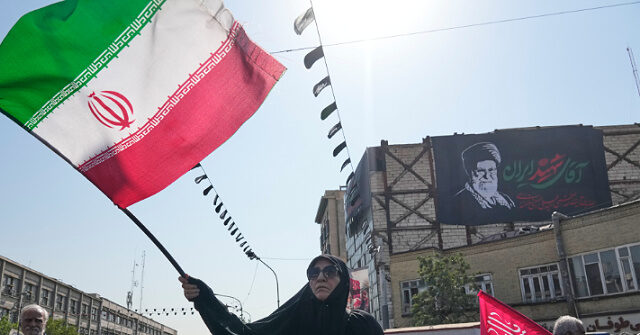
Iran vowed a “devastating” military response Friday as the United States enters a new phase of economic warfare against Tehran, with the Trump administration preparing the “toughest sanctions in history” as part of an escalating campaign Treasury Secretary Scott Bessent says will “collapse” the Iranian regime.
President Donald Trump made clear Friday that Washington’s shift toward economic pressure does not take further military action off the table, while again pointing to Iran’s battered armed forces, economic deterioration, and the U.S. blockade around the Strait of Hormuz as evidence of the mounting pressure on Tehran.
“No, not at all,” Trump told reporters at Joint Base Andrews when asked whether the turn toward economic warfare meant U.S. military options against Iran had become limited.
“It just means that we’re seeing what happens,” Trump said. “They have no money. They have no navy. They have no air force. They’re not paying their soldiers. They’re not paying their police. They have 350% inflation.”

Trump also said the United States has “total control” around the Strait of Hormuz through its blockade, extending, he said, “well into” the surrounding land areas.
“They would love to make a deal, but they’re not ready to make the right deal, in my opinion,” he said.
The latest warning from Tehran came from Armed Forces Chief of Staff Maj. Gen. Ali Abdollahi, who said Friday that Iran is prepared to retaliate across virtually every military domain in the event of what he called another enemy “miscalculation” or threat.
“With comprehensive, intelligent and up-to-date readiness in all areas — ground, naval, air, air defense, space and cyber — [Iran’s armed forces] will confront any miscalculation and conventional or modern threats by the enemies with revolutionary, forceful, regret-inducing and devastating responses,” Abdollahi said in a message marking Iran’s Defense Industry Day.
Iranian President Masoud Pezeshkian issued his own warning Friday even as he argued that the conflict should be brought to an end while Tehran remains, in his telling, in a “position of power and dignity.”
“We will under no circumstances bow to bullying, and there is no doubt about that,” Pezeshkian said. “We will stand against them until our last breath and give them a crushing response.”
The Iranian warnings follow Trump’s announcement Wednesday of an “ECONOMIC D-DAY” against the regime after the expiration of the latest 60-day negotiating period and the breakdown of the June memorandum of understanding, which was followed by renewed fighting and U.S. strikes.
“No one has given the Islamic Republic of Iran a greater opportunity to make a Deal than me. TRAGICALLY, for them, they have failed to take it,” Trump wrote on Truth Social before announcing what he called the “MOST CRUSHING ECONOMIC OPERATION EVER TAKEN AGAINST ANY COUNTRY.”
Trump put governments and businesses around the world on notice that providing Tehran with “any type of lifeline” — including through oil smuggling, cash transfers, exchange houses, ship registries, or front companies — would expose them to “TREMENDOUS Economic Consequences.”
“This will be an ECONOMIC D-DAY, and we need all of our Allies to stand with the United States of America to isolate, and defeat, the Iran threat,” Trump wrote.
Bessent laid out the strategy in even starker terms Thursday, describing the continuing U.S. blockade and coming sanctions as a “one-two punch” and warning countries and companies that continue doing business with Tehran: “You are either with us or against us.”
“We are going to squash the economy of this murderous regime,” Bessent said during an appearance on CNBC.
Bessent said he will detail the new measures Monday, vowing that the administration’s coming sanctions will be the “toughest sanctions in history” and expressing confidence that the combined economic and maritime pressure will break Tehran’s remaining sources of revenue.
“It is going to work in Iran, and we are going to collapse this regime,” he said.
The Treasury secretary also argued that the intensified economic offensive could make another major round of U.S. strikes less likely — without suggesting Washington had taken military force off the table.
“If we are doing the maximum economic pressure, then that means that likely there will not be a large-scale kinetic restart,” Bessent said.
Vice President JD Vance similarly described the conflict Thursday as entering a “new phase,” with economic pressure now becoming what he called Washington’s “most effective tool” after U.S. military operations severely degraded Iran’s conventional forces and nuclear infrastructure.
“We’re kind of now in a new phase where the most effective tool that we have is the economic pressure that we can apply to them,” Vance said on The Clay Travis & Buck Sexton Show.
“Do they want to have their economy strangled for the rest of time or do they want to have a better relationship with the West?” he asked.
Vance acknowledged Tehran would seek to impose economic costs of its own, but argued that the balance of pressure has increasingly shifted against the Iranian regime.
“What has been true over the last couple of weeks is they felt a lot more pressure than we have,” he said. “We’re going to keep that going because we think that’s the best way to ultimately accomplish the final objective here.”
The pressure is already showing in Iran’s oil trade, its most important source of hard currency, as Washington increasingly constricts Tehran’s exports while helping move other Gulf energy supplies through Hormuz.
China, by far the largest buyer of Iranian crude, imported an estimated 534,000 barrels per day so far in August, down from 823,000 barrels per day in July and well below the roughly 1.4 million barrels per day it purchased on average last year, according to data from maritime analytics firm Kpler.
Available Iranian supplies are also tightening. Kpler senior crude oil analyst Muyu Xu estimated that roughly 40 million barrels of Iranian oil remain aboard ships in Malaysian waters, much of it already committed to buyers.
“This suggests buyers could face virtually no new Iranian supplies available for late-September delivery onwards since no laden Iranian tankers have so far managed to break through the US blockade,” Xu said.
At the same time, U.S. forces have established a protected southern corridor through Hormuz that is moving substantial quantities of non-Iranian Gulf oil despite continued Iranian attacks.
American officials told Axios this week that roughly 15 to 20 tankers are moving through the southern channel each night, with close to ten million barrels of oil per day now reaching global markets — roughly half the volume that passed through the strait before the conflict.
“We have been controlling the southern lane of the Strait of Hormuz for two months now,” one U.S. official with direct knowledge of the operation said. “The Islamic Revolutionary Guard Corps can be a nuisance, but they don’t control the strait. We do.”
Trump further underscored the point Wednesday, saying, “there is a tremendous amount of oil coming out of the Strait of Hormuz,” as he continued to tout U.S. control over the strategic waterway.
CENTCOM provided another measure of the squeeze Thursday, saying American forces enforcing the blockade have now redirected 67 commercial vessels, disabled three, and boarded two while U.S. warships continue operations in the Arabian Sea.
Signs of the strain are increasingly surfacing in Tehran’s own rhetoric.
Pezeshkian acknowledged Friday that inflation and other economic hardships are weighing on Iran, appearing to rebuke hardliners demanding continued confrontation without reckoning with its costs.
“When we chant slogans, we must also accept their severity,” he said.
“War has to end at some point,” Pezeshkian added, arguing that Tehran would be better served ending the conflict now while it can still portray itself as acting from strength.
Parliament Speaker Mohammad Bagher Ghalibaf, Iran’s lead negotiator in mediated talks with Washington, likewise acknowledged Friday that Tehran must find ways to withstand the coming economic pressure.
“We must make plans to deal with the unjust sanctions so that we can overcome them,” Ghalibaf said during a visit to Iraq, where he called for deeper economic ties with Baghdad and greater use of national currencies to reduce reliance on the U.S. dollar.
Foreign Minister Abbas Araghchi, meanwhile, sought to belittle the new American campaign by casting it as merely the latest in a series of pressure efforts he claimed had failed.
“14 years ago: ‘Most crippling sanctions in history.’ Failed. 8 years ago: ‘Maximum pressure.’ Failed. 5 months ago: ‘Unconditional surrender.’ Failed. Today: ‘Most crushing economic operation ever.’ Bound to fail,” Araghchi wrote Friday on X.
“We have seen this movie before,” he added. “Same bull. Different bullies.”
Yet even as Pezeshkian publicly argued for ending the conflict, Iran’s military establishment was openly calling for a more aggressive posture, with senior commanders pushing an accelerated buildup of offensive and defensive capabilities and warning that another round of fighting would be more destructive than the last.
IRGC commander-in-chief Maj. Gen. Ahmad Vahidi said Friday that Iran must rapidly expand both its offensive and defensive capabilities, describing that buildup as the “only smart and effective strategy” against present and future threats.
IRGC spokesman Brig. Gen. Hossein Mohebbi warned Thursday that Tehran has continued developing weapons with greater precision and destructive power and said any renewed war would feature capabilities different from those previously employed.
“If another war begins, our weaponry will certainly be different from those of the past,” Mohebbi said, pointing to potential changes in warheads, strike precision, missile range, and other systems.
Trump, however, made clear Friday that Washington’s move into an economic phase does not mean the United States has relinquished its own military leverage.
Asked directly whether America’s military options against Iran had become limited, Trump replied:
“No, not at all.”
Joshua Klein is a reporter for Breitbart News. Email him at jklein@breitbart.com. Follow him on Twitter @JoshuaKlein.
Read the full article here


