





The “supreme leader” of Iran, Mojtaba Khamenei, was notably absent from funeral events for his father and predecessor Ali Khamenei this weekend – an absence emphasized by the presence of three of his brothers.
The elder Khamenei, who brutalized his citizens for decades as dictator, was eliminated in an American military action on February 28, as announced by President Donald Trump. The Iranian terror regime waited until the weekend of July 4, which marked the 250th anniversary of the founding of the United States, to organize massive nationwide events of forced mourning for the bloodthirsty ruler.
Iranian officials hastily announced in the aftermath of the elderly Khamenei’s death that his son, Mojtaba, would succeed him as “supreme leader.” Mojtaba has not at press time, however, made any public appearances, appeared on live television, or released any verified audio. Iranian state television has read written messages allegedly from the younger Khamenei, which have done little to quell increasingly lurid rumors that Mojtaba Khamenei had been severely injured in American airstrikes, potentially having lost limbs or suffered facial deformities. Unrelated rumors also accused him of homosexuality; it is unclear how those rumors would inform why Khamenei has been in hiding.
President Trump initially referred to Mojtaba Khamenei was a “lightweight” who he would not accept as leader of the country. Following the announcement of his appointment as dictator, Trump publicly speculated in March that Khamenei was in no position to run the country, telling reporters that he was rumored to be “badly disfigured” and “we don’t know if he’s dead or not.”
This weekend’s activities have not clarified the status of the “supreme leader.” Funeral broadcasts on Iranian state media on Sunday showed Mostafa, Meysam and Masoud Khamenei mourning their father in prayer before his coffin and those of several other family members believed to have been killed in the American airstrikes. They were accompanied by a host of high-profile Iranian political figures at the event, including President Masoud Pezeshkian, whose office is subordinate to the “supreme leader,” and Esmail Qaani, the head of the Islamic Revolutionary Guard Corps (IRGC) Quds Force, a low-key figure who succeeded terror mastermind Qasem Soleimani.
The Jerusalem Post reported that the funeral events on Monday also brought out leaders of Iranian proxy terrorist organizations such as Kata’ib Hezbollah (KH), which is based in Iraq. Visibly present on Monday was Iranian former President Mahmoud Ahmadinejad, who rumors had suggested had died in airstrikes during America’s “Operation Epic Fury,” but whose demise had never been confirmed.
The Iranian Foreign Ministry also boasted that representatives of over 100 countries were allegedly present for funeral events over the weekend, though reports did not specify whether these individuals were part of the governments of their countries, nor did they list the countries involved.
Speaking to Reuters, one funeral attendee lamented that Mojtaba had not been present.
“Until the last moment, before the prayer began, I kept telling those around me that I hoped (Mojtaba Khamenei) himself would come. That was our only wish,” a female mourner claimed.
Iranian state media has announced a week of activities to celebrate Khamenei’s brutal reign, stalling peace negotiations with the United States following the signing of a memorandum of understanding in June that ended the active hostilities of “Operation Epic Fury.” According to the head of the funeral organizing committee, Brigadier General Hassan Hassanzadeh, the regime expects the ultimate funeral procession to last as long as 12 hours.
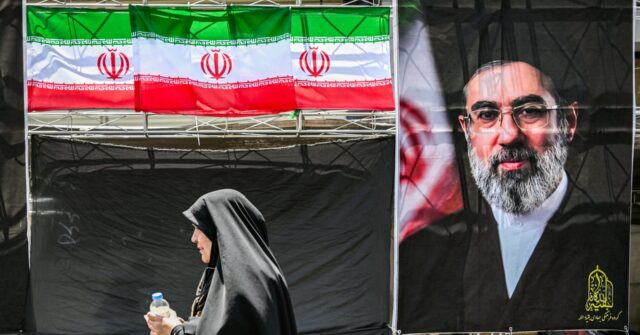
The state-linked Tasnim News Agency estimated that crowds in Tehran totaled in the “millions” to pay respects to the dictator. Photos of the crowds attending showed many carrying images in praise of Khamenei and disparaging President Trump, including death threats. One man held a poster bearing a photo of Trump behind crosshairs, reading “there will be blood.” Another group of people held a banner reading, in English, “#Kill Trump,” while a large crowd held a sign reading plainly, “We will kill Trump.”
While Iranian state outlets depict the elaborate funeral ceremonies as necessary to allow the general public to express love for their former oppressor, reports indicate that the lavish events are prompting quiet frustration among Iranians suffering through a bleak economy and noting the dire state of the country’s healthcare system, job market, and other basic pillars of society. The independent outlet Iran International reported that sources within the country are complaining that small businesses are being forced to pay for food and drinks for funeral attendees, while the regime is threatening other countries to donate to pay for the expenses generally.
“The Islamic Republic and the Revolutionary Guards have forced all companies in Tehran to pay for booths and food for the funeral,” one source told the outlet. “More than 1,000 billion rials (over $570,000) has been taken from automobile manufacturers, while workers are struggling to make ends meet.”
“They increased bread prices just before the funeral,” another source complained. “Now they want to hand out free bread along the procession routes so more people will attend.”
Follow Frances Martel on Facebook and Twitter.
Read the full article here


