






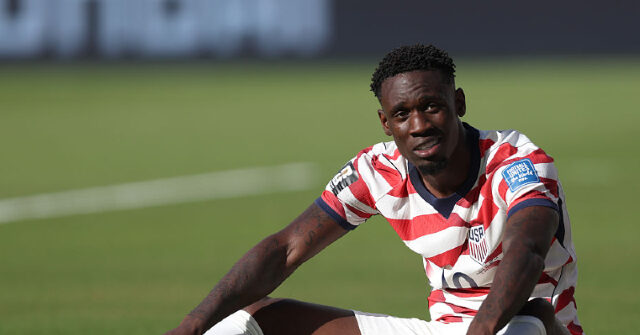
On Monday, Belgian soccer officials were granted the right to appeal the FIFA decision to suspend the highly controversial red card given to star U.S. striker Falorin Balogun, mere hours before the Belgians were set to face the Americans in their Round of 16 matchup in Seattle.
The appeal comes on the heels of a strongly worded protest lodged by the Union of European Football Associations (UEFA) in which the organization charged FIFA with crossing a “red line.”
FIFA officials suspended the red card on Sunday and converted Balogun’s punishment into a one-year probation, using the same powers under Article 27 of the FIFA disciplinary code that the organization’s judicial body used to allow Portuguese star Cristiano Ronaldo to compete in the qualifying rounds despite a two-game suspension.
Article 27 of FIFA’s disciplinary code states that “the judicial body may decide to fully or partially suspend the implementation of a disciplinary measure.”
It adds: “If the person benefiting from a suspended sanction commits another infringement of a similar nature and gravity during the probationary period, the suspension shall be revoked by the judicial body and the sanction enforced without prejudice to any additional sanction imposed for the new infringement.”
After FIFA announced the shocking reversal of Balogun’s penalty, the Royal Belgian Football Federation (RBFF) issued a statement of protest, saying it was “astonished” by FIFA’s ruling.
“The Royal Belgian Football Association (RBFA) is astonished by FIFA’s decision to declare suspended United States player Folarin Balogun eligible to play in the USA–Belgium match on Monday, 6 July at 5:00 p.m. (Seattle time).

Belgium’s appeal will be heard by a member of the FIFA appeals committee who is also not of UEFA or CONCACAF, to avoid a conflict of interest.
“Belgium and US Soccer bosses were ordered to make submissions by 8 a.m. EST Monday ahead of the appeal being heard,” the New York Post reports.
It is unclear if the appeal will be adjudicated before the U.S. and Belgium square off at Lumen Field in Seattle at 8 PM EST. It is also unknown what will happen if the Belgians win the appeal before the game begins. Would Balogun’s disqualification immediately take effect? Preventing him from competing against Belgium? Or would the punishment merely revert to FIFA’s one-year probationary ruling?
Balogun’s red card came in the 64th minute of the U.S. men’s match against Bosnia and Herzegovina. The play did not result in a foul or yellow card in real time. However, Brazilian referee Rafael Claus was ordered to review the play on VAR to assess the severity of the infraction.
FIFA rules allow VAR to be used when determining the seriousness of a penalty but forbid the use of slow-motion and still shots if no foul was assessed during live action. Thus, ensuring that the manner in which the referee is reviewing the foul is consistent with what the review would have been in real time, and not a slow-motion review, which may make a foul look worse than it actually was.
This is precisely what occurred in the Bosnia and Herzegovina game as the world was shown the slow-motion images Claus reviewed.
The incorrect procedure used by Claus and the VAR officials formed the crux of U.S. soccer’s protest over the Balogun red card and what ultimately led to its suspension.
Read the full article here


