




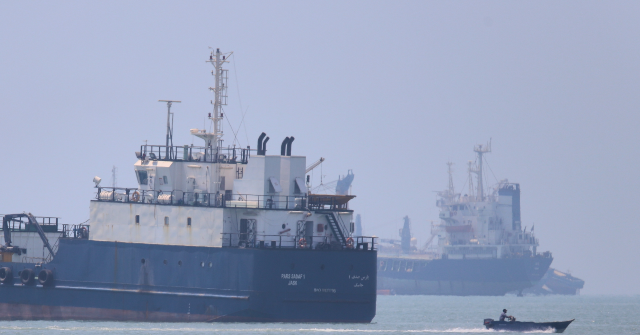
Representatives of the United States and Iran on Wednesday held indirect “technical talks” in Doha, Qatar, reportedly centered on fully reopening the Strait of Hormuz, as required by the Memorandum of Understanding (MOU) signed in June.
Iranian sources said that Tehran is demanding international recognition of its right to control the strait and extort fees from commercial vessels.
The talks in Doha were “indirect,” meaning that the U.S. and Iranian negotiators passed messages through intermediaries, rather than speaking to each other.
The White House announced that President Donald Trump’s envoys Steve Witkoff and Jared Kushner would be in Doha for the talks, but Iran’s representative refused to meet with them, so only the “technical talks” billed as a “sideline” event by the White House actually took place.
Witkoff and Kushner did meet with officials from host country Qatar, whose foreign ministry confirmed on Wednesday that no meetings between Witkoff, Kushner, and the Iranians were scheduled.
“The talks will be around all regional issues which are of concern, including, of course, the negotiations with Iran, but also including Lebanon and other files in the region,” said a Qatari foreign ministry spokesman on Tuesday.
“So, they are not here for direct negotiations with the Iranians or related meetings,” the spokesman said. “To the best of my knowledge, there are no direct meetings scheduled between the two parties in the coming days.”
A senior Trump administration official told CBS News that “very positive conversations had been held between Witkoff, Kushner and regional leaders,” and “good progress in technical talks” was being made.
“As far as things are going, the denuclearization of Iran is moving along well. They’ve had very good meetings, and we’ll see,” President Trump told reporters on Wednesday.
“We hit them very hard, but we’re getting along very well,” he added.
Iranian Foreign Ministry spokesman Esmail Baqaei on Tuesday insisted that “no meeting at any level with the American side is scheduled for the near future.”
Baqaei said that Iran’s primary interest in the “technical talks” was ensuring that the U.S. continues to deliver the benefits promised to Iran in the MOU, particularly the unfreezing of Iranian assets held in Qatar. He said an Iranian team of financial experts was due to meet with the Qataris on Wednesday to discuss the return of the funds.
Baqaei added that Iran will “not enter a new phase of talks” until it is satisfied of the “full and sustained implementation of the other party’s commitments.”
Two senior Iranian officials told Reuters on Wednesday that Iran is “determined to win international recognition of its control over the Strait of Hormuz, and ability to levy fees on ships entering or leaving the Gulf, even if it has to do so by force.”
The two Iranian officials said Tehran believes the wording of the MOU could be interpreted to give it “control of which ships may pass, and which route they take through the narrow waterway.” They said Iran will not move forward to any other area of negotiations until the U.S. accepts this interpretation.
“One of the senior officials said Iran would not let the situation return to the pre-war status quo. Instead, it believes new arrangements must govern Hormuz including Iran choosing how vessels enter and leave the Strait, holding the right to deny entry to any it suspects of threatening Iranian security, and charging fees for compulsory services it provides,” Reuters reported.
Both officials said that Iran is “ready to impose its demands on the Strait through force if there is no agreement by other countries to accept its terms,” and does not fear the possibility of further military action by the United States. Instead, Tehran sees a “historic opportunity” to “secure a long-term advantage.”
Iranian Foreign Minister Abbas Araghchi said on Wednesday that his country is prepared to use force against the U.S. and Israel if they do not comply with Iranian demands, particularly Iran’s demand that Israel withdraw from Lebanon.
“POTUS (President Trump) has committed the U.S. to muzzling its pets in Tel Aviv. If they ignore their master, Iran will school them,” he said.
Araghchi was responding to Israeli Defense Minister Israel Katz saying on Monday that Israel is ready for war “tomorrow” if Iran launches another missile attack, and he said this war would not end until the regime in Tehran was eliminated, no matter what agreements the U.S. has made.
“There is no equation we will accept in which Iran fires at Israel. This has also been made clear to the Americans. The IDF is just waiting for it and is on alert. There are targets,” Katz said, elaborating that Iranian Supreme Leader Mojtaba Khamenei would be “marked for death.”
“If Iran attacks, that is the third Iran war. The situation is very clear. There is no reality in which Israel will allow missile fire at its territory without responding with force. It could happen within two days. My directive to the IDF is to prepare for a blue-and-white operation in Iran,” he said. A “blue-and-white” operation is a battle Israel fights alone, without relying on outside partners like the United States.
Read the full article here


