




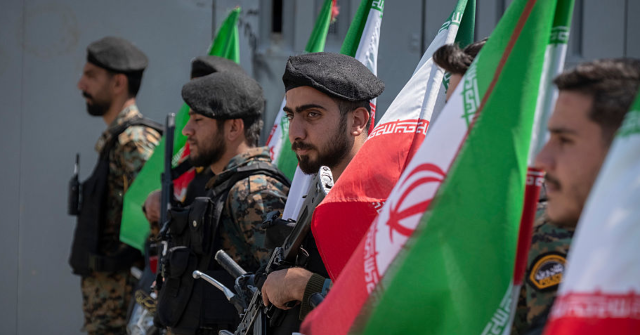
Iran’s terrorist Islamic Revolutionary Guard Corps (IRGC) threatened a “very devastating” response to any future military activity by the United States on Tuesday following confirmation from the Pentagon that it had conducted “self-defense” airstrikes on Iranian targets.
U.S. Central Command (CENTCOM), the arm of the Pentagon responsible for Middle East activities, confirmed on Monday evening that it had conducted operations against Iranian targets accused of maintaining missile launch sites and maritime assets allegedly used to “emplace mines” in the Strait of Hormuz. Since Washington launched Operation Epic Fury to erode the Iranian regime’s ability to pose a threat to its neighbors in February, the IRGC has blocked regular commercial traffic in the Strait of Hormuz, one of the most important economic transit points in the world and a major source of oil and liquified natural gas (LNG) heading from Gulf states to Asia.
“U.S. forces conducted self-defense strikes in southern Iran today to protect our troops from threats posed by Iranian forces,” CENTCOM spokesman Tim Hawkins explained on Monday. Hawkins emphasized that the military was “using restraint” in its targeting, not seeking to rekindle the paused war between America and Iran.
The Times of Israel reported that some “unconfirmed reports” indicated that the American strikes occurred in Bandar Abbas, a southern region of Iran near the Strait of Hormuz.
The United States and Iran have been in an official state of “ceasefire” since April, when President Donald Trump announced that he would halt the Operation Epic Fury hostilities to allow for negotiations towards a long-lasting agreement to end Iran’s illicit nuclear development. The U.S. military has conducted some limited strikes during the ceasefire period which have not previously resulted in resumed consistent hostilities. Trump dismissed these strikes in early May as “love taps” that did not rise to the definition of a ceasefire violation.
Iranian state media reported the strikes as ceasefire violations, but claimed victory, making the claim that the IRGC had successfully shot down an American MQ-9 drone. The U.S. government has not confirmed the claim at press time. Rather than confirming that Tehran was planning a violent response to the strikes, Iranian officials warned that any continuation of the completed American strikes would be what triggers retaliation.
The Islamic Republic News Agency (IRNA), the flagship Iranian state media outlet, cited IRGC officials accusing America’s “terrorist” military of violating American airspace and claiming that its forces successfully prevented an attack.
“According to the statement, IRGC air defense forces identified and destroyed an MQ-9 drone. It added that Iranian forces also fired at an RQ-4 drone and a hostile F-35 fighter jet, forcing them to flee and leave Iran’s territorial airspace,” IRNA claimed. The outlet did confirm “overnight strikes” on “military and radar facilities,” but statements from Iranian military officials did not indicate that they would immediately respond to the strikes aside from the unconfirmed American drone shootdown.
“If the U.S. and Israel launch a new attack on our country, Iran’s reaction will be very devastating,” Brigadier General Abolfazl Shekarchi was quoted as saying, apparently not identifying the Monday night airstrikes as a “new attack.”
Shekarchi insisted that the IRGC had prepared “surprises and new tactics” against the Americans and would respond to “new adventurism” from America if it occurred.
Similarly, IRNA reported that lawmaker Ebrahim Azizi, who chairs the Iranian parliament’s foreign policy committee, said on Tuesday that America faces a “decisive response” from Iran and that the IRGC was at “the utmost readiness and power” for any future attack. These comments appeared to imply that the Iranian military would respond in the future, however, rather than that they were preparing a direct response to the strikes on Monday.
“As in the past, our Armed Forces will respond maximally to any act anywhere, whether within our geography or beyond the region if insecurity originates there,” Azizi declared. He also claimed that the IRGC had already engaged in “confrontation.” The lawmaker promised a “crushing, decisive, and regret-inducing response” in the future.
The American strikes followed days of growing optimistic language from the White House, where both President Trump and Secretary of State Marco Rubio suggested progress was being made in peace talks with Iran. Two of Iran’s most powerful civilian leaders, Parliament Speaker Mohammad Baqer Qalibaf and Foreign Minister Abbas Araghchi, traveled to Doha, Qatar, on Monday for in-person negotiations on future peace talks. In a message on Monday, President Trump suggested that the Iranian team was moving towards acceptance of limitations on its illicit nuclear program, including the confiscation of fissile materials.
“The Enriched Uranium (Nuclear Dust!) will either be immediately turned over to the United States to be brought home and destroyed or,” Trump said on his website Truth Social, “preferably, in conjunction and coordination with the Islamic Republic of Iran, destroyed in place or, at another acceptable location, with the Atomic Energy Commission, or its equivalent, being witness to this process and event.”
Follow Frances Martel on Facebook and Twitter.
Read the full article here


