
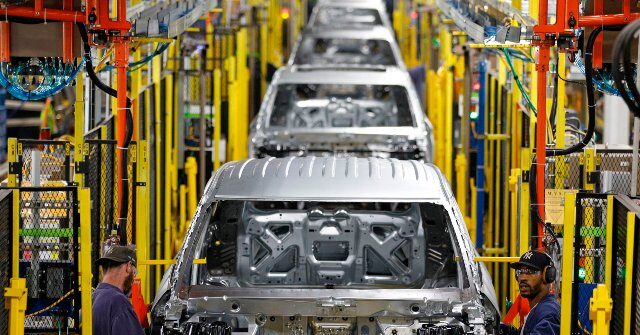
Ford is acknowledging the challenges it faced with AI production and design systems after the automaker recently claimed the top spot in JD Power’s initial quality ranking for mainstream brands for the first time in 16 years. According to Ford, attempting to replace highly-skilled employees with AI-powered systems was a mistake.
The Verge reports that Ford has revealed that its reliance on artificial intelligence and automated systems in vehicle production and design created significant quality problems, forcing the company to bring back experienced engineers and technicians to correct mistakes made by its robots.
Charles Poon, Ford’s vice president of vehicle hardware engineering, explained during a briefing with reporters this week that the automaker believed simply introducing AI and adjusting existing design requirements would automatically yield high-quality vehicles. “Mistakenly, we thought that by just introducing artificial intelligence and adjusting the design requirements that we had, that that would produce a high-quality product,” Poon said.
The problem was compounded when some of Ford’s most experienced personnel departed before their accumulated institutional knowledge could be fully captured by the company’s automated systems. This loss of expertise proved particularly damaging because the effectiveness of AI depends entirely on the quality of data used to train the models. Ford had underestimated the value of veteran engineers who had worked through multiple vehicle-development cycles and possessed deep understanding of potential problems that could emerge during production.
To address this gap, Ford hired, promoted, or brought back more than 350 experienced engineers to rebuild its technical expertise base. These seasoned professionals were tasked with retraining the automated systems and mentoring younger engineers who were struggling to maintain vehicle quality standards. “That’s where some of our most experienced engineers have had experience solving and identifying those problems before they creep into the system,” Poon said.
Ford’s quality challenges have been well documented in recent years. The automaker currently leads the industry in number of recalls, with quality ratings declining over several years. Difficulties intensified during launches of the Explorer and Aviator models, supply-chain disruptions during the COVID-19 pandemic, and a growing number of vehicle recalls that damaged consumer confidence.
According to COO Kumar Galhotra, Ford determined that its quality approach had become too fragmented across the organization. Different departments operated in isolation, and the company relied heavily on a reactive “find and fix” philosophy that focused on identifying defects after they appeared rather than preventing them from occurring. “We’re moving from that find-and-fix mentality to preventing issues before they occur,” Galhotra said. “We’re focused on enablers and early indicators versus outputs. Stop admiring the problem and start solving it.”
The transformation involves closer collaboration between previously separated teams. Software and digital teams now work more directly with vehicle engineering, manufacturing, and supply-chain operations. Ford is attempting to merge the speed and flexibility of software development with the rigorous validation requirements essential for automotive-grade engineering.
Software quality presented particular challenges historically. Ford was discovering software bugs too late in the development process because it wasn’t fully utilizing rapid iteration cycles available in modern development. However, Poon noted that the automaker could not adopt the consumer electronics approach of “move fast and fix later” because vehicles operate in safety-critical environments where customers depend on software functioning correctly from delivery. Unlike smartphones, automotive software failures can have life-threatening consequences.
To address this, Ford established a dedicated 40-person software quality assurance team specifically responsible for preventing problems before they reach customers. The company has also dramatically expanded automated testing capabilities, adding more than 100,000 new AI-powered tests designed to identify edge cases and stress software systems under varied conditions.
“Because these tests are highly automated, even if we have a late change in the software, we can rapidly run back through the entire validation process to guarantee it works perfectly well before it reaches the customer,” Poon said. “We’ve established software reliability as its own rigorous disciplines with strict metrics.”
The economy is currently going through the growing pains of adapting AI and finding the correct balance between man and machine. Breitbart News social media director Wynton Hall has written his instant bestseller Code Red: The Left, the Right, China, and the Race to Control AI to serve as the definitive guide on how the MAGA movement can create positions on AI that benefit humanity without handing control of our nation to the leftists of Silicon Valley or allowing the Chinese to take over the world.
Read more at the Verge here.
Lucas Nolan is a reporter for Breitbart News covering issues of AI, free speech, and online censorship.
Read the full article here