




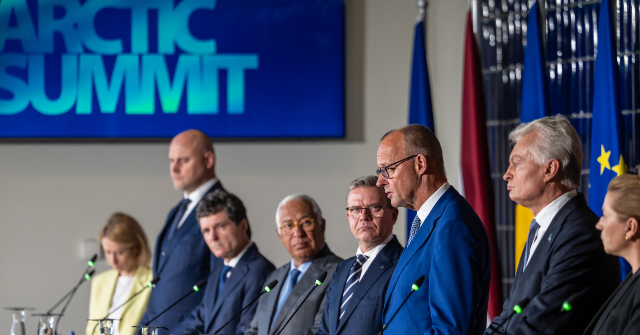
The European Arctic Summit held its first working session in Finland on Monday, bringing leaders from across Europe together to discuss the possibilities offered by new Arctic shipping routes and natural resources, as well as the dangers posed by Russia’s heavy presence.
“This region has become a geopolitical hotspot. Russia is building up its military capabilities here, and Russia uses its presence for hybrid activities every day,” German Chancellor Freidrich Merz told reporters.
“Let me put it this way: High north — and low attention — is over,” he said.
“The Arctic has emerged as the central arena of great power competition,” agreed Finland’s Prime Minister Petteri Orpo.
The summit issued a joint statement, signed by Finland, Denmark, Estonia, France, Greece, Germany, Latvia, Lithuania, the Netherlands, Poland, Romania, and Sweden, calling on the European Union (EU) to strengthen its engagement with the Arctic region.
“We agree that the EU needs to step up its action to promote stability, sustainable development, and prosperity while safeguarding its interests,” the signatories said.
The statement outlined an ambitious Arctic agenda for the EU, including improved surveillance and information-sharing, more investment in transportation and digital infrastructure, and better protection for EU assets in the Arctic.
“The idea is essentially to strengthen the EU’s common strategic approach to the Arctic in this situation, where the geopolitical and economic significance of the region is growing considerably,” explained Tuomas Tikkanen, senior adviser on European affairs to Prime Minister Orpo.
EU foreign policy chief Kaja Kallas, who attended the summit, said there was a particularly urgent need for more icebreaker ships to take advantage of new maritime routes opened by Arctic ice melts.
Russia controls the lion’s share of the icebreaking equipment for the Arctic at present, and those new shipping lanes are heavily populated by the rickety cargo ships and tankers of Russia’s sanctions-evading “shadow fleet.” Studies have shown that up to a third of the traffic along Russia’s Northern Sea Route consists of ships that are under international sanctions.
The EU might be nervous about relying on Arctic routes which Russia not only dominates but could unilaterally shutter if its relations with Europe deteriorate further. Only two days before the European Arctic Summit, Russian President Vladimir Putin threatened to go to “war” with Europe if the Europeans sent troops into Ukraine as a “peacekeeping force.”
Also on the eve of the summit, more details emerged of a Russian exercise in April that appears to have been a dress rehearsal for undersea sabotage in the Arctic region. Last month, Putin held his own special Arctic meeting of the Russian Security Council to plan a “development strategy for the Russian Arctic” and promote “national security in the region.” Putin’s conference was decidedly militaristic in character.
In early September, Putin unveiled a plan for building data storage and processing centers in the Arctic — along with “small nuclear power plants that have no analogues in the world” to supply them with energy.
Also earlier this month, Norway seized a Russian cruise ship in the Arctic at the request of Ukraine’s energy company Naftogaz, which wanted the ship as a down payment on its $4.22 billion compensation suit against Russia for illegally annexing Crimea in 2014.
Russia denounced the seizure of the ship as an act of “piracy” and accused the Europeans of trying to “blockade” the Arctic.
“Russia is building up its military capabilities here, and Russia uses its presence for hybrid activities every day,” Merz cautioned at the European Arctic Summit.
China, which enjoys much better relations with Russia than the EU, jumped on the chance to establish an “Ice Silk Road” that would bypass the unstable Middle East to ship cargo through Russia’s Northern Sea Route. Chinese officials describe the Ice Silk Road as a roaring success that has already sold out for the coming season. Russia, meanwhile, has been using its Arctic routes to ship oil to China over the past three years.
Media accounts of the European Arctic Summit portrayed the attendees as even more worried about the United States than China and Russia because of President Donald Trump’s efforts to acquire Greenland.
Danish Prime Minister Mette Frederiksen told reporters that a “working group” is looking for equitable solutions to the U.S.-Denmark conflict over Greenland, and she was “optimistic that we can find a way.”
One of Trump’s major concerns was that Denmark and the EU lacked the capabilities, funding, or will to protect Denmark and Europe’s Arctic interests against Russia and China. The European Commission and the North Atlantic Treaty Organization (NATO) have been laboring in recent weeks to demonstrate that they take Arctic security seriously.
Read the full article here


