




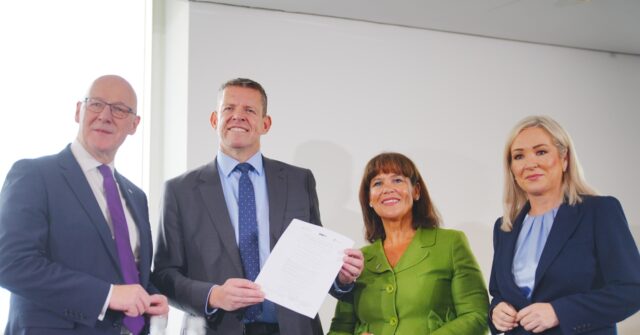
The First Ministers of Northern Ireland, Scotland and Wales put on a united front on Monday, vowing to — at least eventually — break up the UK on the basis of national “self-determination” while simultaneously promising to bring their populations back under the yoke of the globalist European Union.
Putting on the veneer of nationalists, the left-wing leaders of Plaid Cymru, Sinn Féin, and the Scottish National Party (SNP) gathered in Cardiff Bay on Monday to declare the right of their constituent countries “to determine its own future, through democratic means and in accordance with the wishes of its people.”
In a joint statement, the three First Ministers — who function as regional governors — John Swinney of Scotland, Michelle O’Neill of Northern Ireland, and Rhun ap Iorwerth of Wales, said they believe that “the political landscape across these islands is changing.”
The left-wing leaders noted that for the first time since the left-wing Tony Blair government devolved power locally to the three countries at the end of the last century, all three first ministers are now in favour of leaving the United Kingdom after Plaid Cymru formed a government in Wales following the May elections.
“For people watching across these islands – for people watching around the world – there could be no clearer sign that Westminster’s time is coming to an end,” the leftist politicians wrote.
“Momentum is behind our movements; we believe that constitutional change is coming. We therefore commit to strengthening cooperation between our parties and identifying practical areas where working together can make a real difference,” they added.
However, despite their supposed commitment to national self-determination, the three First Ministers said that after leaving the United Kingdom, they would look to reverse Brexit and rejoin the European Union, which would likely constrain their ability to act nationally far more than the present restrictions from Westminster.
“Brexit has damaged our economies and limited opportunities for our people. We believe the future of our nations belongs in the European Union,” they said.
“We want to work together to rebuild and strengthen those European relationships, creating greater opportunities for trade, investment, culture and cooperation.”
The left-wing politicians claimed that their vision would enable them to create “stronger, fairer” economies that can “tackle inequality” and “deliver social justice”.

However, it is unclear how they plan on doing so, given the likelihood that funding from Brussels would be significantly lower than that provided by the UK government in Westminster.
Should they join the bloc as individual member states, they would likely also need to slash their own spending to comply with EU deficit rules. Indeed, Scotland’s budget deficit currently stands at 10.9 per cent of GDP, while Brussels forbids a deficit above 3 per cent.
It is also unclear whether the three British nations would consider dropping the pound in favour of the euro, which would likely cause significant economic friction with their potential top trading partner, England.
While all three countries have significant representation in the UK Parliament, their collective influence would also be greatly diminished within the 27-member European Union, and would effectively lose sovereignty over their own borders.
Despite the confidence expressed by the three First Ministers, it remains to be seen whether their populations would actually agree to leave the United Kingdom, with the recent independence referendum in Scotland resulting in 55.3 to 44.7 per cent voting against leaving.
There are also structural hurdles, including the fact that the British Prime Minister has significant powers to prevent independence referendums in Scotland and Wales. Current Prime Minister Andy Burnham — a proponent of devolved powers — has so far ruled out any independence votes.
Additionally, in Northern Ireland, First Minister Michelle O’Neill is in a power-sharing arrangement with Deputy First Minister Emma Little-Pengelly of the Democratic Unionist Party (DUP), which strongly favours remaining within the UK, making any independence vote unlikely.
A spokesman for Prime Minister Andy Burnham said per The Telegraph: “The Prime Minister is committed to delivering change across all four nations of the United Kingdom, and believes strongly in the Union.
“The United Kingdom is at its best when people come together around our shared values and problem-solving, rather than division. And the Prime Minister will continue to ease pressures on household finances and delivering greater economic security, rather than engaging in constitutional debates or further referendums.”
Follow Kurt Zindulka on X: Follow @KurtZindulka or e-mail to: kzindulka@breitbart.com
Read the full article here


